
Sindoor, Mangalsutra and Bangles: What These Marriage Symbols Mean
The marks of a Hindu marriage, explained

Sunil Chaurasia
13 Nov 2026 • 6min
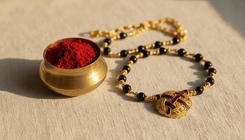
When a woman marries in a Hindu ceremony, she receives three visible marks of marriage: sindoor in her hair parting, a mangalsutra around her neck, and bangles on her wrists. These are not ornaments chosen for beauty alone. Each carries meaning rooted in Hindu tradition and signals a woman's married status to the world. They speak to commitment, protection and the transition into a new phase of life.



What Sindoor Is and Means
Sindoor is the vermilion powder that a husband applies to his wife's hair parting immediately after the marriage vows. The parting is one of the most visible parts of a woman's appearance, and the sindoor marks it distinctly red.
The word "sindoor" comes from Sanskrit, and the practice is ancient in Hindu tradition. It has been worn by married women for centuries across India. The red colour itself holds significance: red represents auspiciousness, fertility and the divine feminine energy called Shakti in Hindu philosophy.
In many regions, a woman wears sindoor daily as a sign of her married status. She applies it to the parting of her hair from the forehead back into the hair. In some families and communities, the practice is less strict—a woman might wear it only on special occasions or religious ceremonies. In others, it remains a daily visible commitment. Some regions and sampradayas follow different customs, and modern practice varies widely.
The application of sindoor is one of the final acts in many Hindu marriage ceremonies. It is an act performed by the husband, which is why some traditions hold that widows do not wear sindoor after their husband's death. However, practices around this vary significantly by region and family tradition.
The Mangalsutra: Its Place in Marriage
The mangalsutra is a necklace that a groom ties around his bride's neck during the marriage ceremony. It consists of a string or chain—traditionally made of black beads and gold—with a pendant hanging from it. The pendant is often shaped like an auspicious symbol or the numeral "8" rotated, which represents infinity and eternal union.
The name comes from the Sanskrit word "mangal," meaning auspicious. The mangalsutra is specifically a mangal, or auspicious ornament, worn to denote that a woman is married. It represents the husband's commitment to his wife and her welfare. In some traditions, it is believed to protect the marriage and the couple's life together.
Unlike sindoor, which may be worn only by some women in modern times, the mangalsutra remains a more universal marker across Hindu communities. A woman typically wears it continuously after marriage. The weight of it around her neck is a constant reminder of her marital bond.
The design of a mangalsutra can vary greatly by region and community. Some are simple, others ornate. The materials may differ—some are made with gold and black beads, others with different materials according to local tradition or family preference. What matters is that it is recognised across Hindu society as the sign of a married woman.
Bangles and Their Significance
Bangles worn on the wrists are another symbol of marriage in Hindu tradition. A bride typically receives bangles as part of her wedding gifts and adornment. The bangles are often made of glass, metal, or sometimes ivory, and they come in colours—traditionally red and gold, though this too varies by region.
The bangles serve a practical and symbolic purpose. They make a gentle sound as a woman moves, and this sound was traditionally understood to announce her presence and her married status. The bangles are also understood to represent the strength and stability of marriage. A woman's wrists adorned with bangles signify her role as a wife and, in some traditions, her fertility and wellbeing.
In some communities, only red and gold bangles are worn immediately after marriage. Over time, a woman might wear different colours and designs. The practice of wearing bangles regularly also varies—some women wear them daily, others reserve them for special occasions or religious ceremonies.
The number of bangles a woman wears can also carry meaning. In some traditions, a full set of bangles covering the wrist completely is preferred, as it is seen as bringing good fortune. Like sindoor and mangalsutra, the specific customs around bangles differ by region and family practice.
How These Symbols Connect
Sindoor, mangalsutra and bangles are worn together and function as a set. They are not independent choices but part of a unified expression of married status. A woman wearing all three is immediately recognised as married in traditional Hindu society. They are applied or given at specific moments in the wedding ceremony, often in sequence, creating a ritual moment that marks her transition from unmarried to married life.
The three symbols also reflect different dimensions of marriage in Hindu tradition. The sindoor, applied by the husband, emphasises his role and his commitment. The mangalsutra, tied by the groom, represents the auspiciousness of the union. The bangles represent strength, fertility and the flourishing of the marriage. Together, they create a complete picture of what marriage means in this tradition.
Modern Practice and Meaning
Today, the wearing of these symbols varies considerably. In urban areas and among younger couples, some women choose not to wear sindoor or choose to wear it differently. The mangalsutra remains more common, though even this is not universal. Bangles continue to be worn widely, though often as part of everyday jewellery rather than strictly as marriage markers.
What has remained constant is the meaning beneath these symbols. They represent a woman's marital status, a commitment to her partner, and her place in a community bound by shared tradition. Whether a woman wears them daily or only on certain occasions, whether she wears all three or selects from among them, she is drawing on practices that have held meaning for centuries in Hindu culture.
These symbols are not obligations but inheritances. Each woman chooses her own relationship with them, guided by her family's tradition, her community's practice, and her own sense of what feels right for her marriage.
Common questions
Can a divorced or separated woman wear sindoor and mangalsutra?
Practice varies by family, community and region. Some women continue to wear them, while others remove them as part of marking the end of their marriage. There is no single Hindu rule—local tradition and personal choice guide what a woman does.
Do all Hindu communities wear these symbols the same way?
No. The designs, materials, and customs around sindoor, mangalsutra and bangles differ significantly by region, caste and sampradaya. Some communities emphasise all three; others place different weight on each. Always look to your own family and community tradition.
What is the difference between sindoor and bindi?
Sindoor is applied by a husband during marriage and worn in the parting of the hair; it marks married status. A bindi is a small dot worn on the forehead by any woman, married or unmarried, and is not specifically a marriage symbol, though it can be worn for religious or decorative reasons.

Related Articles


