
Sindoor Khela: The Red Farewell on Durga's Last Day
Where women dance, celebrate, and bid farewell to Durga

Sunil Chaurasia
18 Nov 2026 • 7min
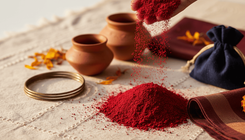
Sindoor khela is the ceremonial play of vermillion that marks the climax of Durga Puja, the four-day festival when the goddess Durga is worshipped in Bengal and eastern India. It happens on Vijayadashami (also called Dashami), the tenth and final day of the festival, after the goddess's image is carried in procession to be immersed in water. What began as a private moment between married women and the goddess has become a public celebration—a gathering where women apply vermillion to each other's foreheads and faces, laugh, dance, sing and share sweets. To watch sindoor khela is to see a festival turn tender, communal and joyful at the very moment it is ending.



What Sindoor Khela Means
Sindoor—vermillion powder—has long held meaning in Hindu practice. For a married woman, a vermillion mark on the forehead signals her married status and is considered auspicious. At Durga Puja, when the goddess is honoured as a form of Shakti, the divine feminine power, the sindoor takes on another layer. Applying vermillion in the presence of Durga becomes an act of blessing and protection, a moment when the energy of the goddess is believed to transfer to those who participate.
Khela means play or game. Sindoor khela is not solemn ritual but joyful celebration—women throw sindoor powder on each other, paint it on faces and foreheads, and embrace. The playfulness is deliberate. It turns what could be a somber farewell to the goddess into something alive with colour, noise and laughter. This is worship expressed as joy, not as restraint.
When Sindoor Khela Happens
Sindoor khela takes place on Dashami morning, after the principal puja offerings have been made to the goddess. The exact timing varies by pandal and locality, but it generally occurs once the morning prayers are complete. In many communities, the women wait until the final moment of the festival, just before the image of Durga begins its journey toward the river for immersion. The timing carries meaning: it is the last act before the goddess departs, a final celebration before the goodbye.
The practice is most widespread and central to worship in Bengal, particularly West Bengal, where Durga Puja culture is strongest. However, sindoor khela is also observed in Assam, Odisha, parts of Jharkhand, and among Bengali communities elsewhere in India and abroad. The core ritual remains the same—women gathering, applying vermillion to each other—though regional and pandal-specific variations exist in how it is conducted.
How Sindoor Khela is Performed
On Dashami morning, women—both married and unmarried, though the ritual holds particular significance for married women—gather at the puja pandal after the main rites are complete. They may be wearing new saris, often in red or white with gold borders. One by one, or in small groups, they approach the image of the goddess to pay final respects. Then they begin: one woman applies sindoor to another's forehead, cheeks or chin. The recipient laughs, embraces her, and returns the gesture.
What starts as a gesture of respect and affection between two women quickly becomes collective. Women move around the pandal seeking out friends, relatives, and sometimes even strangers, each application of sindoor accompanied by playful banter. Some women sing traditional Bengali songs. Others distribute sweets. The atmosphere is both devotional and festive—there is reverence for Durga's presence, and at the same time a sense of release, as if the concentrated energy of the four-day worship is finally permitted to overflow into noise and colour.
In some pandals, the ritual extends beyond the women to include the priests and community members. Vermillion may be offered in small bowls at the deity's feet before being distributed. The exact order and who leads the khela varies; some pandals begin with the oldest or most senior women, others proceed more informally. The unifying element is the act itself: vermillion exchanged, shared, celebrated.
The Goddess and the Farewell
Durga Puja tells the story of the goddess's victory over the buffalo demon Mahishasura. On Dashami, Vijayadashami (the day of victory), that victory is commemorated, and then—immediately afterward—the goddess's image is taken in procession toward the river and immersed. For a festival that lasts ten days, the goodbye is swift. Sindoor khela is the women's farewell, a moment to hold the goddess's presence a little longer before she departs.
There is also a practical element. Historically, many Bengali women did not have regular occasions to gather and celebrate together, to claim space and time as their own. Sindoor khela provided that. It was their moment in a festival where the public sphere and the sacred space belonged, at that instant, to them. That social and spiritual meaning persists even as the festival has become more public and more commercialized in some places.
Sindoor Khela Beyond Bengal
Outside of Bengal, Vijayadashami is observed in different forms. In southern India, Vijayadashami is marked by Dasara, where the goddess Durga is worshipped and the victory of good over evil is celebrated, often with different ritual practices. In western India, the day is connected to the burning of effigies and public processions. In each region, the festival adapts to local tradition.
Sindoor khela, however, remains distinctly associated with Bengal. It is not widely practiced outside Bengali communities, though as Bengali communities have settled in other parts of India and the world, the practice has spread with them. In cities like Delhi, Mumbai and Bangalore, Bengali cultural organisations and pandals now host sindoor khela during Durga Puja celebrations, bringing the tradition to a broader audience.
The Spirit of the Practice
Sindoor khela endures because it honors something true about devotion: it is not only about restraint and ritual correctness, but also about joy, connection and the breaking open of everyday boundaries. The vermillion that marks a woman's marriage also marks her participation in a community of worship. When women apply sindoor to each other on Dashami morning, they are renewing bonds with each other and with Durga herself—not in solemnity but in celebration.
As the festival has evolved and more people have access to Durga Puja celebrations through social media and travel, sindoor khela has gained visibility beyond its traditional strongholds. Some worry that commercialization or crowding will erode the intimacy of the practice. Others see in its wider reach a natural expansion of a ritual that was always, at heart, about women claiming their own moment of joy and power within a much larger festival.
Common questions
Who can participate in sindoor khela?
Sindoor khela is open to all women present at the pandal. While the ritual traditionally held particular significance for married women, many pandals today invite women of all ages and marital statuses to participate in the celebration.
Does sindoor khela happen in places outside Bengal?
Sindoor khela is most central to Durga Puja celebration in West Bengal and among Bengali communities globally. In other regions of India, Vijayadashami is observed differently—through Dasara in the south and other rituals in the west—though some Bengali cultural organisations in cities like Delhi and Mumbai now host sindoor khela during their Durga Puja celebrations.
What happens to the goddess's image after sindoor khela?
After sindoor khela, the image of Durga is carried in procession toward a river or water body and immersed, marking the end of the festival. Sindoor khela is the women's final celebration before this immersion takes place.

Related Articles


