
Sindoor and Mangalsutra: What These Symbols Mean in Hindu Marriage
The marks of marriage, rooted in duty and devotion

Sunil Chaurasia
13 Nov 2026 • 6min
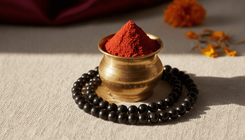
When a woman becomes a wife in a Hindu wedding, certain symbols mark that change. Sindoor and mangalsutra are the two most recognisable: the vermilion powder applied along the parting of the hair, and the necklace placed around the neck. These are not merely decorative. They carry meaning that runs deep into how Hindu marriage is understood as a lifelong bond, a commitment held not just by the couple but acknowledged by their families and community.



The Sindoor: Vermilion and Auspiciousness
Sindoor is the vermilion powder applied in the centre parting of the hair, from the hairline down towards the crown. In most Hindu communities, this is applied for the first time by the groom during the wedding ceremony itself. The act carries weight: it is a public declaration that the woman is now married.
The colour red holds significance across Hindu practice. It is the colour of shakti, of auspiciousness, of fertility and life force. Vermilion has been used in Hindu ritual for centuries—offered to deities, worn by ascetics, used in puja ceremonies. When applied as sindoor, it places a wife under the protection of her husband and the household she has joined. Different regions and sampradays apply it differently. In some communities, it is worn only during the day or only when the husband is alive. In others, it is worn continuously. The extent of the parting also varies: some traditions fill only the part itself, while others extend it further down the crown.
Historically, the bright red colour also served a practical purpose: it was visible proof of marriage, recognisable in the marketplace and the street. This mattered in times when a woman's marital status affected her legal standing and her safety.
The Mangalsutra: The Wedding Necklace
The mangalsutra is a necklace made of black beads strung on a cord or chain, often with a gold pendant. Like sindoor, it is placed by the groom around the bride's neck during the ceremony, and it remains her marker of marriage. The word itself means "the thread of auspiciousness"—mangal, auspicious, and sutra, thread or necklace.
The mangalsutra's design varies by region and community. In South India, it often features a pendant shaped like a small drum or traditional ornament. In North India, the design tends towards a more elaborate gold pendant. The black beads are traditionally believed to protect the wearer: black is thought in Hindu thought to ward off negative influences. The combination of black and gold—inauspicious and auspicious colours joined together—creates a balance meant to protect the marriage itself.
Unlike sindoor, which can be worn or removed with changing circumstances or regional custom, the mangalsutra is worn continuously as long as the marriage is unbroken. It is removed only on the death of the husband, in an act that formally ends the married state. This is one reason why the mangalsutra carries such weight: it is a constant, visible symbol of the marriage bond.
The Bindi and Other Marks
While sindoor and mangalsutra are the primary wedding symbols, the bindi—the dot worn on the forehead—is also associated with married women in many communities. The bindi's origins are separate from marriage; it was worn by both men and women as a mark of spiritual practice or auspiciousness. But over time, in many regions, a married woman's bindi has taken on marital significance. The colour, size and placement vary greatly by region and personal choice.
It is important to note that the bindi is not universally understood as a marriage symbol. Many unmarried women and men wear bindis, and in some communities, married women do not. This is one area where custom shifts significantly between regions and between families.
Bangles as a Marital Symbol
In many communities, bangles—particularly those made of glass, lac or metal—are worn by married women. They are often put on during the wedding ceremony alongside sindoor and mangalsutra. Bangles make a tinkling sound as a woman moves, and this sound itself carries associations with an active, living household. Like sindoor, the wearing of bangles may vary by region: some traditions see them as essential to the married state, while others treat them more flexibly.
The combination of bangles, bindi, sindoor and mangalsutra together created what was understood as the complete appearance of a married Hindu woman. Each symbol served a purpose: to mark the change in status, to invite the community's acknowledgment of the marriage, and to express the woman's new role and the responsibilities that came with it.
Regional and Personal Variations
Hindu marriage customs vary widely across India's many communities, languages and regions. What is worn in Kerala differs from what is worn in Maharashtra or Bengal or Gujarat. Some communities emphasise all four symbols; others stress only one or two. In urban settings and among younger generations, some women choose to wear these symbols differently or not at all, though the symbols remain culturally significant even when their wearing becomes a matter of personal choice.
What matters is not uniformity but the meaning each woman and each community assigns. These symbols continue to mark marriage because they carry the weight of history, family expectation and personal commitment. Whether worn every day or on special occasions, whether strictly traditional or creatively adapted, they speak to a Hindu understanding of marriage as a transformation—one that is witnessed, celebrated and marked on the body itself.
Common questions
Can a widow continue to wear sindoor and mangalsutra?
In traditional Hindu practice, a widow removes both sindoor and mangalsutra after her husband's death, as these symbols specifically mark an active marriage. However, many modern Indian women choose to continue wearing them, and this practice is increasingly accepted. Customs vary by region, family and personal choice.
Are unmarried women allowed to wear bindis?
Yes. The bindi originated as a spiritual or decorative mark worn by people of any marital status. While it became associated with married women in some communities, unmarried women and men also wear bindis today for personal, spiritual or cultural reasons. The bindi's meaning has never been exclusively marital.
What if someone is allergic to vermilion or cannot wear these symbols?
Some people experience skin reactions to traditional sindoor. Many families adapt by using alternative vermilion products, applying it only occasionally, or finding other ways to mark the marriage that hold meaning for them. The commitment matters more than the specific symbol; families and couples work within their circumstances.

Related Articles


