
Sindoor and Mangalsutra: Symbols of Hindu Marriage
Marks of Commitment, Rooted in Love

Abhilash Ramakrishna
12 Nov 2026 • 6min
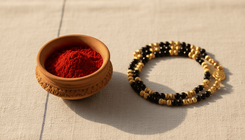
When a woman marries in a Hindu ceremony, she receives sindoor and mangalsutra—two adornments that announce her new status to family and community. But these are not simply jewellery. They carry centuries of meaning. Sindoor, the vermillion powder placed in the parting of the hair, and the mangalsutra, the sacred necklace, are among the most recognisable symbols of a married Hindu woman, each with its own significance in ritual and daily life.



What Sindoor Means
Sindoor is the vermillion, usually red or deep orange, that a bride receives during the marriage ceremony. The groom traditionally places it in the parting of the woman's hair as a central moment of the wedding ritual. This act marks the moment her status changes from unmarried to married.
The colour itself carries weight in Hindu tradition. Red represents fertility, prosperity and auspiciousness. By wearing sindoor in her hair—the most visible place on her body—a married woman signals her new role and her husband's presence in her life. In many communities, the deeper or brighter the sindoor, the more auspicious the marriage.
In daily life after marriage, applying sindoor becomes a practice many women continue for years or decades. Some wear it every day. Others wear it on special occasions or festivals. The choice is personal and varies by age, family custom and individual belief. It is not legally required, and many married women do not wear it at all, especially in urban settings or where family tradition differs.
The Mangalsutra: A Promise Made Visible
The mangalsutra is a necklace of black beads or gold, sometimes strung with small gold ornaments. The groom ties it around the bride's neck during the marriage ceremony, and it becomes the most constant symbol of her married status. Unlike sindoor, which can be reapplied or removed each day, the mangalsutra sits against the body as a daily reminder of the marriage bond.
The black beads are believed to absorb negative energy and protect both husband and wife. In this way, the mangalsutra is not ornamental alone—it is a protective amulet. The gold traditionally represents prosperity and auspiciousness, while the knot tied by the groom represents the commitment that binds the couple.
The style of mangalsutra varies by region and community. In South India, it may be made of gold with a T-shaped pendant. In North India, it often features a longer string with beads and a heavier pendant. Some mangalsutras are simple; others are elaborate. The specific form depends on local tradition, but the function—marking and protecting the marriage—remains constant across regions.
Bangles and Other Marks
Beyond sindoor and mangalsutra, a married woman may wear bangles on her wrists. In many communities, bangles are worn during marriage ceremonies and continue to be worn in daily life. Like mangalsutra, they are visible markers of married status. The bangles are often made of glass, metal or both, and their presence or absence can signal whether a woman is married.
Some regions associate specific colours or materials with married women. In certain communities, red and gold bangles are worn, echoing the colour of sindoor. In others, particular metals or widths of bangle carry meaning. These customs are deeply regional—what marks a married woman in one part of India may be different from another.
The bindi, which many people associate with married status, is actually more complex. While some traditions reserve a tilak or bindi for married women, the bindi itself is also worn by unmarried women and men in devotional contexts. It is not exclusively a marriage symbol, though in certain regions and communities it does carry that association.
Personal Choice and Modern Practice
The relationship between women and these symbols has shifted over time and varies widely today. Some married women wear all three—sindoor, mangalsutra and bangles—as continuous markers of their marriage and as part of their family and community identity. Others wear them only on occasions. Still others do not wear them at all, whether by choice, by the custom of their particular community, or by religious orientation.
There is no single rule that applies everywhere. Urban and rural practice differ. Sampradayas—the different schools of Hindu thought and practice—have different approaches. Some families place deep importance on these symbols; others see them as optional or outdated.
What remains consistent is the meaning woven into these adornments when they are worn: they represent a commitment made, a bond entered, and a new chapter begun. For many women, wearing them is a source of pride and connection to tradition. For others, they may feel limiting or irrelevant. The lived experience of marriage symbols in Hindu tradition is as varied as the women who wear them.
When Widowhood Changes Practice
In traditional practice, a widow would remove her mangalsutra and sometimes stop wearing sindoor, marking a significant change in her social status. This custom, more strict in earlier times, reflected the cultural weight placed on marriage and widowhood. In modern India, this practice has evolved. Many widows today choose to continue wearing these symbols if they wish, or to wear them differently—not as a rule, but as a personal choice rooted in their own sense of continuity with their marriage.
The removal or transformation of these symbols at widowhood shows how deeply they are tied to the idea of marriage itself. They are not casual ornaments but markers of a life transition. Understanding this helps explain their continued significance and also why attitudes toward them continue to shift as society evolves.
Common questions
Does every married Hindu woman have to wear sindoor and mangalsutra?
No. Wearing sindoor and mangalsutra is not legally required. Many married women choose not to wear them, especially in urban areas or where family tradition differs. The choice depends on personal belief, family custom, community practice and individual comfort. Some women wear them daily, others only on special occasions, and some not at all.
How does the mangalsutra differ in North India and South India?
In South India, the mangalsutra is typically made of gold and features a T-shaped pendant. In North India, it usually has a longer string with black beads and a heavier pendant. The specific style reflects local tradition, though the function—marking and protecting the marriage—remains the same across regions.
What happens to these symbols when a woman becomes widowed?
Traditionally, a widow would remove her mangalsutra and stop wearing sindoor, marking a significant change in her social status. In modern India, this practice has evolved considerably. Many widows today choose to continue wearing these symbols if they wish, treating the decision as personal rather than mandatory.

Related Articles


