
Shabari and Her Devotion to Lord Rama: A Story of Unwavering Faith
Devotion Without Doubt, Humble and True

Abhilash Ramakrishna
04 Nov 2026 • 5min
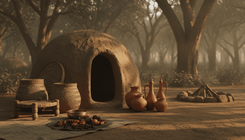
Shabari's story is one of the most moving in Hindu scripture. An elderly woman of humble birth, living alone in the forest, she became a beacon of devotion so complete that Lord Rama himself acknowledged her as one of his greatest devotees. What makes her remarkable is not grand gestures or high rank, but the purity and steadiness of her faith. When Rama came to her ashram during his exile, she offered him fruit she had tasted beforehand—and in accepting it, Rama showed that true devotion matters far more than rules of ritual purity or social standing.



Who Shabari Was
Shabari was born into a hunter community in southern India. According to the Ramayana, she was a woman of no formal education or social privilege. Yet she sought spiritual knowledge and eventually came to live at the ashram of the sage Matanga in the Dandaka forest. Under Matanga's guidance, she devoted herself to tapasya, a disciplined spiritual practice of meditation and prayer. After Matanga's death, she remained at the ashram, waiting faithfully for his prediction to come true. Matanga had foretold that one day Rama himself would visit her, and she spent her remaining years preparing for that sacred moment.
For Shabari, devotion was not something practiced on special days. It was woven into every moment of her life—in her daily meditation, her simple living, her service to the forest, her unwavering faith that what her guru had promised would come to pass. This is what made her a true seeker in the spiritual sense: her mind was always turned towards Rama, even though she had never seen him.
The Meeting in the Forest
When Rama, Lakshman and Sita were exiled in the forest, they eventually came to the ashram where Shabari lived. By this time, she was very old. Recognizing Rama the moment she saw him, she rushed to welcome him with an unselfconscious joy that moved everyone present. She washed his feet with water, offered him a place to rest, and then brought him fruit from the forest—berries she had gathered and tasted one by one to find the sweetest ones.
In that moment, Rama ate the fruit Shabari had bitten into and offered him with her own hands. According to the text, he ate not just a little, but greedily, and with evident pleasure. This was not accidental. Rama was making a profound teaching visible: that the love in a devotee's action matters incomparably more than ritual correctness. Shabari had broken every rule of formal etiquette and purity—an elderly woman of low birth serving food from her own mouth to a prince—yet Rama accepted it without hesitation. Lakshman was startled, but Rama praised Shabari's devotion without measure.
What Made Her Devotion Complete
Shabari's faith had several qualities that Hindu scriptures hold up as the height of bhakti, or devotion. First was simplicity: she did not perform elaborate rituals or claim special knowledge. She lived humbly and quietly, tending her small ashram. Second was steadiness: she believed in her guru's word absolutely and did not waver or doubt, even though decades passed and Rama did not come. Third was humility: she knew her own low birth and simple mind, yet did not feel that this separated her from the divine. She served with her whole heart, expecting nothing in return.
Most importantly, her devotion was free from self-interest. She did not think of how this meeting would elevate her status or bring her reward. She simply loved, because loving was her nature. When Rama praised her, he was not being courteous; he was acknowledging that she had achieved what many lifelong scholars could not.
Shabari's Teaching for Us
The Ramayana and other Hindu texts return again and again to Shabari as proof that birth, education and ritual knowledge are not the true measures of spiritual worth. A person born into a tribe of hunters, with no formal learning, achieved such devotion that Rama himself sat in her presence as a guest. Many brahmins and scholars also encountered Rama during his exile, but few are remembered with the reverence given to Shabari.
Her story speaks to anyone who has felt small or unworthy. It teaches that devotion is not a luxury for the learned or the privileged. It is available to anyone willing to turn their heart steadily towards the divine, to trust what their guru teaches, and to serve with humility. You do not need to understand complex philosophy or perform elaborate rituals. The fruit you offer with love, the water you give with care, the presence you bring to your practice—these are what matter.
In her old age, sitting in a forest ashram, Shabari became a model of bhakti that would be remembered for thousands of years. She shows us that a life lived with unwavering faith, even in smallness and obscurity, is never small to the divine.
Common questions
Where did Shabari live and how long did she wait for Rama?
Shabari lived in the Dandaka forest at the ashram of the sage Matanga. After Matanga died, she remained there alone, maintaining her devotional practice for many years while waiting for Rama's arrival, as her guru had promised.
What does Shabari's story teach about caste and social rank in Hindu belief?
Shabari's story shows that spiritual worth is not determined by birth or social status. Though born into a hunter community with no formal education, her pure devotion was recognized by Rama himself as equal to or greater than that of many brahmins and learned people.
Why did Rama accept fruit that Shabari had tasted?
By accepting the fruit, Rama demonstrated that the devotion and love in an offering matter far more than rules of ritual purity or social etiquette. This was a deliberate teaching that spiritual worth comes from the heart, not from following conventional formalities.

Related Articles


