
Rangoli and Kolam: The Meaning of Threshold Designs
Sacred geometry at the doorway

Sunil Chaurasia
11 Nov 2026 • 7min
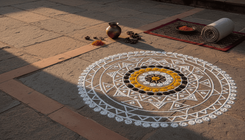
Rangoli and kolam are the coloured floor designs drawn at thresholds and courtyards across South and North India, each morning or before festivals and auspicious occasions. The names vary by region—rangoli in Maharashtra, Gujarat and northern states, kolam in Tamil Nadu, alpona in Bengal—but the tradition is the same: geometric and floral patterns made from rice flour, turmeric, charcoal and flower petals, drawn directly onto stone or earth. These designs mark sacred space. They welcome deities, invite auspiciousness into the home, and set apart the threshold between the outside world and the domestic sanctuary. What makes them ritual and not merely decorative is the intention behind them and the way they transform an ordinary space into one prepared to receive the sacred.



Why Threshold Designs Matter in Dharma
The threshold holds particular importance in Indian spiritual practice. It is the boundary between two worlds—inside and outside, sacred and ordinary, protected and exposed. Crossing a threshold is not neutral; it marks a passage. By drawing rangoli or kolam at this liminal space, you consecrate it. You announce that this house, this courtyard, this temple entrance is not just a place, but a space held with intention. The design itself serves as a kind of spiritual boundary, a statement made in rice flour that says: here, we are mindful.
In many households, the rangoli or kolam is drawn fresh each morning or on festival days. This daily or periodic renewal matters. It is not a permanent mark but a temporary one, made and unmade by feet and rain and time. This impermanence is itself meaningful. The design teaches that beauty and order are not meant to last forever, that we remake what matters to us with our own hands, and that auspiciousness comes from the act of creating, not from possession. Watching a kolam fade or be walked across is a meditation on impermanence.
What the Patterns Represent
The patterns themselves are rarely random. Many designs draw from nature—flowers, leaves, animals, the sun and moon. Others are purely geometric: spirals, diamonds, circles, grids. Each shape carries meaning. Concentric circles can represent the cycles of time and the movement toward the centre, toward stillness. Flowers are offerings and symbols of growth. Lines and grids suggest order and the structure beneath chaos. Some patterns are traditional and specific to a family or village, passed down through generations. A woman drawing her family's particular kolam design is maintaining a thread of continuity with her mother, her grandmother, and the women before them.
In Tamil Nadu, the kolam often begins with a central dot and radiates outward in radial symmetry, echoing the structure of mandalas found in meditation and worship. In Gujarat and Maharashtra, rangoli can be more freely flowing and floral. In Bengal, alpona often features mythological scenes or tells stories. The form changes, but the principle remains: the design is a gift, drawn with the hands as an offering, creating order and beauty as an act of devotion.
Rangoli, Kolam and the Seasons
Different patterns and materials align with different times of year and different festivals. During Diwali, rangoli becomes particularly elaborate and colourful. For Pongal or Makar Sankranti, designs often include images of sugarcane and the harvest. For weddings and other auspicious occasions, the rangoli or kolam is scaled up and made with particular care. In some traditions, designs are specific to the Ekadashi (eleventh-day lunar fast) or to monthly observances. The practice thus ties the household into the rhythms of the calendar and the ritual year.
The materials themselves matter and change with availability and tradition. Rice flour, the most common base, is itself auspicious—it is the grain of life and nourishment. Charcoal makes black lines. Turmeric provides yellow. Flowers add colour and fragrance. In some regions, crushed stone, chalk, or shop-bought colours are used. Each choice reflects local resources and what is at hand. The ritual is not about access to rare materials, but about what can be made with what is present.
Drawing as Spiritual Practice
The act of drawing a rangoli or kolam is not separate from its meaning. The practice itself is the ritual. It requires presence and attention. Your hands move in patterns you may have learned from your mother or from observation. You are focused on the line, the curve, the balance of the design. For that time, you are not thinking of other things. The mind settles. This is why the practice endures even in apartments and cities where soil and stone are harder to find—the action itself, the meditation of making, matters as much as the finished design.
Many who draw regularly speak of a quieting of the mind, a sense of calm that comes from the repetitive, intentional movement. In this way, drawing rangoli or kolam is akin to other meditative practices. It is a form of moving meditation, a way of bringing awareness into the body and the hands. For children learning the tradition, it is also a way of learning geometry, pattern and spatial reasoning through direct experience, not through instruction.
Keeping the Tradition Alive
The tradition of rangoli and kolam persists because it asks little and gives much. You need only rice flour, water, colour if you have it, and space—a doorstep, a courtyard, a temple threshold. You need time: perhaps fifteen minutes, perhaps longer. You need intention: a decision to mark this morning, this festival, this moment as significant. In many households, the practice passes from mother to daughter, from mother-in-law to daughter-in-law. It is one of the threads that hold family and tradition together.
In cities and diasporas, the practice adapts. Some draw kolam on paper or canvas, bringing the tradition indoors. Some draw on doorsteps where they are able. Online communities now share patterns and keep the practice visible to new generations. The forms may change, but the underlying gesture remains the same: the creation of sacred space through the hands, the marking of threshold and time as significant, the offering of beauty and intention as a kind of prayer.
What matters is not perfection, but presence. A kolam drawn with care by uncertain hands is as valid as one drawn by someone who has drawn the same pattern every morning for forty years. The tradition invites everyone to participate, to make something with intention at the threshold, and in doing so, to mark the boundary between the everyday and the sacred.
Common questions
What is the difference between rangoli and kolam?
Rangoli and kolam are the same tradition with different regional names. Rangoli is the term used in Maharashtra, Gujarat and northern India, while kolam is used in Tamil Nadu and the southern states. Alpona is the Bengali name. The practice, materials and spiritual meaning are essentially the same across regions.
How often should rangoli or kolam be drawn?
In many households, rangoli or kolam is drawn daily in the morning, renewing the pattern each day. On festival days or for auspicious occasions like weddings, larger and more elaborate designs are created. The daily practice emphasizes renewal and impermanence as part of the spiritual meaning.
What materials do I need to draw rangoli?
The simplest materials are rice flour and water to form a paste. For colour, you can add turmeric for yellow, charcoal for black, and use flower petals for other hues. In regions where materials vary, crushed stone, chalk or shop-bought colours are also used. What matters is using what is available in your home.

Related Articles


