
Ramana Maharshi and the Question 'Who Am I?'
Truth Found in Self-Inquiry

Sunil Chaurasia
20 Nov 2026 • 7min
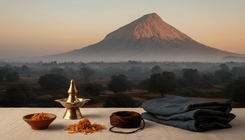
Ramana Maharshi teachings centre on a deceptively simple practice: asking yourself "Who am I?" This is not a question meant to be answered with words or concepts. The inquiry into self-identity is the whole of the path he taught, a way to dissolve the sense of separation and return directly to what you are. If you have wondered whether spiritual practice needs to be elaborate or time-consuming, Ramana's approach offers something else entirely: the possibility of awakening through a single, persistent question.



The Life That Shaped the Teaching
Venkataraman was born in 1879 in Tamil Nadu. At sixteen, he experienced a spontaneous fear of death that became the gateway to his awakening. Rather than resist it, he lay down and imagined his body dead, asking himself: if my body is dead, am I dead? The answer came as a direct knowing that he, the witness of all experience, could not die. This inquiry led to permanent stabilisation in the state he called the Self. He soon left his home and made his way to Arunachala, the sacred mountain revered for thousands of years as the embodiment of Shiva. He spent the rest of his life there, and the place became inseparable from his teaching.
What made Ramana unusual among saints was his accessibility. He did not demand initiation, ritual preparation or specific conditions. He invited people to look directly at who was asking the questions they brought to him. Seekers came from all over the world—Indian householders, Western philosophers, even British colonial administrators—and left with the same instruction: turn the mind inward and investigate the sense of "I".
The Method: Who Am I?
The Ramana Maharshi teachings are built around self-inquiry, known as atma-vichara. The method begins with the thought "Who am I?" but does not stop at the verbal level. The point is not to accumulate answers or philosophies about the self. Instead, you follow the "I" thought back to its source, the feeling of "I am" that exists prior to thought.
In practice, this means noticing the sense of personal identity—the bundle of thoughts, preferences and memories you call yourself—and asking who is aware of it all. When you look at your thoughts, they appear as objects within your awareness. When you look at your emotions, they too are witnessed. But what is the witness itself? The inquiry does not demand an answer; it creates an inward attention that gradually reveals the nature of consciousness itself.
Ramana did not prescribe any particular form. Some seekers did the inquiry formally during meditation. Others held the question loosely while going about their day. He taught that the method adapts to the temperament of each person. Those drawn to devotion might approach it as an offer to the divine. Those of intellectual bent might pursue it as direct investigation. What mattered was sincerity: the genuine willingness to know yourself as you truly are.
The Direct Path Versus Preparation
Most spiritual traditions teach progressive stages: ethical discipline first, then practices to purify the mind, then meditation leading eventually to insight. Ramana Maharshi taught something called the "direct path". He held that since the Self is already your nature, no preparation is truly necessary. The obstacles to knowing it are not real obstacles; they are misunderstandings that collapse when you look directly.
This does not mean external conditions are irrelevant. Ramana acknowledged that stillness, solitude and freedom from pressing worldly concerns all support the practice. He lived as a renunciate and attracted many seekers who came to Arunachala precisely to create the conditions for inquiry. But he was clear that these were supports, not prerequisites. A person living an ordinary life could turn inward at any moment and begin to question the nature of the "I" they took for granted.
He also taught that grace—the natural pull of consciousness towards knowing itself—does the deeper work. Effort and sincere inquiry remove the obstacles to that recognition, but they do not manufacture awakening. When Ramana pointed to the Self, he was pointing to what is already present, already conscious, already free. Your nature as unchanging awareness cannot be created or destroyed by anything you do.
Arunachala and the Teaching
Arunachala held deep significance in Ramana's work. In Hindu philosophy, the mountain is known as Arunachaleswara, a form of Shiva expressing supreme consciousness. Ramana taught that the mountain itself embodied the truth he pointed to—the still, unchanging presence at the heart of all existence. For those who came to meet him, circumambulating the mountain or simply sitting in its presence became an expression of the inquiry itself.
Many of Ramana's most devoted followers were Western seekers who had come through intellectual or philosophical paths. They found in him something no book had offered: a living embodiment of the peace and clarity that the inquiry pointed toward. Unlike many teachers who demanded explicit belief, Ramana simply sat quietly while people brought him their questions. His presence itself seemed to create the conditions for insight.
After his death in 1950, his teaching dispersed through his devotees and the community that formed around Arunachala. Writings collected in texts like "Talks with Sri Ramana Maharshi" and "The Gospel of Sri Ramana Maharshi" preserve his words, but those who encountered him emphasised that his teaching was transmitted more through silence than speech. Many described sitting near him as itself a transmission, as if the stillness could be passed from one consciousness to another.
The Teaching in Practice Today
For those drawn to Ramana Maharshi's teachings now, the core remains unchanged: the question "Who am I?" is available to anyone with genuine interest. It is not reserved for monastics or those living in retreat. You can bring the inquiry into ordinary life, pausing whenever you notice the sense of personal identity active and turning attention back to the source of that feeling.
Many practitioners describe early experiences of peace or clarity that arise from sustained inquiry. Others find that the practice gradually loosens the grip of habitual thinking, allowing space for something simpler to emerge. Some report dramatic shifts in perspective; others note subtle changes in how they respond to life's challenges. Ramana taught that the outcome is not the point; the inquiry itself reveals the nature of what you are.
The path suits those who find that other practices—devotion, service, breath work, study—have led to a sense of completion or a need for something more direct. It is especially suited to those who are already asking fundamental questions about identity and consciousness. If you have wondered who the "I" is that thinks your thoughts and witnesses your life, the inquiry invites you to find out for yourself, not through belief but through immediate investigation. That was Ramana Maharshi's whole teaching, offered with simplicity and without condition.
Common questions
Is the 'Who am I?' inquiry the same as positive affirmation?
No. Affirmation repeats a chosen statement to shape your thinking. Self-inquiry turns attention backwards to investigate the source of the sense of 'I' itself, not to affirm anything but to see what is actually true. The two are opposite in method and aim.
Do I need to live in a monastery to practice self-inquiry?
No. Ramana taught that the inquiry is available to anyone in any circumstance. Solitude and freedom from urgent responsibilities support the practice, but the question 'Who am I?' can be turned toward whenever you notice the sense of personal identity—whether at home, at work, or anywhere else.
What is the difference between Ramana's direct path and other spiritual teachings?
Most traditions teach progressive stages of purification and practice leading eventually to insight. Ramana taught that since the Self is already your nature, direct inquiry can reveal it without waiting for lengthy preparation. Both approaches are valid; the direct path suits those ready to investigate their fundamental nature immediately.

Related Articles


