Raksha Bandhan: Meaning, Legends and Customs
The Bond That Celebrates Care and Protection

Abhilash Ramakrishna
07 Nov 2026 • 7min
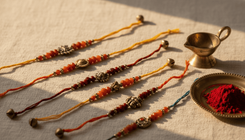
Raksha Bandhan is a festival centred on the ritual tying of a sacred thread called a rakhi, and its meaning reflects the word itself: raksha means protection and bandhan means bond or knot. The festival celebrates the relationship between siblings, particularly the bond between sisters and brothers, though it has expanded in modern practice to honour any relationship of care and protection. A sister ties a rakhi on her brother's wrist as a prayer for his protection and wellbeing, and the brother pledges in return to care for and protect his sister. This exchange, performed during the month of Shravana in the lunar calendar, is one of the most widely observed festivals across Hindu, Sikh, Jain and Buddhist communities in India, and among diaspora populations worldwide.



The Legends Behind the Festival
The festival carries multiple stories from Hindu scripture and mythology that explain its origins and spiritual meaning. One of the most cited accounts involves Indra, the king of the gods, who was defeated in battle against the demons called the Asuras. Indra's wife Indrani took a sacred thread and tied it around his wrist as a protection against evil, reciting a mantra for his welfare. After wearing this thread, Indra returned victorious from battle, establishing the tradition of tying a protective thread.
Another significant legend appears in the Bhagavata Purana and involves Krishna and Draupadi. According to the story, Krishna was wounded while fighting the demon Shishupal, and Draupadi tore a piece of her sari and wrapped it around his wrist to stop the bleeding. Krishna promised in return that he would always come to her aid, a promise he famously honoured during the disrobing incident in the Mahabharata when he miraculously protected her modesty. This narrative deepens the meaning of raksha bandhan beyond mere physical protection to include moral support and unconditional care.
A third account tells of the demon king Bali, who had pleased the gods through his devotion but became tyrannical. When Vishnu subdued him, Bali's wife Vindhyavali tied a sacred thread on Vishnu's wrist as a symbol of care and asked for her husband's welfare. Some interpretations of the festival connect it to this story of dharma, duty, and the restoration of order.
These legends, while sometimes differing in regional tellings, share a common thread: the protective power of a sacred bond, the reciprocal nature of care, and the spiritual intention that accompanies the ritual.
How Raksha Bandhan is Observed
The festival is primarily marked by the ritual of tying the rakhi. On the day itself, a sister performs a small puja honouring her brother's wellbeing. She applies tilak, a mark, on his forehead, lights a lamp, and ties the rakhi around his wrist while reciting or thinking a blessing. This action is the emotional and spiritual heart of the observance. The brother, in turn, accepts the rakhi and gives a gift—traditionally money, though today this takes many forms—and often promises to support his sister.
The ritual varies across regions and communities. In some families, the rakhi is tied after a full puja ceremony with offerings to the family deity. In others, it is a simpler, more intimate gesture. In urban and diaspora settings, many observe raksha bandhan through phone calls, video calls, or by posting rakhi through the mail when distance prevents in-person celebration. What matters most is the intention behind the act rather than the exact procedure.
The festival also extends beyond the sibling relationship in many communities. Teachers are honoured with rakhis tied by students. In some traditions, people tie rakhis on the wrists of their gurus or respected elders. Some communities tie rakhis on trees, wells, or other natural features as a prayer for protection of the environment. These variations show how the festival's core meaning—creating a bond of care and protection—has been adapted across different relationships and contexts.
The Significance of the Rakhi
The rakhi itself carries symbolic weight. Traditionally, it is made of coloured thread, often with a small pendant or charm woven into it. The thread represents the continuity of the bond between siblings, something that does not break easily. Some families have specific designs or colours that hold personal significance. In modern times, rakhis are created with diverse materials and designs: beads, bells, jewels, or charms reflecting the interests or tastes of the person receiving it. Yet regardless of its appearance, the rakhi functions as a visible reminder of the protective bond it represents.
The act of tying itself—the knotting of thread around the wrist—is not merely symbolic. It marks a moment of intention and exchange between two people. For the sister, it is an expression of care, blessing, and a wish for the brother's safety and happiness. For the brother, accepting the rakhi is an affirmation of his responsibility and commitment to his sister's wellbeing. This mutual acknowledgment of responsibility is central to why the festival remains meaningful even in modern contexts where traditional family structures have changed.
Raksha Bandhan and Bhai Dooj
Raksha Bandhan is sometimes confused with Bhai Dooj, another festival celebrating the sibling bond, particularly in North India. However, the two festivals are distinct. Bhai Dooj occurs a few days after Diwali and is observed during the Hindu month of Kartik, while Raksha Bandhan occurs during Shravana. During Bhai Dooj, a sister applies tilak to her brother's forehead and prays for his wellbeing, much like in Raksha Bandhan, but the ritual focus is different and the date is different. Both festivals honour sibling relationships but are separate observances on the lunar calendar. Some families observe both, while others prioritise one or the other based on regional tradition or personal practice.
Extending the Meaning
In contemporary practice, Raksha Bandhan has broadened beyond the traditional brother-sister pairing. Single sisters tie rakhis on brothers, cousins, or close male friends. Brothers sometimes tie rakhis on sisters to express their own commitment to protection and care. Some people tie rakhis on themselves as a personal intention-setting ritual. This expansion reflects a deeper understanding that the festival's essence is not about enforcing a particular family structure but about acknowledging and strengthening bonds of care, responsibility, and mutual protection.
For those who observe it, Raksha Bandhan offers a chance to pause and consciously affirm the relationships that matter most. Whether you tie a rakhi or receive one, whether you do so in person or from a distance, the festival invites you to reflect on the ways you show up for the people you care about, and the ways they show up for you.
Common questions
Can sisters without brothers observe Raksha Bandhan?
Yes. Many sisters tie rakhis on male cousins, close friends, or mentors. Some tie rakhis on themselves as a personal affirmation of self-care and inner strength. The festival's meaning extends to any relationship centred on care and protection, not only biological siblings.
What is the difference between Raksha Bandhan and Bhai Dooj?
Raksha Bandhan is observed during Shravana and the ritual is centred on tying a rakhi. Bhai Dooj occurs after Diwali during Kartik and focuses on the sister marking her brother's forehead with tilak. Both celebrate the sibling bond but occur on different dates in the lunar calendar and have different ritual practices.
Can you tie a rakhi on someone who lives far away?
Yes, many people send rakhis through the post to siblings living in other cities or countries, or tie them during a video call. Some tie the rakhi on a chosen date and time, even across time zones, to mark the intention together. The physical distance does not diminish the spiritual meaning of the bond.

Related Articles