
Rahu, Ketu and the Eclipse Legend in Hindu Tradition
How Shadow Planets Dance Through the Sky

Sunil Chaurasia
11 Nov 2026 • 6min
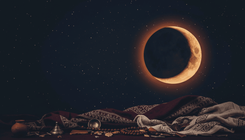
The story of Rahu and Ketu, the shadow planets in Hindu tradition, explains why eclipses happen and why they matter spiritually. These are not physical planets but mathematical points on the lunar orbit where it crosses the sun's path. Their mythology is rooted in one of Hinduism's oldest and most beloved stories: the churning of the cosmic ocean.



The Churning of the Ocean and the Nectar of Immortality
The tale begins with a war between the devas, the gods, and the asuras, the titans. Both wanted to drink amrita, the nectar of immortality, from the cosmic ocean. The story appears in texts including the Mahabharata and the Puranas. To obtain this nectar, the devas and asuras worked together to churn the great ocean using Mount Mandara as a churn and the serpent Vasuki as the rope.
As they churned, many treasures emerged from the depths: the wish-fulfilling tree, the elephant of the clouds, and finally the physician of the gods, Dhanvantari, carrying the pot of nectar. But when the asuras saw the prize, they snatched the pot and began to drink. The gods found themselves empty-handed. They appealed to Vishnu, the sustainer, who took the form of a beautiful woman, Mohini, to distract the asuras and reclaim the nectar for the devas.
Swarbhanu and the Deception
In this moment of deception, one asura saw through the trick. His name was Swarbhanu, and he disguised himself among the devas to drink the nectar before being discovered. He managed to drink some before the moon and sun, the two devas closest to him, noticed and alerted Vishnu. Vishnu's discus severed Swarbhanu's head from his body, but because he had already drunk the nectar, both the head and body became immortal.
The severed head became known as Rahu, the planet of hunger and obsession. The headless body became Ketu, whose name means "flag" or "comet tail." Both are considered shadow planets because they have no physical form—they exist at the nodes where the moon's orbit crosses the ecliptic, the sun's apparent path through the sky. Rahu and Ketu move backward through the zodiac, opposite to the usual direction of the planets, which is why they are said to move in retrograde motion.
Why Rahu and Ketu Cause Eclipses
In Hindu tradition, eclipses are understood literally as Rahu or Ketu swallowing the sun or moon. Rahu causes solar eclipses when he positions himself between the earth and sun. Ketu causes lunar eclipses when he stands opposite to the sun, swallowing the moon. These are moments of cosmic drama, the moment when the asura seeks revenge on the celestial bodies that betrayed him.
The timing of these eclipses follows mathematical rules described in jyotisha, Hindu astrology and astronomy. The nodes of the moon move backward through the zodiac, completing a full circle roughly every 18 years and 7 months. Within that period, there are predictable windows when eclipses can occur. Because both Rahu and Ketu are always exactly opposite each other, eclipses happen in pairs: a solar eclipse is always accompanied by a lunar eclipse within two weeks or so.
The Spiritual Significance of Eclipse Moments
Hindus regard eclipses as spiritually potent times, neither purely auspicious nor inauspicious but charged with transformative power. Many people fast during eclipses or visit rivers and temples to cleanse themselves spiritually. The eclipse is seen as a moment when the boundaries between the seen and unseen worlds grow thin, when prayer and practice are said to bear greater fruit.
Different traditions place different emphasis on these practices. Some follow strict rules about fasting and bathing before, during and after the eclipse. Others see the eclipse as a chance to release what no longer serves, to let Rahu's hunger consume old patterns and Ketu's comet tail sweep them away. The ritual response varies by region and by family practice, but the underlying idea is consistent: eclipses are moments to pause and turn inward.
Rahu and Ketu in Your Natal Chart
In jyotisha, Rahu and Ketu appear in your birth chart just as the seven planets do. They describe your soul's trajectory across lifetimes, your karmic purpose and the areas of life where growth happens through challenge. Rahu represents what you hunger for, what you reach toward and grasp at. Ketu represents what you have already mastered, what you can release, and the wisdom you carry without knowing it.
The position of these nodes in your chart is said to influence your personality, your strengths and your struggles. Some schools of Vedic astrology give them enormous weight; others see them as secondary to the planetary positions. But across these differences, Rahu and Ketu are understood as gateways to self-knowledge, not as planets of pure misfortune. They point to where your life asks something of you.
When Rahu or Ketu moves through a particular sign in the zodiac, it brings themes of that sign to the forefront of collective experience. Many jyotishis mark these transits as times to attend to specific areas of life or to deepen particular practices. Understanding Rahu and Ketu's movement is part of reading the panchanga, the Hindu calendar, just as understanding the moon's phases is.
Common questions
What is the difference between Rahu and Ketu?
Rahu is the ascending node of the moon, represented as a severed head symbolising hunger, desire and what pulls you forward. Ketu is the descending node, the body that was separated, representing release, past karma and spiritual wisdom. Together they move backward through the zodiac and mark the points where eclipses can occur.
Can I do puja during an eclipse?
Practices vary by tradition and region. Many communities fast or avoid beginning new activities during an eclipse itself, seeing it as a pause in ordinary time. After the eclipse ends, bathing in a river or performing puja is common. If you follow a specific sampradaya or family tradition, ask your guru or elder what is recommended for your practice.
How often do Rahu and Ketu change zodiac signs?
Rahu and Ketu spend approximately 18 months in each zodiac sign before moving backward to the next. Their movement is steady and mathematically predictable, and you can find these transits listed in any panchanga or jyotisha calendar for the current year.

Related Articles


