
Purusha Sukta Meaning: The Vedic Hymn of Cosmic Order
The hymn that shapes Hindu worship and philosophy

Abhilash Ramakrishna
10 Nov 2026 • 6min
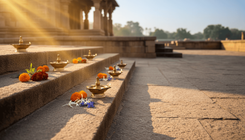
The Purusha Sukta is a foundational hymn from the Rigveda that describes the cosmic person, or purusha, who encompasses and transcends all existence. Recited in temples, homes and ceremonies across Hindu practice, it addresses questions that concern many who encounter it: What is the purusha? Why is this hymn so important in worship? And what does it actually say? This ancient text has shaped Hindu philosophy for over three thousand years and remains central to ritual and meditation today.



What the Purusha Sukta Describes
The Purusha Sukta presents a vision of cosmic order through the body of the purusha. In this hymn, the entire universe—gods, elements, beings and dimensions—emerges from and inhabits the body of a single cosmic person. The earth, sky and all directions arise from different parts of this infinite form. The hymn describes how creation unfolds through sacrifice, or yajna, with the purusha as both the sacrificer and the sacrifice.
This is not poetry about an ordinary human being. The hymn speaks of something vastly larger: a principle of consciousness and order that underlies all existence. When the text says the gods perform a sacrifice and the purusha becomes the victim, it is describing a cosmological act, not a physical event. The hymn uses the metaphor of the body to make the incomprehensible tangible to human understanding.
The Purusha Sukta appears in the tenth mandala, or book, of the Rigveda. It is one of the Rigveda's most widely known hymns, taught in ashrams and recited in homes throughout the Hindu world. Scholars and philosophers have drawn on it for millennia to explore questions about creation, consciousness, social order and the nature of reality itself.
Why It Is Recited in Worship
The Purusha Sukta holds particular significance in puja because it connects the ritual act to cosmic principles. When priests or worshippers recite it, they are not simply speaking words—they are aligning themselves with the fundamental order of existence described in the hymn. Many pujas in both temple and home settings include its recitation, especially in Shiva and Vishnu worship.
The hymn appears in funeral rites and in the daily practices of many traditions. Some families recite it each morning as part of their spiritual discipline. In temples, priests often chant it during abhisheka, the ritual bathing of the deity, and during other significant ceremonies. The specific verses chosen may vary depending on the tradition and the purpose of the ritual.
Beyond its use in formal worship, the Purusha Sukta has become a reference point for understanding Hindu cosmology. When a teacher explains how the universe is structured, or how sacrifice maintains cosmic order, they are often drawing on ideas rooted in this hymn. Its language and concepts recur throughout the Upanishads, the philosophical texts that follow the Vedas, showing its foundational importance to Hindu thought.
The Content and Philosophy
The hymn begins by describing the purusha as having a thousand heads, a thousand eyes and a thousand feet. This is not meant literally, but rather to convey that the cosmic person exceeds all measure and number. From this vast being, all worlds are created, yet the purusha extends beyond creation itself.
A central passage in the Purusha Sukta describes the sacrifice in which the gods perform a ritual using the purusha as the offering. From this sacrifice arise the Vedas, the seasons, plants, animals and the various beings of the world. The four varnas, or social orders—Brahmana, Kshatriya, Vaishya and Shudra—are said to emerge from different parts of the purusha's body. This passage has been interpreted in many ways across Hindu history, and scholars continue to debate its meaning.
The hymn teaches that creation is not a one-time event but an ongoing process. The sacrifice continues eternally, sustaining the cosmos. This idea underpins the Hindu understanding of yajna as the force that maintains dharma, or righteous order. Every ritual, from the grandest temple ceremony to a simple daily practice, participates in this cosmic sacrifice.
The philosophy expressed in the Purusha Sukta influenced major schools of Hindu thought. Advaita philosophers drew on its vision of non-dual consciousness. Dualist traditions used it to explore the relationship between the supreme self and the world. The hymn's flexibility—its capacity to be read at multiple levels of meaning—is one reason it has remained vital across centuries and samprapayas, or lineages.
Chanting and Sound
Vedic chanting is an art in itself, and the Purusha Sukta has a specific musical structure. The Rigveda is traditionally chanted using particular melodies called svaras, which preserve the exact pronunciation and rhythm of the ancient text. When chanted correctly, the sound becomes a vehicle for the meaning, not merely a delivery of words.
Many people undertake to learn the Purusha Sukta by ear, guided by a teacher versed in Vedic recitation. The proper intonation affects both the sound and, practitioners believe, the spiritual efficacy of the chant. Recordings of the Purusha Sukta chanted in traditional style are widely available, and many people listen to them as part of their practice or as background during meditation.
The act of chanting this hymn is itself considered a form of worship in many traditions. Whether sung in a temple during a major ceremony or whispered in morning prayer, the recitation is understood to align the speaker with the cosmic order the hymn describes. For this reason, many spiritual teachers recommend learning at least the opening verses.
Modern Practice and Understanding
Today, people encounter the Purusha Sukta through many routes: in temple worship, in yoga and meditation classes, in books on Hindu philosophy, and online through recordings and translations. Its ideas appear in contemporary discussions of consciousness, ecology and social philosophy. Yet modern interpretations vary widely, and it is important to understand that the hymn means different things to different practitioners.
Some traditions emphasize its role in ritual and worship. Others focus on its philosophical content and its teachings about the nature of reality. Some use it as a meditation text, reflecting on its images of cosmic unity. All these approaches are valid within Hindu practice.
If you wish to deepen your understanding of the Purusha Sukta, seek out a teacher or guide versed in Vedic interpretation. Reading scholarly translations alongside recordings of the chant provides both intellectual and embodied knowledge. Whether you approach it as a spiritual practice, a philosophical study or a ritual text, the Purusha Sukta rewards careful attention.
Common questions
Where does the Purusha Sukta appear in the Rigveda?
The Purusha Sukta is found in the tenth mandala of the Rigveda. It is among the most widely known and frequently recited hymns from the Vedic tradition.
How is the Purusha Sukta used in different types of worship?
Temple priests often chant it during abhisheka and major ceremonies. Many families recite it in morning prayers or as part of daily spiritual practice. Some traditions include it in funeral rites and in rituals honouring Shiva and Vishnu. The specific use varies by sampradaya.
What does it mean that the purusha has a thousand heads and eyes?
This is not a literal description but a metaphorical way of expressing that the cosmic purusha transcends all measurement and number. The exaggeration conveys the infinite and all-encompassing nature of this cosmic principle.

Related Articles


