
Prahlada and Hiranyakashipu: How Devotion Defeated Tyranny
When faith stands firm against all worldly power

Kushal K
28 Oct 2026 • 6min
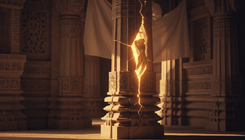
The story of Prahlada and Hiranyakashipu is one of the deepest teachings in Hindu scripture about the nature of devotion, dharma and divine protection. It shows us how a child's unwavering faith can stand against a father's absolute power, and why the gods themselves must intervene when tyranny grows unchecked.
Hiranyakashipu, a demon king of immense strength, had earned a boon that made him nearly invincible. He could not be killed by any god, man or creature; not in day or night; not indoors or out; not on earth, sky or sea. Armed with this protection, he ruled with cruelty and terror, forbidding all worship of the gods and demanding that everyone worship only him. His own son, Prahlada, was born into this regime of fear. Yet Prahlada grew to love Vishnu with every part of his being.



The Boy Who Refused to Bow
Prahlada was no ordinary child. From his earliest years, his heart turned naturally to Vishnu. While his father enforced atheism through threats and punishment, Prahlada sang hymns of devotion, meditated on the divine name, and spoke of dharma to anyone who would listen. His teachers, appointed by Hiranyakashipu to teach the demon ways, found him hopeless: he would not learn cruelty, conquest or pride in power. Instead, he turned their lessons to questions about duty, surrender and the nature of the eternal.
When his father discovered this defiance, his rage was boundless. Here was his own son, inheriting his throne and his strength, choosing to worship the very god who opposed the demons. For Hiranyakashipu, this was unbearable betrayal. He resolved to destroy the boy.
Hiranyakashipu commanded his servants to execute Prahlada in every way possible. They tried poison, but it could not touch him. They threw him from a cliff; he landed unharmed. They locked him in a chamber with his mother and filled it with fire; the flames parted around him. They set serpents upon him; they would not bite. With each attempt, Prahlada remained calm, his mind fixed on Vishnu, his faith so complete that no weapon, no fear and no suffering could shake it. Meanwhile, his father's fury only deepened.
Why Devotion Matters More Than Fear
The Bhagavata Purana, one of the most beloved texts of Hinduism, uses the Prahlada story to teach that devotion—bhakti—is the path that even surpasses knowledge and ritual. Prahlada had no power, no army, no place of safety. He was utterly dependent, helpless before his father's will. Yet he possessed something his father could never obtain: complete surrender to something greater than himself.
This is the paradox at the heart of the story. Hiranyakashipu had sought ultimate power and near-invulnerability. He had bent the cosmos to his will through tapas, discipline and force. Yet all of it left him fearful and desperate, forever trying to consolidate his rule and eliminate threats. Prahlada, by contrast, had given up the need for power altogether. He accepted whatever came—torture, exile, the possibility of death—because his trust was elsewhere. This surrender, this bhakti, was a strength no boon or weapon could provide.
When people ask why Prahlada survived his father's attacks, the answer is not that he had magical protection, though the gods did eventually shield him. The answer is that his devotion was so absolute that no external force could harm the core of who he was. His body could be threatened, but his soul—his dharma, his faith—could never be touched.
The Arrival of Narasimha
When Hiranyakashipu saw that no ordinary cruelty could break his son, he decided to end this himself. He confronted Prahlada directly and demanded proof: if your Vishnu is so powerful, where is he now? Let him appear, or I will kill you with my own hands.
Prahlada replied with perfect faith: Vishnu is everywhere—in you, in me, in all things. You cannot avoid him. And at that moment, as Hiranyakashipu raged, a figure emerged from a pillar in the hall: Narasimha, the Man-Lion, an avatar of Vishnu that was neither fully god nor fully demon, neither day nor night, neither man nor animal. In this form, Vishnu could take the life of the demon king without violating any of the terms of the boon. Narasimha seized Hiranyakashipu and, as the sunset fell between day and night, upon a threshold between indoors and out, struck him down.
With this act, the rule of tyranny ended. Prahlada's faith had not failed; nor had the gods forgotten their duty to protect dharma when it could not survive under human—or demonic—rule alone.
What the Story Teaches
The narrative of Prahlada and Hiranyakashipu is not simply a tale of good overcoming evil through divine intervention, though it includes that. It is a teaching about the nature of power and protection. Worldly power—strength, wealth, armies, even supernatural boons—can be taken away or turned to cruelty. But the power of dharma, of lived faith and devotion, cannot be shaken by any external force. A person who surrenders completely to the divine stands untouched by the schemes of the powerful.
This is why Prahlada is revered across Hindu tradition as an ideal of bhakti. He did not fight back or plot revenge. He did not use his father's strength against him. He simply held to his truth, no matter what came. And in doing so, he became unbreakable. His father, for all his power, could not touch what mattered most: Prahlada's soul, his faith, his dharma.
The story reminds us that true strength lies not in domination, but in alignment with dharma and the divine. It teaches that evil may flourish for a time, but it cannot endure when it stands against the eternal. And it shows that a single person, holding firm to truth, can become the instrument through which the cosmos restores its balance.
Common questions
Is the Prahlada story told during a particular festival?
Yes, the story is central to Holi celebrations, which commemorate Prahlada's survival and the destruction of his father's tyranny. Holi is also called Holika Dahan because it marks the burning of Holika, the demoness sent to kill Prahlada—who emerged from the flames unharmed.
Did Prahlada have any training in devotion, or did it come naturally?
According to the Bhagavata Purana, Prahlada's devotion came naturally from birth, though it deepened through his own meditation and reflection. His father appointed teachers to corrupt him into demonic ways, but instead Prahlada turned their teachings toward spiritual understanding.
What happened to Prahlada after Hiranyakashipu died?
Prahlada became king of the demons and ruled with dharma and justice, establishing a reign of truth and righteousness. He is remembered as one of the finest rulers in Hindu tradition, showing that devotion leads not to powerlessness but to just and virtuous rule.

Related Articles


