Pradosh Kaal on Diwali: Why This Timing Matters for Your Puja
The Hour of Blessings: Timing Your Worship Right

Abhilash Ramakrishna
18 Oct 2026 • 7min
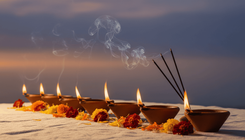
On Diwali, Pradosh Kaal is the most widely recommended time to perform Lakshmi Puja and other evening rituals. If you are planning your puja, understanding what Pradosh Kaal is and why it matters will help you time your worship for maximum spiritual benefit. This window of roughly two and a half hours after sunset carries special significance in Hindu practice, and on Diwali—when the new moon prevails during this time—it becomes the central window for the festival's main worship.



What Is Pradosh Kaal?
Pradosh Kaal is a sacred period that occurs each day, beginning at sunset and lasting for about two hours and twenty-four minutes afterwards. The word pradosh comes from Sanskrit and refers to the evening or the early part of the night. This twilight window is considered one of the most spiritually potent times of the day in Hindu practice.
The exact timing of Pradosh Kaal depends on your geographical location and the time of sunset on any given day. Rather than a fixed clock time, it is calculated from the sunset moment itself. This is why you cannot apply last year's timing to this year—the time shifts as the seasons change and differs from city to city. Many Hindu calendars and panchang apps calculate the precise Pradosh Kaal for your location, which is worth checking if you want to perform puja at the optimal moment.
Pradosh Kaal holds significance across many Hindu traditions. It is a favourable time for worship, meditation and spiritual practice, and it is especially associated with the worship of Lord Shiva on Pradosh Vrat, observed on the Trayodashi (thirteenth lunar day) of each fortnight. On Diwali, Pradosh Kaal takes on special importance because the main festival worship is tied to it: Diwali is observed on the day when Amavasya, the new moon tithi, is in effect during Pradosh Kaal.
Why Pradosh Kaal Is Central to Diwali Worship
Diwali falls on the new moon day of Kartik (or Ashwin, in the amanta calendar). In general, Amavasya is not considered a favourable day for beginning auspicious undertakings, but the Diwali Amavasya is a notable exception—the darkest night of the year's most important lunar month becomes the night on which Lakshmi is welcomed with light. The darkness of this new moon is seen as a blank canvas for fresh intentions, and the lamps lit at dusk symbolise light overcoming darkness. When Amavasya prevails during Pradosh Kaal, the evening's natural quietness and the symbolism of the darkest night combine to create a moment when worship is believed to be especially heard and blessed.
Lakshmi Puja, the main ritual of Diwali in much of India, is timed to coincide with Pradosh Kaal for this reason. Lakshmi is associated with abundance, prosperity, wisdom and the light of consciousness—qualities that are ritually invoked during this window. Many traditions refine the timing further by choosing the part of Pradosh Kaal that coincides with a Sthir Lagna, or fixed ascendant—usually Vrishabha (Taurus), which rises during the evening on Diwali. Worship during a fixed lagna is believed to make Lakshmi's blessings stay in the home. This is why panchangs usually give the Lakshmi Puja muhurat as the time when Pradosh Kaal, Vrishabha Lagna and Amavasya all overlap.
Beyond Lakshmi Puja, other rituals performed on Diwali evening—such as lighting lamps, making offerings and chanting mantras—also benefit from being done during Pradosh Kaal. The quality of attention and receptivity present during this time is believed to amplify the power of the ritual itself.
How Pradosh Kaal Differs from Other Puja Times
While Diwali puja can technically be performed at other times on Diwali, performing Lakshmi Puja during Pradosh Kaal is considered most beneficial in most household traditions. Other times may be used for Diwali rituals in certain traditions or circumstances. In Bengal, Odisha and Assam, for example, the Diwali new moon is celebrated as Kali Puja, which is performed during Nishita Kaal, around midnight. Some tantric and business traditions also perform a late-night Lakshmi Puja during Mahanishita Kaal.
Some families have traditional times passed down through generations, and these deserve respect—there is no single "correct" time that applies everywhere. However, if you are performing Lakshmi Puja for the first time or wish to align with the most widely recommended timing, Pradosh Kaal—ideally during Vrishabha Lagna—is the choice that appears across most household traditions.
If you cannot perform your puja during Pradosh Kaal for practical reasons—family schedules, work commitments or other constraints—your puja is not invalidated. The intention and sincerity of your worship matter deeply. That said, if you have flexibility, timing your Lakshmi Puja to fall within Pradosh Kaal creates conditions that support your practice.
Preparing for Pradosh Kaal Puja
Begin by checking the exact Pradosh Kaal and Lakshmi Puja muhurat for your location on Diwali. This information is typically available in Hindu calendars, panchang apps or from local temples and spiritual teachers. Planning ahead prevents last-minute rushing, which can undermine the meditative quality of your worship.
Prepare your puja space in advance: clean the altar, arrange your offerings, and gather all items you will need. This might include a lamp (diya), flowers, incense, and any items specific to your family's tradition. Have water for ritual purification ready. If you are performing a longer puja, ensure you have uninterrupted time during Pradosh Kaal—switch off phones and let family members know you are not to be disturbed.
On the day itself, bathe and dress in clean clothes before sunset, when Pradosh Kaal begins. Some people fast during the day and break their fast after the puja. Be seated at your puja space a few minutes before your muhurat begins, allowing time to settle into a calm, meditative state. The goal is to enter the ritual with clarity and focus rather than hurrying through it as evening darkens.
Regional Variations in Pradosh Kaal Practice
Across India and the Indian diaspora, the way families observe Diwali puja timing varies. In much of North and West India, families take care to time their Lakshmi Puja precisely to Pradosh Kaal, often choosing the portion that falls within Vrishabha Lagna. In Tamil Nadu and much of South India, Deepavali itself is celebrated on the morning of Naraka Chaturdashi, and evening Lakshmi Puja, though observed in many homes, is less central to the festival. In Bengal, Odisha and Assam, the main worship of the Diwali night is Kali Puja, performed around midnight.
Some temples announce the official Pradosh Kaal and Lakshmi Puja muhurat for their locality, and families synchronise their home puja to align with these timings. This creates a collective spiritual resonance across the community. In other places, families keep to their own household traditions without reference to a communal time.
What unites these variations is the shared understanding that the timing of Diwali worship matters. Whether your family observes it with minute-to-minute precision or with a more flexible approach, the recognition that the evening twilight of the Diwali new moon holds special power is a thread running through Hindu practice across many regions and generations.
Check your local panchang for the exact Pradosh Kaal and Lakshmi Puja muhurat on your Diwali. If you are new to this practice, ask someone in your family or community what has been done traditionally, and work from there. Your Lakshmi Puja will carry the weight of intention, and timing it to Pradosh Kaal deepens that sacred intention further.
How to perform puja during Pradosh Kaal on Diwali
Check your local Pradosh Kaal timing Look up the exact Pradosh Kaal start and end times, and the Lakshmi Puja muhurat, for your location on Diwali using a panchang app, Hindu calendar or local temple. Note these times so you can plan your puja around them.
Prepare your puja space and items Clean your altar in advance and gather everything you will need: a lamp (diya), flowers, incense, offerings and water for ritual purification. Arrange these items in the order you will use them.
Purify yourself before sunset Bathe and dress in clean clothes before sunset, when Pradosh Kaal begins. This prepares your body and mind for the ritual and allows you to enter the puja space calmly rather than in a rush.
Settle in a few minutes early Sit at your puja space a few minutes before your muhurat begins and light your diya as the puja starts. This creates a transition from everyday time into ritual time and settles your focus.
Perform your Lakshmi Puja Follow the puja steps taught in your family or community tradition, making offerings and chanting mantras with full attention. The auspicious timing of Pradosh Kaal supports your concentrated intention.
Common questions
When does Pradosh Kaal begin and how long does it last?
Pradosh Kaal begins at sunset and lasts for about two hours and twenty-four minutes afterwards. The exact timing varies depending on your geographical location and the time of sunset on Diwali, so check your local panchang for the precise window.
Can I perform Diwali puja outside of Pradosh Kaal?
Yes, and if you cannot do so during Pradosh Kaal for practical reasons, your worship is not invalidated. Some traditions also perform their main Diwali worship at other times, such as Kali Puja around midnight in Bengal. However, for Lakshmi Puja, performing it during Pradosh Kaal—ideally during the Vrishabha (Taurus) Sthir Lagna—is considered most auspicious and is recommended in most household traditions.
Why is Pradosh Kaal especially important on Diwali?
Pradosh Kaal is significant on many occasions—it is central to Dhanteras worship and to the fortnightly Pradosh Vrat for Lord Shiva. On Diwali, its importance comes from the rule that the festival is observed when Amavasya, the new moon tithi, prevails during Pradosh Kaal. Combined with the Sthir Lagna, this makes the Diwali evening an especially powerful window for Lakshmi Puja.

Related Articles