
Poush Parbon: Bengal's Winter Harvest Festival
Warmth, Sweets and Community Through Winter

Abhilash Ramakrishna
22 Nov 2026 • 7min
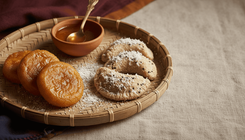
Poush Parbon is Bengal's winter harvest festival, celebrated as the sun begins to move northward at Poush Sankranti, the winter solstice. This is the moment when the earth receives the season's new paddy rice, and across West Bengal, Assam and parts of Odisha, families gather to mark the transition with feasting, ritual offerings and the making of pithe—the sweet and savoury rice cakes that have made Poush Parbon a festival of abundance and sharing.
The festival falls in the month of Poush (usually late December to mid-January by the solar calendar), and its timing is rooted in both astronomy and agriculture. Poush Sankranti marks the sun's entry into Capricorn, known as Makara Sankranti across India, but in Bengal the observance carries its own character. It is a moment of gratitude for the harvest and a threshold: winter is at its coldest, but the light is beginning to grow again. For farming communities, this turning point has always been a time to pause, celebrate and reinforce the bonds that sustain a village through the harder months ahead.



The Significance of Poush Sankranti
Poush Sankranti holds both spiritual and practical meaning in the Bengali calendar. It is not tied to a fixed Gregorian date but falls on the solar day when the sun enters Makara Rashi (Capricorn). This solar event is celebrated across India, but Bengal marks it with particular warmth and culinary elaboration.
The festival is rooted in the concept of uttarayan—the sun's northward journey—which begins at Makara Sankranti. In Hindu philosophy, uttarayan is considered the more auspicious time for rituals and observances. It is also the season when days begin to lengthen and the grip of winter begins to ease. For agricultural societies, this astronomical shift was inseparable from earthly rhythms: the new rice crop has been harvested, stored, and is now ready to be used. The festival therefore carries thanksgiving for plenty and hope for the cycles ahead.
In Bengal, rituals associated with Poush Sankranti are often less prescribed than in other regions. The emphasis falls more on gathering, eating together and expressing joy through shared food than on formal puja sequences. This reflects the festival's roots in community rather than in household ritual alone.
Pithe and Patishapta: The Heart of the Festival
Pithe are the soul of Poush Parbon. These are cakes or dumpling-like confections made from rice flour, jaggery and sometimes lentils or sesame, often filled with grated coconut, jaggery and ghee. The varieties are numerous and regional. Nolen Gur Pithe is made with fresh date palm jaggery, a seasonal ingredient prized for its complexity. Puli is a pithe filled with jaggery and sesame that is boiled rather than fried. Patishapta is a crepe-like pithe filled with jaggery and grated coconut, rolled and fried until crisp.
Making pithe is work and joy mixed together. Families gather—often daughters-in-law and grandmothers, cousins and neighbours—to mix dough, roll filling, and shape cakes through the morning. The making is as much part of the celebration as the eating. Each region of Bengal has its own variants, and families often have recipes passed down over generations. Some pithe are fried until golden, others steamed, some boiled. Some are eaten warm, fresh from the pan. Others are stored in ghee to be eaten over weeks.
Jaggery, known as gur in Bengali, is essential. Fresh date palm jaggery, nolen gur, is harvested specifically in this season and has a distinctive earthiness and sweetness that cannot be replicated. Using it marks the festival as a celebration of seasonal abundance. When date palm gur is not available, cane jaggery is used, but the best pithe are made when the season is right.
Traditional Rituals and Offerings
The rituals of Poush Parbon vary by household and region, but many families begin the day by bathing and offering gratitude at the household shrine or at water—a river, tank or well. Some households prepare offerings of pithe and other foods for the sun, since uttarayan is associated with Surya, the sun deity. These offerings are often made outdoors or at a window facing east.
In many families, it is customary to give pithe as gifts—to relatives, to priests, to the poor. This giving is not seen as charity but as sharing in abundance. The first pithe made is often offered to elders first, and eating together from the same batch is a way of affirming kinship and community. In some regions, particularly around Kolkata and in neighbouring areas, Poush Parbon is marked by larger gatherings where pithe are made in bulk and shared widely.
Some families observe a mild fast on Poush Sankranti morning, eating only light food or rice and vegetables, before breaking the fast with sweet pithe. This practice varies greatly; it is not universal or obligatory. The festival is fundamentally one of abundance, so where fasting is observed, it is often brief and followed by rich eating.
Poush Parbon in Contemporary Practice
Today, Poush Parbon remains a living festival across Bengal, though its character has shifted in urban settings. In villages, the festival still marks the turning of the season and brings families together for the labour of making pithe. In cities, the emphasis has increasingly moved to buying pithe from sweet shops rather than making them, though many families still make at least some pithe at home.
The festival has also begun to be celebrated by diaspora communities, particularly Bengalis living outside India. Recipes for pithe and nolen gur are shared online, and Bengali associations in other countries hold Poush Parbon celebrations. This has helped sustain the festival's traditions even where the seasonal markers and ingredients are harder to access. Date palm jaggery, in particular, is now imported or ordered specifically for the festival by families living abroad.
Contemporary practice has also expanded to include more explicit social messaging around the festival: it is increasingly celebrated as an environmental occasion, marking renewed connection to the earth and seasonal eating. Some households have made a conscious effort to revive forgotten pithe recipes or to source date palm jaggery directly from rural producers as a way of supporting small farmers.
Across West Bengal and Assam, Poush Parbon remains a marker of winter and belonging. For many, the festival is more about the texture of community—the morning spent shaping pithe, the taste of nolen gur, the gift of a pithe to a neighbour—than about formal worship. It is a festival that asks people to slow down, to gather, and to taste the sweetness of a season's work.
Carry this into your own winter: if you have access to rice flour and jaggery, try making even one simple pithe. If not, seek out a Bengali sweet shop or find a recipe online. The point is not perfection but participation, the small act of making something with your hands to mark a threshold the sun has crossed.
Common questions
When is Poush Parbon celebrated each year?
Poush Parbon falls on Poush Sankranti, which is a solar date when the sun enters Capricorn (Makara Rashi). This usually occurs between late December and mid-January, but the exact date shifts each year. Check the Bengali calendar or Panchanga for the precise date in your location.
What is nolen gur and why is it special for Poush Parbon?
Nolen gur is fresh date palm jaggery harvested specifically during the winter season in Bengal. It has a distinctive earthy sweetness and is prized for making the best pithe. The connection between this seasonal ingredient and the festival marks Poush Parbon as a celebration of regional harvest and seasonal abundance.
Can I make pithe without date palm jaggery?
Yes. While date palm jaggery creates the authentic taste, cane jaggery works as a substitute. You can also experiment with other fillings like sesame and coconut (as in Puli) or simply make plain rice flour pithe with a jaggery-ghee filling. The core of the festival is the act of making and sharing, not achieving a single perfect recipe.

Related Articles


