
Pongal: The Tamil Harvest Festival and Its Four Days
Rice, cattle and the sun's turning celebrated

Sunil Chaurasia
09 Nov 2026 • 6min
Pongal is a harvest festival celebrated primarily in Tamil Nadu, though variants are observed across South India. The festival marks the sun's turning northward in the sky—the moment astronomers call the winter solstice—and gives thanks for the rice crop just gathered. Over four days, Tamil families perform specific customs rooted in gratitude to the sun, the earth and the animals that work the land. If you have wondered what pongal traditions actually involve, or what makes each day distinct, this article will walk you through the festival as it is observed.



The Timing and Calendar of Pongal
Pongal is fixed to the solar calendar rather than the lunar months that govern most Hindu festivals. It begins on the day when the sun enters the zodiac sign Makara—a shift that falls between 13 and 15 January every year. Because the date is tied to the sun's position and not the moon's phases, pongal falls on the same date each year in the Gregorian calendar, unlike festivals such as Diwali or Holi.
The four-day celebration moves through four distinct observances, each with its own name and purpose. They flow one into another, so the festival as a whole tells a narrative of thanksgiving—from the initial preparation through celebration with cattle and family, to the final day of renewal.
Bhogi: The Day of Clearing and Bonfire
The first day, called Bhogi, begins the festival cycle. On this day, families traditionally light bonfires and burn old items—worn cloth, dried sugarcane stalks, dried cattle dung (used as fuel in rural areas). The bonfire symbolises the burning away of the old harvest season and any negativity associated with the past year. Children often walk around the fire singing traditional Bhogi songs, a practice that remains common in villages and towns.
The morning of Bhogi is also when families paint their doorsteps with kolam—intricate patterns made from rice flour, turmeric and other coloured powders. This has become one of the most recognisable pongal customs. The kolam is not merely decorative; it is an offering to the earth and an invitation to prosperity. The patterns are often geometric or naturalistic, and each household may have its own style passed down through generations. Alongside the kolam, the house is cleaned and decorated, sometimes with mango leaves, marigolds or banana leaves, preparing the home for the days ahead.
Thai Pongal: The Day of the Harvest Pot
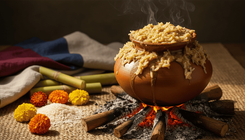
Thai Pongal is the main day of the festival, when the pongal dish itself is prepared and offered. Early in the morning, families gather in the courtyard or kitchen to cook rice, milk and jaggery in an open clay pot set over a wood fire. As the mixture boils and rises, the family calls out "Pongalo pongal!"—"May the rice overflow!"—expressing hope for abundance. The overflowing pot is seen as a blessing, not a mess.
Once the rice is cooked, it is offered first to the sun with prayers of thanksgiving. The dish is traditionally served on banana leaves, and portions are given to family members and sometimes to animals, particularly cattle. In many regions, turmeric, ginger and peppercorns are added to the pongal, and it is eaten with jaggery and ghee. The exact flavouring and accompanying side dishes vary by region and family tradition—some add cashew nuts or raisins, others keep it simple.
Thai Pongal is also the day when cattle feature in the celebrations. Farmers honour their cattle with decoration, food and gentle handling. In some areas, the cattle are anointed with turmeric paste and vermillion, and given special fodder. This is rooted in the reality of rural life: the cattle have worked the fields all year, and this day marks both gratitude and the rest period that follows the harvest.
Mattu Pongal and Kannu Pongal: Cattle and Community
The third day is called Mattu Pongal, when cattle are the central focus. In villages and towns, cattle are decorated with brightly coloured paint, bells and flower garlands. In some regions, young men engage in jallikattu—a bull-taming sport that has become controversial in recent years. In other areas, the day is marked more simply with parades of decorated cattle through the streets and villages. The purpose remains consistent: to honour the animals that have sustained the community through their labour.
The fourth and final day, called Kannu Pongal (or sometimes Adi Pongal or Thiruvalluvar Day, depending on the region), is a day of community gathering and sometimes competitive games. Families visit temples, exchange gifts and sweets, and greet one another with the phrase "Pongalayo Pongal"—a seasonal greeting wishing prosperity on the receiver. In some areas, young women play games with clay pots and coins, a tradition that appears in regional variations. This day marks a natural conclusion to the festival and often the return to ordinary routines.
Regional Variations and Modern Observance
While pongal is primarily a Tamil festival, similar harvest celebrations exist across South India under different names. In Karnataka, the festival is called Makar Sankranti; in Andhra Pradesh and Telangana, it is also Makar Sankranti or Bhogi; in Kerala, it is Makara Vilakku. Each region has adapted the basic themes—thanksgiving for harvest, marking the sun's turning, cattle blessing—to its own customs and food traditions.
In modern urban areas, the festival is observed somewhat differently. Apartment dwellers may prepare pongal in their kitchens and distribute it to family and friends rather than cooking in a courtyard. Some communities gather in parks or community halls for celebrations. Yet the core customs—the kolam, the pongal dish, the exchange of greetings, and the sense of gratitude for the harvest—persist even where the exact circumstances have shifted with urban living.
Common questions
Why is Pongal celebrated in January if most Hindu festivals are lunar?
Pongal is tied to the solar calendar and the sun's position, not the lunar months. It marks the winter solstice and the sun's northward turning, which occurs around 13 to 15 January each year in the Gregorian calendar. This is why Pongal falls on almost the same date every year, unlike lunar festivals that shift.
What is the difference between Bhogi and Thai Pongal?
Bhogi is the first day, when families light bonfires and paint kolam patterns to welcome the new season. Thai Pongal, the second day, is when the pongal dish itself is cooked and offered to the sun. Thai Pongal is considered the main day of the festival.
Can you make pongal without a clay pot, or does it have to be cooked in one?
Traditionally, pongal is cooked in an earthenware clay pot set over a wood fire, and this is the most meaningful way to prepare it if possible. However, many urban families now cook it in regular pots on stoves and still observe all the customs and prayers. The core ritual is the offering and overflow of the rice, regardless of the vessel.

Related Articles


