Parivartita Chakrasana
The Art of Bending Without Breaking
Shanti Arunkumar
26 Jul 2025 • 6min
In yoga, every posture tells a story—not just of the body, but of the spirit. While some asanas are dramatic expressions of strength or flexibility, others, like Parivartita Chakrasana, are quieter conversations with the self. From the outside, it may seem like a simple side bend. But in its grace, simplicity, and subtle engagement, lies a profound lesson: balance does not always come from rigidity; sometimes, it is found in the ability to bend with awareness.
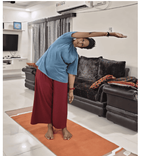
Parivartita Chakrasana, or Revolved Wheel Pose, is a standing lateral stretch that opens the side body, elongates the spine, and encourages conscious breathing. Unlike traditional backbends or twists, this pose revolves not around extremes, but around the center—gently shifting the spine sideways, drawing attention to the breath, and creating space where tension hides. It symbolizes the cyclical nature of life—the rising, turning, bending, and returning—all while staying rooted in one’s center.
As we arc the body like a half-moon, we awaken a new dimension of balance: the kind that emerges from movement, breath, and the strength to expand gently beyond our limits. In this way, Parivartita Chakrasana becomes both grounding and liberating—a wheel that doesn’t spin chaotically but turns with purpose and grace.
How to Practice Parivartita Chakrasana (Standing Side Bend)
Best performed after warming up the spine and shoulders. Ideal during the middle phase of your asana practice.
Begin in Tadasana (Mountain Pose)
Stand tall with feet together or hip-width apart. Ground yourself evenly through both feet. Engage your thighs, lengthen your spine, and draw the belly gently in.
Raise Your Arm
Inhale and lift your right arm overhead, close to the ear, palm facing inward. The left arm remains relaxed alongside the body or rests gently on the hip.
Perform the Side Bend
Exhale slowly as you bend your torso to the left, keeping the hips squared and legs firm. Avoid collapsing forward; keep the chest open and the shoulders aligned.
Feel the Elongation
Stretch through the fingertips of the raised hand while grounding through the opposite foot. Keep the neck soft—gaze can remain forward or gently upward.
Hold the Posture
Stay in the position for 5–7 breaths. With each inhale, lengthen; with each exhale, deepen the side stretch without forcing.
Return to Center and Repeat
Inhale as you rise back up to standing. Exhale, lower the arm. Repeat on the other side.
Benefits of Parivartita Chakrasana
Expands Lung Capacity
Side bending stretches the intercostal muscles, making more room for the lungs and supporting fuller, more relaxed breathing.
Increases Flexibility of the Spine and Waist
Mobilizes the thoracic and lumbar spine, relieving stiffness and improving posture.
Enhances Core Stability and Alignment
Even a simple side bend challenges your center and awakens the obliques, improving strength and control.
Stimulates Digestion and Detoxification
The lateral compression massages abdominal organs and can aid digestion.
Supports Mental Clarity and Balance
By engaging both sides of the body equally, this pose fosters physical symmetry and emotional harmony.
Precautions and Modifications
- Avoid or practice with care if you have:
- Recent spinal or lower back injuries
- Herniated discs or chronic lumbar pain
- Vertigo or high blood pressure (keep gaze neutral)
- Shoulder discomfort (place the top hand on the waist)
Modifications:
- Keep the lower hand on the waist for support.
- Use a wall beside you to guide alignment.
- Bend the knees slightly if there is tightness in the lower back.
Tips for Deeper Practice
- Don’t rush: move slowly and mindfully into the pose.
- Keep the lower ribs from jutting out; draw the belly in slightly.
- Visualize the entire side body—fingers to hip—lengthening like a pulled string.
- Focus on maintaining vertical alignment—avoid tilting forward or back.
Conclusion: Bending with Balance, Living with Grace
Parivartita Chakrasana invites us to explore the quiet magic of lateral space—space in the body, space in the breath, and space in the mind. In a world that pushes us forward relentlessly, this pose teaches us to pause and lean gently to the side, to notice where we are constricted, and to breathe into those forgotten spaces.
It reminds us that balance is not always symmetrical, and strength is not always about holding tight. Sometimes, it is in the deliberate side-step, the graceful arc, and the quiet stretch that we find our truest alignment.
In life—as in yoga—there will be times when we are asked to bend. Parivartita Chakrasana shows us that we can do so beautifully, without breaking, and with unwavering balance at our center.

Related Articles