
Naraka Chaturdashi: the Festival of Krishna's Victory Over Evil
Cleansing Light Before the Festival of Lights

Sunil Chaurasia
10 Nov 2026 • 7min
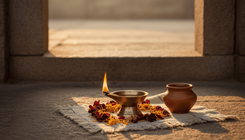
Naraka Chaturdashi is the day when Krishna killed the demon Narakasura, and it is celebrated on the darkest night before Diwali—on the fourteenth day of the dark fortnight of Kartik, a month falling between mid-October and mid-November. The festival is also known as Choti Diwali (the smaller Diwali) or Kali Chaudas, and it marks the opening of the Diwali season. In many households, the day begins before dawn with an oil bath, a practice tied to the ancient story of Krishna's victory and rooted in the belief that anointing the body with oil on this morning brings health, strength and protection through the year ahead.



The Story of Narakasura
Narakasura was a demon who ruled a kingdom on earth and caused immense suffering to the people. According to the Bhagavata Purana, he had been blessed with boons that made him nearly invincible and he used his power to oppress the weak and steal treasures. Krishna learned that the demon had imprisoned 16,000 girls in his palace and had abducted the earrings of Indra, the king of the gods. Determined to free the captives and restore order, Krishna set out to defeat Narakasura.
The battle was fierce and required Krishna to use all his skill and strength. In the end, Krishna slew the demon and freed the imprisoned girls, returning them safely to their families. With Narakasura's death, the people of that realm were liberated from terror and oppression. This victory is not simply a story of one man defeating an enemy; it is understood as the triumph of dharma (righteousness) over adharma (unrighteousness), of light over darkness, of protection over harm.
The Pre-Dawn Oil Bath
The ritual most closely connected to Naraka Chaturdashi is the pre-dawn oil bath. On the morning of the festival, many people wake before sunrise, anoint their body with oil, bathe, and dress in fresh clothes. The practice is rooted in the belief that the oil protects the body and purifies it, much as Krishna's actions purified the world of the demon's influence.
Different regions and families follow different customs around this bath. Some apply scented oils like coconut or sesame; others use a mixture of herbs and oils believed to have healing properties. Some people apply the oil while it is still cool from the night; others warm it gently. The exact materials and methods vary, and all of these variations are accepted within the tradition. The key element is the intentional act of anointing the body at dawn on this auspicious morning, which is seen as a way of inviting health and protection into the year.
The oil bath is often followed by a ritual bath in water, which is why the day is also called the day of the pre-dawn bath or the bath of victory. After bathing, many households light oil lamps, offer prayers, and may prepare special foods to mark the occasion.
Naraka Chaturdashi in the Diwali Season
Naraka Chaturdashi falls on the night before the new moon of Kartik. This is the darkest night of the month, and it is followed by Lakshmi Puja, the main festival of Diwali, which falls on the new moon itself. Naraka Chaturdashi thus serves as a threshold: a day of cleansing and victory that prepares the home and body for the arrival of Lakshmi and the abundance of the season.
While Diwali itself celebrates the return of Rama to Ayodhya and the victory of light, Naraka Chaturdashi centres on Krishna's protection of the vulnerable and his destruction of tyranny. Together, these two festivals—coming on consecutive nights—frame the Diwali season as a time of both personal and cosmic renewal.
In many parts of India, Naraka Chaturdashi is observed with less fanfare than Diwali itself, yet it is an important part of the festival cycle. Some households prepare sweets or savouries to distribute or eat with family. Some light fireworks, though this is less common than on Diwali night. In some regions, people visit temples to offer prayers and receive blessings.
Regional and Household Variations
The way Naraka Chaturdashi is observed varies across India and within communities. In some households, the oil bath is the central practice. In others, the emphasis falls more on worship, on gathering with family, or on preparing food. Some families mark the day with a vrat (fast), while others do not.
In Tamil Nadu and other southern regions, the festival is sometimes marked by a ceremonial bath with fragrant oils and flowers, followed by eating a special sweet or savoury dish with family. In Gujarat and Rajasthan, some households prepare khichdi and sweets. In Bengal, the observance is less prominent, though the principle of ritual bathing and the defeat of a demon echo the broader story of the season.
None of these variations is more correct than another. What matters is that the day is marked with intention and awareness: an acknowledgement of Krishna's protection, a moment of cleansing, and a step into the brightness of the Diwali season ahead.
Carrying the Day's Meaning Forward
Naraka Chaturdashi invites you to think about what it means to live under the protection of righteousness. The story of Krishna and Narakasura is not simply an old tale; it speaks to the eternal struggle between what uplifts and what harms, between the forces that protect the vulnerable and those that prey upon them.
The pre-dawn oil bath is a practice rooted in this understanding. When you anoint your body with oil on the morning of Naraka Chaturdashi, you are not just following a custom—you are aligning yourself with Krishna's action and inviting its blessing into your life. The oil becomes a symbol of protection and nourishment. The bath becomes a moment of renewal.
As you move into the Diwali season, this day offers an opportunity to reflect on the choices you make and the values you uphold. It asks: do your actions serve dharma or hinder it? Do you offer protection to those who need it, or do you turn away? The festival does not demand grand gestures—it works in small, daily acts of care and integrity. Begin with the pre-dawn bath, if that calls to you. The cleansing of the body is also a cleansing of intention.
Common questions
Can I do the Naraka Chaturdashi oil bath on a different day if I miss the morning?
The oil bath is most auspicious when done before dawn on Naraka Chaturdashi itself, but many people perform it on the morning of the day even if they wake after sunrise. The spirit of the practice—anointing the body with oil as an act of protection and renewal—carries meaning whenever it is done with intention during the festival.
What oil should I use for the pre-dawn bath?
Coconut oil, sesame oil, and mustard oil are all commonly used and are believed to have protective and nourishing properties. Some families use fragrant oils infused with herbs or flowers. There is no single correct choice; what matters is that you anoint your body mindfully at this auspicious time.
Is Naraka Chaturdashi the same as Diwali?
No. Naraka Chaturdashi falls on the night before the new moon of Kartik and celebrates Krishna's victory over Narakasura. Diwali (Lakshmi Puja) falls on the new moon itself. Naraka Chaturdashi begins the Diwali season and prepares the home and heart for the arrival of the main festival.

Related Articles


