
Moli and Kalava: The Sacred Red Thread Tied on Your Wrist
Thread, strength and blessing tied close to the heart.

Abhilash Ramakrishna
09 Nov 2026 • 7min
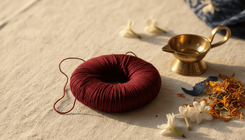
The moli, also called kalava, is the red (or sometimes yellow or white) thread tied around your wrist during a puja or ritual. It is one of the most recognisable blessings you receive from worship. When a puja is complete and you have made your offering to the deity, the priest or elder performing the rite ties this thread on your right wrist. The moment stays with you: a visible, tangible mark of your devotion and of the deity's grace. The thread is simple in appearance but carries meanings that run deep through Hindu practice.



Why the Red Thread Matters
The colour red holds particular power in Hindu ritual and daily life. Red signifies auspiciousness, strength and the divine energy of shakti. It appears in kumkum, the powder applied to the forehead; in the vermillion that marks a married woman's part; in the flowers offered to the deity. The thread, by being red, carries all these associations into something you can wear and touch. It is a reminder worn on the body itself, not set on an altar or carried away in a bag.
Some regions and traditions use other colours: yellow thread is common in southern India and in Vaishnavite worship; white appears in certain rituals. But red remains the most widespread, the colour first reached for in most households and temples. The specific shade and the material—cotton, silk or synthetic—varies, but the purpose is consistent: to carry the blessing of the puja from the sacred moment into your day and your home.
The Thread as Protection and Blessing
The moli serves as a spiritual protection. In many households, it is tied around the wrist to ward off inauspicious influence or the evil eye. The thread becomes a shield, a visible marker that says: this person has been blessed. In that sense, it works alongside other protective practices—the tilaka on the forehead, the mantra spoken aloud, the offerings made with intention. You are not protected by the thread as one might be by a lock, but by the sanctity that surrounds the moment in which it was tied.
At the same time, the thread is a connection. It links you to the ritual that was performed, to the deity you have addressed, and to all those who have worn such threads across generations. When you see it on your wrist, you remember the puja. You carry that remembrance through your day. Many people choose not to remove the thread until it falls away naturally, or until a new one is tied in another ceremony. Some tie a new thread before important undertakings—an exam, a journey, a significant day—as a way of inviting blessing into what is to come.
How and When the Kalava is Tied
The thread is usually tied toward the end of a puja, after the main offerings and prayers. The person conducting the ritual—a priest, an elder, a family member—takes the thread and winds it around your right wrist, sometimes tying it in a knot, sometimes weaving it in a specific pattern. The exact gesture varies by tradition and region. In some places, a small coin or a piece of turmeric is tied into the thread. In others, the thread alone is enough.
The right wrist is standard, though in some traditions or circumstances the thread may be tied on the left. If you are left-handed, some practitioners will tie it on your left wrist so that it sits closest to your working hand. There is no rigidness about this; the intention matters more than the exact mechanics. The thread is tied firmly enough to hold through your day but not so tight that it cuts off your circulation.
In domestic worship, a family member often ties the moli on the others in the household. A mother may tie it on her children; a wife on her husband. This act of tying carries its own meaning—it is an offering of care, a prayer made tangible through touch. In a temple or in a larger ceremony, the priest ties the thread on worshippers as they complete their darshan, their viewing of the deity's image.
Kalava in Different Traditions and Observances
While the moli appears in many contexts, it has particular importance in certain practices. During Raksha Bandhan, a festival celebrated during the month of Shravana (July to August), sisters tie a sacred thread called a rakhi on their brothers' wrists. The rakhi is a type of kalava, a ritual marking that carries protection and the bond of siblinghood. Some families also tie a thread during Diwali, the festival of lights, as part of new year observances.
The thread appears too in domestic pujas performed at home. When a family worships before a home shrine, a kalava may be tied on family members as the puja closes. It is common after pujas dedicated to particular deities—Ganesha, Hanuman, the Durga in her various forms. It may be tied during life-stage rituals or to mark the completion of a vrat, a ritual fast.
In some traditions, the moli is believed to hold the blessing until it falls away of its own accord. In others, it may be removed after a set time—when it becomes worn, or after a new one has been tied. There is no single rule that holds everywhere. The practice is guided by local custom and family tradition. What matters is the intention: that the thread reminds you of the sacred act you have performed, and that you are held within a current of care and blessing that extends beyond the moment of worship itself.
Wearing and Caring for Your Moli
Once the thread is tied, the question of how to care for it arises. Many people sleep with the thread on, bathe with it, and go through their normal daily life wearing it. The thread may fade, fray or loosen over time. None of this diminishes its value. The wearing down of the thread is sometimes understood as a natural discharge of its protective function—it has done its work and is ready to be released.
When you do remove the thread—whether it has fallen off naturally or you choose to take it off—many people keep it rather than discarding it. It may be placed in a home shrine, tucked into a drawer with other sacred items, or loosely kept. Some tie it into a small bundle with threads from other pujas, accumulating a collection over months or years.
If you receive a moli but are unsure how to wear it or when to remove it, it is worth asking the person who tied it. Priests and elders are generally happy to explain the practice particular to their family or temple tradition. There is no transgression in asking; the ritual belongs to you more fully when you understand it.
Common questions
Should I remove the moli when I sleep or bathe?
Most traditions hold that the thread is worn continuously until it naturally falls off or wears away. Bathing and sleeping with it on are normal; there is no requirement to remove it. When it eventually loosens or tears, that is understood as the time for it to go.
What should I do with the thread once it falls off?
Many people keep worn threads in a home shrine or sacred space rather than throwing them away. Some collect them over years. You may also place it in flowing water—a river or stream—as a way of releasing it with reverence, though this is a personal choice and not universally required.
Can someone other than a priest tie a kalava on me?
Yes. Family members, elders, or anyone performing a puja can tie the thread. In domestic worship, mothers often tie it on their children. The person tying it should do so with intention and care, but there is no requirement for priestly ordination.

Related Articles


