
Meditation Poses Yoga: Padmasana, Sukhasana and Siddhasana
Sit steady, rest deeper, find stillness

Sunil Chaurasia
09 Nov 2026 • 7min
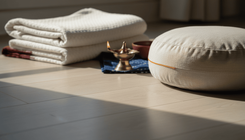
When you sit to meditate, the way you hold your body shapes the quality of your mind. A stable, comfortable seat is not a luxury—it is the foundation that lets you stay present for as long as you need. Three poses stand out in the yoga tradition for supporting meditation: padmasana, sukhasana and siddhasana. Each one roots you differently, and each one is within reach.



Why a meditation pose matters
The right pose does something precise: it keeps your spine naturally upright, anchors your awareness in the body, and allows your breath to move freely without strain. When you fidget or fight discomfort, your mind follows. When you sit steadily, your attention settles. The yoga tradition recognizes this link between body and mind, which is why specific poses are recommended for specific practices.
You do not need to be flexible or practised to start meditating. You can build capacity gradually. The goal is not to perfect a pose, but to find a seat where you can rest your awareness without distraction.
Sukhasana: the easy pose
Sukhasana is the most accessible of the three. You sit on the ground with your legs crossed, one shin in front of the other, feet tucked underneath or slightly forward, knees wider than hip-width apart. Your pelvis sits level and your spine extends upward naturally. From here, you rest your hands on your knees or in your lap.
Sukhasana is where most people begin. There is no complex footwork, no deep flexibility needed. If your knees sit high above your hips, sit on a cushion—this tilts your pelvis forward and removes the strain. Many people meditate in sukhasana for years without needing to change.
The pose invites a quality of ease, which is exactly what the name promises. It suits short sits and long ones, and it works just as well if you are recovering from injury or managing a chronic condition. If you find yourself drifting or restless, your body is probably comfortable enough that your mind can wander freely. That is not a failure; it is simply where you are practising.
Padmasana: the lotus pose
Padmasana, or lotus pose, is the image most people hold of meditation. You sit with one foot placed high on the opposite thigh, then the other foot placed on the first thigh, creating a symmetrical figure. Both knees point downward toward the floor. Your spine rises naturally, your pelvis sits stable, and your body becomes a contained, centered form.
This pose demands hip flexibility that takes time to build. Many people never practise it daily, and that is fine. But if you do the slow groundwork—regular hip openers over weeks and months—padmasana becomes accessible. It offers a particular gift when you reach it: the interlocking of the legs creates a sealed, stable base that many practitioners find deepens their sense of grounding.
Start with half-lotus if you are working toward the full pose. Place one foot on the opposite thigh and let the other leg extend or cross in front, creating a gentler version. Practise this for weeks. Only when half-lotus feels easy should you explore bringing the second foot up. Never force. Forcing creates injury, and injury stops practice.
Siddhasana: the adept's pose
Siddhasana is less well-known in the modern West, but it appears frequently in classical yoga texts as a pose perfectly suited to meditation and pranayama. You sit with one heel placed against the perineum or the inside of the thigh, and the other leg folded so that foot rests on top of the first calf or ankle. Your spine extends upward, and your body creates a stable triangular base.
This pose is symmetrical in intent but asymmetrical in structure, so you will sit on one side first, then switch sides on your next session. Many people find it easier than padmasana because it does not demand the same degree of hip opening, yet it offers similar stability.
Siddhasana carries specific associations in the yoga tradition. Classical texts suggest it supports prana—the body's life force—and directs energy inward, making it valued for pranayama and meditation work. You do not need to believe this to feel its effects; many practitioners report that the pose itself creates a quality of steadiness and inward focus that is harder to reach in other seats.
Building your practice
Start with sukhasana. Sit for 5 or 10 minutes, then gradually extend the time as your body and mind grow comfortable. Do not jump to an advanced pose because you think you should. Your job is to sit steadily, not to achieve a particular shape.
If you feel called to padmasana, begin hip-opening work: bound angle pose, pigeon pose, or cow-faced pose, practised gently several times a week. This is not a race. Weeks or months of regular practice might pass before half-lotus feels sustainable, and that is normal.
When you choose a pose, commit to it for a meditation block of a few weeks or a season. Let your body adapt. Notice what happens to your mind when your seat is stable. Notice what shifts when you change poses. Over time, you will develop a felt sense of which pose serves your practice on any given day.
The deepest meditation does not happen in the most advanced pose. It happens in the pose where you can forget about your body and meet what is happening in your mind. That is the meditation pose for you.
How to sit in sukhasana
- Sit on the ground Cross one leg in front of the other, with both shins extended in front of you. Tuck your feet underneath or slightly forward so your knees point outward at roughly 90 degrees.
- Level your pelvis If your knees sit high above hip level, sit on a folded blanket or cushion until your pelvis tilts forward naturally and your spine can extend upward.
- Ground your foundation Press your sitting bones firmly into the floor or cushion. Feel the weight of your body held by the earth.
- Extend your spine Lengthen from your tailbone to the crown of your head. Imagine a thread pulling upward through the top of your skull.
- Rest your hands Place your hands on your knees or in your lap, palms up or down. Relax your shoulders away from your ears.
Common questions
How long should I sit in a meditation pose?
Start with 5 to 10 minutes and extend gradually as your body adapts. There is no set time. Some people meditate for 20 minutes daily, others for an hour. Build duration slowly—rushing causes discomfort and discourages practice. Your nervous system needs time to settle into a new pose.
What if my knees hurt in sukhasana or padmasana?
Use a cushion under your seat to tilt your pelvis and lift your knees. If your knees still hurt, stop immediately; pain is a signal, not progress. Sit in a chair or try siddhasana instead. Forcing knee pain leads to injury and sets back your practice.
Can I meditate in a chair?
Yes. If floor poses are not available to you, sit in a chair with your feet flat on the ground and your spine upright. The principle is the same: a stable, comfortable seat where you can rest your attention. Tradition prizes floor poses, but a chair supports real, sustained practice.

Related Articles


