
Lord Ganesha's Birth Story: Why He Has an Elephant Head
Beloved Son, Remade in Devotion

Abhilash Ramakrishna
30 Oct 2026 • 6min
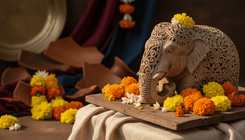
The lord Ganesha has an elephant head because his mother Parvati created him as a guardian, and when he would not yield to her husband Shiva, Shiva cut off his human head in anger. Parvati's grief moved Shiva to restore her son to life, but the original head could not be found. Shiva then gave Ganesha the head of an elephant—the first creature that came to hand—and blessed him with a place of honour at Parvati's threshold and in every home and ritual in the Hindu tradition.
This story matters because it explains not only how Ganesha came to be as he is, but why he stands guard at doorways and why he receives worship before all other gods. It is a tale of protection, a mother's love, and the acceptance of what makes you different.



How Ganesha Came to Be
According to the Shiva Purana, Parvati created Ganesha alone, without Shiva's involvement. She was preparing for a bath and needed someone to watch the threshold and keep intruders away. So she shaped the boy from the turmeric paste and oil used for her own bathing ritual, breathed life into him, and placed him at the door with instructions to let no one pass—not even Shiva himself.
When Shiva returned home and found a child barring his way, he did not know this was his wife's creation. Ganesha, obeying Parvati's command, refused to let him enter. Shiva grew angry at what he saw as an act of disrespect and, in his fury, drew his sword and cut off the boy's head.
Parvati's grief was absolute. She emerged from her chamber and saw her son dead at the threshold, the very place where she had stationed him. She cried out that if her beloved son could not be restored, she would destroy all creation itself. Her pain and devotion moved even Shiva to action.
Why Shiva Gave Him an Elephant Head
When Shiva saw Parvati's terrible grief, he felt remorse for his hasty act. He instructed his attendants, the ganas, to find the head of any creature they encountered first on the road to the north and bring it back. The first creature they met was an elephant. Shiva took the head and, using his divine powers, placed it upon Ganesha's body and brought the boy back to life.
Some versions of the story say that Shiva chose the elephant deliberately. The elephant is an animal of great strength and wisdom, of gentleness and memory, of loyalty and presence. It is also revered in the tradition as a carrier of sacred energy. By giving Ganesha the head of an elephant, Shiva was not diminishing the boy but elevating him, marking him as extraordinary and worthy of worship.
Other tellings say it was chance—that the ganas found an elephant first. Either way, Shiva blessed what had become true. He declared that from this moment forward, Ganesha would be honoured before all other deities. He would be worshipped at the beginning of every ritual, every home, every new venture. He would be known as Ganapati, the lord of the ganas, Shiva's own band of attendants.
The Deeper Meaning of the Elephant Head
The elephant head was not a punishment but a symbol of purpose. The elephant is the largest land animal, and in Hindu tradition it carries associations with strength, steadiness, and benevolence. To the people of ancient India, the elephant was also a sign of kingship and divine protection. Giving Ganesha this head was to say that he would be not just a guardian but a lord.
The trunk of an elephant is sensitive and precise, able both to lift and to comfort. It becomes a symbol of Ganesha's own nature: he is the remover of obstacles, the maker of paths, the lord of beginnings. Yet he is also tender and wise, accessible to anyone who calls. The elephant, being a vegetarian, also reflects Ganesha's gentle nature despite his power.
In temples and homes across India, Ganesha is painted, carved and sculpted with this elephant head, a visual reminder of a story that teaches us something important: that we are not diminished by our differences, but that difference itself can be a mark of grace and purpose when it is embraced with acceptance and love.
Regional Variations in the Story
The tale of Ganesha's birth appears in several Hindu scriptures, and different regions and communities emphasise different versions. In some tellings, found in texts like the Brahma Vaivarta Purana, Parvati shaped Ganesha deliberately as a son, intending all along that he would be extraordinary. In others, the act of creation is less deliberate, almost accidental—he arose from the substances of Parvati's ablutions.
The Shiva Purana and the Mudgala Purana present their own variations on the theme. Some South Indian traditions place different emphasis on Ganesha's role as Parvati's helper. In Kashmir Shaivism and other schools of philosophy, the story is understood as carrying layers of symbolic meaning about consciousness itself. What remains constant across these versions is that Ganesha received his elephant head through divine grace, becoming all the more powerful and revered for it.
Ganesha's Role After His Rebirth
Once restored to life and given his elephant head, Ganesha became the guardian of thresholds and the lord of auspicious beginnings. He earned his place at the start of rituals not by inheritance alone, but by his mother's fierce love and his father's acceptance of what love demands. He is called Vighnaharta, the remover of obstacles, and Siddhidata, the giver of success.
The story teaches that transformation and loss, when met with devotion and forgiven with love, can lead to a form of grace that ordinary life would never have known. Ganesha bears an elephant's head, a head that was not born to him but given to him. Yet he is one of the most beloved and most honoured of all the gods in the Hindu tradition.
Common questions
In which Puranas is Ganesha's birth story told?
Ganesha's origin appears in several scriptures, including the Shiva Purana, Brahma Vaivarta Purana, and Mudgala Purana. Different texts emphasise different aspects of the tale, and regional and philosophical traditions interpret them in various ways.
Why is Ganesha worshipped before all other gods if he was created so late?
After Shiva restored Ganesha to life with the elephant head, he blessed his son and declared that Ganesha would be honoured first in every ritual, home and new venture. This blessing elevated Ganesha to a supreme position of protection and auspice, earning him worship before all other deities.
Is there a reason the elephant head was chosen instead of another animal?
Some versions say the ganas encountered the elephant first by chance. Others hold that Shiva chose it deliberately because the elephant represents strength, wisdom, gentleness, and loyalty—qualities befitting a lord. Either way, Shiva's blessing transformed the head into a mark of grace and power.

Related Articles


