
Lord Dhanvantari: The Divine Physician of Ayurveda
The healer who emerged from the cosmic ocean

Abhilash Ramakrishna
19 Nov 2026 • 6min
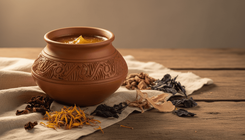
Lord Dhanvantari is the divine physician and the presiding deity of Ayurveda, the ancient Indian system of medicine and healing. In Hindu tradition, he is revered as the source of all healing knowledge and the embodiment of medicine itself. His significance goes far beyond the practice of Ayurveda; he represents the principle that health and wellness are sacred, and that the knowledge to restore balance to the body is divine in origin.



The Emergence from the Ocean of Milk
The most celebrated account of Lord Dhanvantari appears in the Mahabharata and the Puranas, particularly during the story of Samudra Manthan, the churning of the cosmic ocean. When the devas and asuras worked together to churn the primordial ocean of milk, they sought the amrita, the nectar of immortality. As the ocean was churned with the celestial mountain Mandara as the churning rod and the serpent Vasuki as the rope, fourteen precious things emerged from its depths. Among these treasures, Lord Dhanvantari rose from the waters, holding in his hands the pot containing the nectar of immortality.
Dhanvantari appeared in a radiant form, carrying the amrita in one hand and a sacred text on medicine in the other. Some accounts describe him holding four objects: the amrita pot, a vessel of medicine, a leech and a scalpel, symbolising the tools and knowledge of healing. His emergence from the cosmic ocean was understood as the divine gift of healing knowledge being revealed to humanity. He is often depicted as wearing yellow robes, adorned with a garland of flowers, radiating the light of divine wisdom.
The Gift of Ayurveda
What distinguishes Dhanvantari from other healing deities in world traditions is that he did not merely bless medicine—he embodied it. In the Hindu understanding, Dhanvantari brought with him not just the knowledge of how to heal, but the philosophy that underlies all healing: the principle of balance, or prakriti. Ayurveda, the science he revealed, is built on the understanding that health is a state of equilibrium between the three doshas—vata, pitta and kapha—and that illness arises when this balance is disturbed.
The knowledge Dhanvantari carried encompassed not only herbal remedies and surgical techniques, but also the deeper wisdom that prevention is more valuable than cure. Ayurveda teaches that proper diet, daily routine, meditation and living in harmony with the seasons are foundations of health. This holistic view reflects Dhanvantari's gift to humanity: an understanding that wellness touches every aspect of life, from food to sleep to the state of mind.
Worship and Observance Today
Dhanvantari Jayanti, the birthday of Lord Dhanvantari, is celebrated with reverence in temples and homes across India, particularly in communities devoted to Ayurveda and healing. The observance falls during the month of Kartik, usually in November. On this day, devotees visit temples, offer flowers, incense and prayers, and seek blessings for health and the healing of those who are ill.
Many Ayurvedic practitioners and physicians begin their practice by invoking Dhanvantari, recognising him as the source of their knowledge. In Ayurvedic colleges and hospitals, Dhanvantari Jayanti is marked with ceremonies, discussions of medical philosophy and offerings of gratitude. The day serves as a reminder that healing, in the Indian tradition, is never separated from the sacred.
The Relationship Between Dhanvantari and Lakshmi
In some regional traditions, Lord Dhanvantari is understood as an avatar or manifestation of Lord Vishnu, the preserver god. This connection to Vishnu places healing within the cosmic order of maintaining balance and preserving life. His emergence during Samudra Manthan alongside Lakshmi, the goddess of wealth and fortune, underscores a principle: that true wealth includes health and wellbeing, not merely material goods. In fact, some temples and households honour both Lakshmi and Dhanvantari together, recognising that prosperity without health is incomplete.
Dhanvantari in Regional Traditions
The veneration of Dhanvantari takes different forms across India. In Kerala, which has a particularly strong tradition of Ayurveda, Dhanvantari is honoured with special rituals and ceremonies. The famous Dhanvantari Temple in Thiruvananthapuram, located near the Padmanabhaswamy Temple, is one of the most significant shrines dedicated to him. In this region, Dhanvantari Jayanti is observed with particular solemnity, and many Ayurvedic treatments are said to be blessed by his presence.
In other parts of India, Dhanvantari is honoured within the broader framework of deity worship, with devotees making offerings and seeking his blessings for health and recovery from illness. The forms of observance vary, but the reverence remains consistent: Dhanvantari represents the divine origin of healing and the sacred nature of knowledge that restores health.
Living the Legacy of Dhanvantari
To honour Lord Dhanvantari today is not simply to offer prayers on his birthday, though that is a meaningful practice. It is to take seriously the principles he represents: that health matters, that knowledge serves humanity's wellbeing, and that the body deserves respect and care. When someone follows Ayurvedic practices—adjusting their diet to their constitution, maintaining a regular sleep schedule, practising meditation—they are living out the wisdom Dhanvantari brought to the world.
The legacy of Dhanvantari also reminds us that in the Indian tradition, medicine and spirituality are not separate domains. A healer is someone who understands not only the mechanics of the body but also the deeper patterns of existence. This is why Dhanvantari remains relevant today, in an age when the split between medicine and meaning has created much suffering. His story teaches that true healing addresses the whole person: body, mind and spirit.
Common questions
When is Dhanvantari Jayanti celebrated?
Dhanvantari Jayanti is observed during the month of Kartik, usually falling in November. Since the date follows the lunar calendar, it shifts yearly. Many Ayurvedic institutions and temples announce the exact date according to their regional calendar.
Which temple is most famous for Dhanvantari worship?
The Dhanvantari Temple in Thiruvananthapuram, Kerala, located near the Padmanabhaswamy Temple, is one of the most significant shrines dedicated to him. Kerala, with its strong Ayurvedic tradition, has several important Dhanvantari temples and pilgrimage sites.
What does Dhanvantari carry in the traditional depictions?
In most depictions, Lord Dhanvantari is shown holding the pot of amrita (nectar of immortality) and a sacred medical text. Some accounts describe him with four objects: the amrita pot, a medicine vessel, a leech and a scalpel, symbolising the tools and knowledge of healing.

Related Articles


