
Kumbh Mela meaning: The Legend of the Nectar Pot
Where the cosmos meets the earth in pilgrimage

Kushal K
10 Nov 2026 • 7min
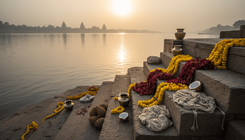
The kumbh mela meaning comes from an ancient story of the gods and demons churning the cosmic ocean together. In that mythological act, a kumbh—a sacred pot—filled with amrit, the nectar of immortality. Several drops fell to earth at four specific places along India's rivers, and the kumbh mela is the great pilgrimage that returns to those sites to mark the memory and blessing of that event. It is the world's largest gathering of pilgrims, and at its heart sits this simple, profound link between myth and geography, between the eternal and the earthly.



The Churning of the Ocean
The story of the kumbh mela begins with Samudra Manthan, the churning of the cosmic ocean. In this episode from Hindu scripture, the gods and demons together churn the ocean using a mountain as a churning rod and a serpent as a rope, seeking to obtain amrit—the nectar that grants immortality. The effort is immense. After centuries of churning, amrit finally emerges from the ocean's depths. When it does, a fierce battle breaks out between the gods and demons, each wanting the nectar for themselves. To protect the amrit and keep it from the demons, the god Indra's son Jayant takes the kumbh and flies away with it, guarded by other celestial beings. The gods pursue, and in the chase, the pot spills. According to tradition, drops of nectar fall at four places on earth where rivers run: Prayagraj in Uttar Pradesh, Haridwar in Uttarakhand, Ujjain in Madhya Pradesh, and Nashik in Maharashtra. The kumbh mela gathers pilgrims at these four sites in a great rotation, returning to each place on a cycle that is tracked by astrology and the positions of the planets.
Four Sites, Four Rivers
The four places where drops of amrit fell are believed to have been blessed by the touch of immortal nectar, making them pilgrimage destinations of profound spiritual power. Prayagraj sits at the sangam, the confluence of the Ganga, Yamuna and the invisible Saraswati rivers. Haridwar lies on the Ganga in the foothills of the Himalayas. Ujjain stands on the Shipra river in central India, and Nashik rests on the Godavari river in Maharashtra. Each site has its own spiritual significance in Hindu tradition, and each becomes a center of pilgrimage when the kumbh mela comes to that place. The gathering at each location brings hundreds of thousands, sometimes millions, of pilgrims who come to bathe in the river during the auspicious dates determined by Hindu astrology and the lunar calendar. The sight of so many people, so many ages and backgrounds, converging on these sacred waters is itself part of the sacred experience. The rivers become the focus of devotion: bathing is an act of purification, surrender and faith in the blessing of that place.
How the Dates Are Determined
The kumbh mela does not follow a simple calendar. Instead, the dates are determined by astrological calculations based on the position of the sun, moon and Jupiter. The principal indicator is the transit of Jupiter through the zodiac—a placement that Hindu astrology calls a rashi. When Jupiter enters a particular sign, or when the sun and moon align at certain angles, the time becomes auspicious for the kumbh mela to begin at one of the four sites. The rotation is roughly twelve years between visits to the same site, though the precise interval varies slightly. This astrological method means that the kumbh mela dates shift relative to the Western calendar each year, but they are held with absolute consistency according to the Hindu lunar calendar and the system of jyotisha, the science of the stars. Sadhus—wandering ascetics and renunciants—use this knowledge to plan their travels, and the wider community of pilgrims marks the dates well in advance. The combination of spiritual belief and astronomical precision is characteristic of Hindu practice: the sacred and the mathematical are held together.
The Pilgrimage and Its Rituals
When the kumbh mela arrives at a place, pilgrims begin to gather weeks in advance. Many come to bathe on the most auspicious dates, which are calculated from the astrological placements. The bathing itself is the central act: pilgrims enter the river in large groups, often organized by their sampradaya (spiritual lineage), their caste, or their region of origin. The act of bathing in these waters is understood to wash away past karma and open the path to spiritual progress. Beyond bathing, the mela is a fair and festival in the fullest sense. Pilgrims camp together, listen to spiritual discourses, attend arti ceremonies at dawn and dusk, and share food and stories. Traders set up stalls selling flower garlands, incense, beads for japa (repetition of mantras), and simple food. Holy men and women from across India gather to teach and to offer blessings. Families come together; children are brought to experience the sacred gathering. The kumbh mela is a living expression of Hindu religious culture: it is at once deeply personal—a moment of prayer and seeking—and deeply collective, a gathering of human will toward the sacred. This combination is part of what makes the experience so powerful for those who attend.
The Spiritual Meaning Beyond the Story
While the story of Samudra Manthan is the foundation, the kumbh mela's true meaning extends beyond the mythological narrative. For pilgrims, the kumbh mela is an opportunity to step outside ordinary time, to gather with others who seek the same spiritual truths, and to align oneself with currents of devotion that have flowed through Hindu culture for centuries. The rivers themselves are honored as sacred presence—the Ganga as a goddess, the waters as carriers of blessing. The four sites are not chosen randomly; each has deep roots in Hindu theology and pilgrimage tradition. To go on kumbh is to say: I belong to this lineage, I seek what my ancestors sought, I offer myself to these waters and this moment. The gathering itself becomes a teaching: the sheer scale of it, the diversity of people, the focused intention of millions moving together, all of this testifies to something larger than individual need. For many Hindus, attending the kumbh mela even once in a lifetime is a cherished spiritual goal, a milestone on the path of devotion.
Common questions
What is the story behind the kumbh mela?
The kumbh mela comes from the story of Samudra Manthan, when gods and demons churned the cosmic ocean together. When amrit, the nectar of immortality, emerged, a battle broke out over it. To protect the nectar, it was carried in a pot that spilled during the flight, and drops fell at four places on Indian rivers: Prayagraj, Haridwar, Ujjain, and Nashik. The kumbh mela returns to these sites to honour that sacred event.
How often does the kumbh mela happen at each location?
The kumbh mela visits each of the four sites roughly once every twelve years, though the exact interval varies slightly because the dates are determined by astrological calculations of Jupiter's position, not by a fixed calendar. The rotation means that at least one kumbh mela is happening somewhere in India every few years.
What happens when you bathe at the kumbh mela?
Bathing at the kumbh mela during the auspicious dates is understood as an act of purification and spiritual progress. Pilgrims believe the waters at these four sacred sites, blessed by the nectar that fell there, wash away past karma and open the path to spiritual advancement. The bathing is both a personal prayer and part of a vast collective offering of devotion.

Related Articles


