
Krishna's Peacock Feather and Flute: What These Symbols Mean
Divine beauty woven into Krishna's form

Aditya Pandey
20 Nov 2026 • 7min
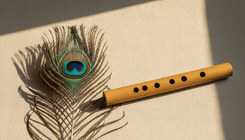
When you see an image of Krishna, two things stand out: the peacock feather in his hair and the flute in his hands. These are not decorations chosen at random. Each one carries meaning that runs through the whole of Krishna's story and teaches something about who he is and why he matters to people who follow him.



The Peacock Feather and Divine Beauty
The peacock feather, or mor pankh, sits at the crown of Krishna's head, often tilted to one side. In Indian tradition, the peacock is a bird of supreme beauty, with feathers that shine and change colour in the light. When Krishna wears it, he is claiming that beauty as his own—not the empty beauty of surface alone, but the radiance of divine presence made visible.
The peacock itself has a long place in Hindu thought. It is sacred to Lakshmi, goddess of abundance and prosperity, and it is the mount of Murugan in South Indian tradition. The bird's ability to absorb poison and remain unharmed has made it a symbol of transformation and spiritual power. When Krishna adorns himself with the peacock feather, he shows that he contains all these qualities: beauty that dazzles, abundance that flows, and the strength to transform what is base into what is luminous.
For devotees, the peacock feather is a sign of Krishna's presence. In temples and homes, a peacock feather on an altar is a way of invoking Krishna specifically. The feather reminds us that divine beauty is not separate from the world but visible within it, if we know where to look. Many devotees keep a peacock feather in their puja space as a focus for meditation and prayer.
The Flute and the Call to Love
The flute that Krishna plays is called a bansuri, and it is made from bamboo—a plant that is hollow, bending, and common. The choice matters. Krishna does not play an instrument of gold or carved from precious wood. He plays something simple and poor, something that any shepherd boy might make for himself. This teaches something important: divinity speaks through the ordinary, and the path to Krishna is open to anyone.
The sound of Krishna's flute is described in the scriptures as irresistible. When he plays, the gopis (milkmaids) and cowherd friends cannot help but move toward the sound. The flute's music is not entertainment; it is a call. It draws the listener out of ordinary life and into something beyond. In this way, the flute represents Krishna's power to summon us toward devotion, to pull our hearts toward the divine.
The flute also carries the meaning of the breath itself. In yogic and tantric thought, the breath is the thread that ties the body to the spirit. When Krishna plays, he is breathing out his love, and when the gopis hear, they breathe it in. The sound passes through the body and touches the heart. For this reason, many bhakti poets and singers have used the image of Krishna's flute as a way of describing the experience of devotion itself—a melting of the separate self into the presence of the beloved.
Both Symbols Together: Beauty and Love United
Alone, the peacock feather speaks of beauty and radiance. Alone, the flute speaks of love and the call to devotion. But Krishna is shown with both because he holds both at once. His beauty is not separate from his love; his love is not separate from his beauty. Together, they tell us that the divine is not distant and cold, not beautiful and empty, not loving but harsh. Instead, it is all at once: radiant, compelling, and endlessly drawing the heart inward.
This combination also reflects the way Krishna appears in different parts of his life. As a child in Vrindavan, he is a figure of mischief and play, often shown with the flute, playing with the other children. As an adult, he is the supreme lord wearing the peacock feather, advising Arjuna on the battlefield of Kurukshetra. The symbols together hold both the playfulness and the majesty, the personal and the cosmic.
How Devotees Use These Symbols Today
In temples across India and in Krishna communities worldwide, these symbols remain central. During festivals like Janmashtami (Krishna's birthday) and Radhastami (the birthday of Radha, Krishna's beloved), devotees dress Krishna's idol with peacock feathers and offer music and song in imitation of the flute. These acts are not mere ritual performance; they are a way of entering into the story, of putting oneself into the scene and experiencing what the gopas and gopis experienced.
Many families keep a picture or small statue of Krishna playing the flute with the peacock feather in a place of honour. These are not objects of superstition but aids to remembrance. Each time a devotee sees them, the image calls to mind what Krishna represents: a divine presence that is both beautiful and accessible, both transcendent and intimate.
The symbols have also moved into poetry, music, and dance. In Bharatanatyam and other classical Indian dance forms, dancers use hand gestures and movements to evoke Krishna with the flute or the peacock feather, telling his stories through the body. In bhakti poetry, especially in Hindi and Bengali traditions, the peacock feather and the flute appear again and again as images through which poets express their longing for Krishna and their understanding of devotion.
Why These Symbols Matter Beyond Ritual
To understand Krishna's peacock feather and flute as mere ornaments or props is to miss their depth. They are teachings in visible form. They tell us that the path to the divine passes through beauty and through love, that divinity is not locked away in temples but plays in the world, and that anyone, high or low, can hear the call and respond. For this reason, they have remained part of Krishna's image for thousands of years, and they continue to guide devotees today toward a way of seeing the world and the sacred within it.
Common questions
Is the peacock feather a real feather or just part of Krishna's crown?
In temples and home worship, devotees often place real peacock feathers at Krishna's altar as an offering and symbol of his presence. In traditional temple worship, a peacock feather may be kept as a sacred object in the sanctum. Whether depicted in art or present physically, the feather is always understood as a representation of Krishna's divine beauty and radiance.
Does Krishna appear with both the flute and peacock feather in every scripture?
No. The peacock feather is most associated with Krishna's form in devotional art and temple iconography, while the flute is particularly central to stories of Krishna's youth in Vrindavan. In some scriptural texts, especially philosophical ones, these symbols appear less prominently than in others. Different regional and sectarian traditions may emphasize one symbol more than the other.
Can I use Krishna's symbols in my own puja if I am not part of a temple community?
Yes. Many individual devotees keep peacock feathers, images of the flute, or paintings of Krishna in their home altar. You can offer flowers, incense, or song to these symbols as expressions of your own devotion. The tradition welcomes sincere practice in the home as much as in formal temple settings.

Related Articles


