
Krishna as Arjuna's Charioteer: The Meaning of the Image
Guide through doubt and duty on the field of life

Sunil Chaurasia
20 Nov 2026 • 6min
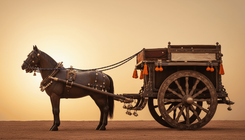
When Krishna took the reins of Arjuna's chariot at Kurukshetra, it was not merely a practical necessity. The image of the divine guide standing at the helm of his friend's vehicle has become one of the most powerful symbols in Hindu thought: the guru driving you forward through confusion, the voice of wisdom calling you to action even when you cannot see the path ahead.



The Setting: Why Krishna Became Charioteer
In the Mahabharata's account of the war at Kurukshetra, Arjuna asks Krishna to position his chariot between the two armies before the battle begins. Arjuna needs to see his enemies clearly—his relatives, his teachers, those he loves. Krishna agrees, and stands at the horses' reins as the armies face each other. What begins as Arjuna's request for a vantage point becomes the occasion for Krishna to offer something far deeper than a battlefield view: a teaching about duty, action and the nature of the self.
The chariot itself is a place of intimacy and instruction. In ancient times, a charioteer was not a servant driving a passenger. He was skilled, trusted, present. He knew the terrain, managed the horses, made constant adjustments. Krishna's role as charioteer places him close enough to Arjuna to speak directly into his ear, to respond to his doubts, to guide him step by step. It is a position of both care and authority.
Arjuna's Crisis: The Moment of Teaching
Arjuna stands ready to fight, his bow in hand, but when he sees the faces of those arrayed against him—his kinsmen, his teachers, his elders—his resolve collapses. He speaks of his confusion, his grief, his unwillingness to act. He asks Krishna what he should do. This is the crisis that opens the door to teaching. Arjuna does not ask for general wisdom; he asks for guidance in a moment when he cannot move, when knowledge and action have become separated.
Krishna's response as charioteer is to stay present. He does not abandon Arjuna to his doubts. He speaks the Bhagavad Gita—not from a distance, but from the driver's seat of the very chariot Arjuna stands in. Every verse is a word spoken to a man in crisis, to someone who must act even without complete certainty. The teaching is not delivered from on high; it emerges between two people, one confused and seeking, the other clear and answering.
The Chariot as a Metaphor for the Self
The Upanishads teach that the human self is like a chariot. The body is the chariot itself; the senses are the horses; the mind is the reins. A charioteer who cannot control his horses is lost. In Krishna's role at Kurukshetra, this teaching becomes visible. Arjuna's inner crisis is reflected in the image of the chariot: he does not know how to direct his own faculties toward action. His horses are wild with emotion. His reins are slack.
Krishna, standing as charioteer, represents the atman, the eternal self within, which is not confused by grief or doubt. He takes hold of the reins—he takes command of the situation—not by telling Arjuna what to feel, but by clarifying what he truly is beneath the turmoil. In the Gita, Krishna teaches that Arjuna is not the doer, but the witness of action. The chariot and horses will move according to their nature. Arjuna's job is not to figure out whether action is right or wrong by counting the outcomes, but to see clearly what he is and act from that clarity.
The Teaching Comes Through Action
Throughout the Gita, Krishna does not tell Arjuna to sit with his doubts or meditate them away. He teaches him that wisdom and duty together require him to act—to pick up his bow, to fight, not from personal desire or hatred, but because that is the dharma, the rightful action, of his position. The charioteer does not remove Arjuna from the battlefield. He clarifies his vision and sends him into it.
This is a radical image: the spiritual guide does not extract you from the world's demands. He stands beside you as you meet them. Krishna's position in the chariot means he too will be exposed to danger, will be part of the action, not safely removed from it. His teaching is not philosophical comfort; it is an invitation to wisdom lived in the thick of life. The chariot stands between two armies. There is no place to hide.
Why This Image Endures
The chariot at Kurukshetra speaks to a question every person faces: How do you act when you are uncertain? How do you move forward when you cannot see all the consequences? What does it mean to be true to yourself in a complicated situation?
Krishna as charioteer offers no escape from that tension. Instead, he offers presence—someone who sees your confusion, knows your nature, and holds the reins steady so you can act with clarity rather than with doubt. He stands close enough to hear your question and answer it directly. He does not make the world simpler; he helps you see what is true within it.
The image has shaped Hindu thought for thousands of years not because it offers easy answers, but because it mirrors a real human experience: the moment when confusion gives way to action, not through certainty, but through trust—trust in a guide who stands beside you, someone who has seen the battlefield and knows the path forward.
Common questions
Why did Krishna stand as charioteer instead of Arjuna's actual charioteer?
The Mahabharata describes Krishna as Arjuna's close friend and devotee. His role as charioteer is a narrative device that places him near enough to speak directly into Arjuna's ear and respond to each of his objections. This closeness and responsiveness—not a separation—is central to the teaching.
Does Krishna teach anything else from the chariot besides the Gita?
The Bhagavad Gita is the main teaching Krishna gives from the chariot. It consists of eighteen chapters of dialogue, in which Krishna addresses Arjuna's doubts about whether to fight. The chariot remains the setting for this entire conversation.
What does the chariot represent spiritually?
The Upanishads describe the chariot as a metaphor for the self: the body is the chariot, the senses are the horses, the mind is the reins. Krishna's role as charioteer represents the atman, the eternal self, which remains clear and unshaken even in moments of crisis and confusion.

Related Articles


