
King Prithu and the Origin of Agriculture
The King Who Taught the Earth to Give

Aditya Pandey
06 Nov 2026 • 6min
The story of King Prithu tells how agriculture came to the earth, and it is one of the Puranas' most vivid accounts of how a ruler's duty creates the conditions for civilisation itself. Prithu was a legendary king whose deeds and spiritual qualities transformed the world, and the tale of his relationship with the earth shows the deep connection between righteous governance and human flourishing.



The Birth of Prithu
Prithu was born through an extraordinary ritual. His father, the tyrant king Vena, had been cursed by the sages for his irreligious ways and his contempt for dharma. When Vena died, the kingdom fell into chaos and famine because the earth, grieving and angry, refused to yield its gifts. The sages called upon the gods to restore order. They performed a ritual churning of the dead king's body, and from this emerged Prithu, fully formed and radiating divine power. His very birth was an answer to prayer—he arrived as the solution to a broken world.
Prithu's name itself came from his father, but he was his father's opposite in every way. Where Vena had mocked the gods and the sages, Prithu showed reverence and wisdom. His emergence marked a turning point: the legitimate king had arrived to restore dharma and set things right.
The King Pursues the Earth
When Prithu took the throne, the kingdom remained barren and starving. The earth, in the form of a cow, was fleeing across the cosmos to escape the suffering of the people. Prithu set out to pursue her with his bow and arrow, determined to catch her and demand that she yield her abundance once more.
The earth, recognising Prithu's righteousness and his unwavering commitment to dharma, stopped running. She appeared before him and revealed the true cause of her refusal: she said that under Vena's reign, she had been constantly plundered without gratitude, and the sacred laws had been trampled. The sages had neglected their duties, the gods had withdrawn their blessings, and the people had forgotten proper conduct. The earth was a mirror of the kingdom's spiritual state, and she could only flourish when order was restored.
Prithu listened with humility. He did not simply demand; he understood. This recognition—that the earth's plenty depends on righteousness and reverence—is central to the Prithu story. The king and the land are bound together spiritually, not just politically.
Prithu Becomes the First Farmer
Prithu then asked the earth what she needed. She told him that the sages must be honoured, the sacrifices must be performed correctly, and the people must live according to dharma. The king himself must lead the way through his own practice of virtue and ritual.
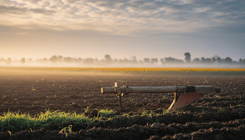
Prithu then took up the plough and became the first farmer. He ploughed the earth with his own hands, using his bow as the plough and his arrow as the ox-goad. As he worked, he blessed the land. Seeds fell from the sky, and where Prithu's plough broke the earth, crops sprang up. The seasons became regular, the rains came reliably, and abundance returned to the world.
The image of the king at the plough is not incidental to the story; it shows that cultivation is a sacred act, a form of sacrifice and service. Prithu did not command others to farm. He performed the work himself, with respect and intention. His labour was penance, service and creation all at once.
The Gifts That Followed
With agriculture established, the kingdom flourished. But Prithu did not stop with the plough. The Vishnu Purana tells that from Prithu's bow emerged all the animals that would serve human need—cows for milk and sacrifice, horses for travel and war, sheep for wool. From his body, the earth herself took physical form as his consort, and he became the cosmic king, the upholder of the wheel of dharma.
Prithu performed great sacrifices that sustained both the human world and the celestial worlds. His reign became a golden age, remembered as the standard of just kingship. The earth was no longer an exhausted victim; she was honoured, cultivated with intention, and made to give her gifts freely because the kingdom had returned to righteousness.
The Legacy of Prithu
The Prithu story appears in the Vishnu Purana and is referenced in other Puranic texts as the template for how a true king should rule. He is often called Prithvi Vallabh, the beloved of the earth. Some traditions honour him as an avatar or divine manifestation sent to restore order when the world had fallen into chaos.
His story teaches that agriculture is not merely a technical matter. It flows from dharma—from righteous conduct, respect for the sacred, and a ruler's commitment to the welfare of all beings. The earth gives when she is honoured; she withholds when she is plundered and disrespected. And the king who wishes to rule well must be willing to take up the plough himself, not stand apart from the labour.
This is why Prithu remains a central figure in Hindu thought about kingship, dharma and the sacred relationship between humans and the earth. He shows that cultivation, governance and spiritual practice are woven together. The lesson still holds: the flourishing of a people depends on right action, and the land responds to virtue.
Common questions
Did Prithu actually exist as a historical person?
Prithu is a legendary figure from the Puranas, not a verified historical person. However, in Hindu tradition he is honoured as a spiritual exemplar and sometimes understood as a divine incarnation sent to restore dharma during a time of crisis. He represents the ideal of righteous kingship rather than a documented historical ruler.
What does Prithu taking up the plough himself teach?
By ploughing with his own hands instead of commanding others, Prithu showed that cultivation is sacred work that a leader must take personally. It demonstrates that dharma is not enforced from above but embodied through the ruler's own labour, humility and service.
Are there festivals or observances honouring King Prithu?
While Prithu is not the focus of major festivals, his story is told and reflected upon during harvest times and in agricultural communities. He is also remembered in contexts of studying righteous kingship, dharma and the sacred relationship with the earth in Hindu learning traditions.

Related Articles


