
Kanya Pujan: Honouring Young Girls as the Goddess
Divine Feminine in Every Child

Kushal K
13 Nov 2026 • 7min
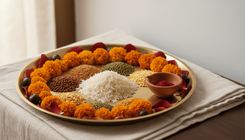
Kanya Pujan is the ritual of worshipping young girls as living embodiments of the divine feminine, observed most prominently on Ashtami and Navami (the eighth and ninth lunar days) during Navratri. On these days, Hindu families invite girls into their homes or temples, wash their feet, feed them sweets and blessed food, and seek their blessings. The practice is based on the belief that during these nine nights dedicated to Devi, the goddess manifests in the form of young girls. To worship them is to worship the divine itself.
The ritual is called by several names depending on region and context. In northern India, it is often referred to as Kanya Pujan. In Punjab and parts of the northern plains, the same practice is called Kanjak. In Bengali tradition, particularly in Kolkata and West Bengal, it is known as Kumari Puja. Despite the different names, the underlying principle remains the same: the goddess Devi lives within every girl child.



The Spiritual Foundation
The Kanya Pujan ritual rests on a principle found throughout Hindu philosophy: that the divine is not separate from creation, but present within all beings. Young girls are chosen for this worship not out of random sentiment, but because childhood is understood as a time of particular spiritual purity and closeness to the divine. In the Devi Mahatmya and other tantric texts, different forms of the goddess are associated with different ages of girls. The nine nights of Navratri correspond to nine forms of Devi, and in some traditions, nine girls are worshipped to represent each form.
The practice also carries the message that femininity and divinity are inseparable. By honouring girls through Kanya Pujan, families and communities affirm that women are not meant to be subservient or marginal, but central to spiritual and social life. This becomes particularly powerful when performed with genuine reverence rather than ritual habit.
How Kanya Pujan is Performed
The ritual usually begins with preparing a clean, decorated space—often a room, a temple corner, or an altar. Girls are invited, typically between two and ten years old, though the exact age varies by family and regional practice. Before the worship begins, their feet are washed with water or milk in a practice called pada prashan. This foot-washing is not merely a gesture of hospitality; it recalls how in Hindu tradition, touching the feet of the divine is a mark of devotion.
After the foot-washing, aarti (a ritual of light) is performed, and the girls are offered bhog—sacred food, often consisting of puri (deep-fried bread), halwa (sweet), and chana (chickpeas), or sometimes khichdi (a rice and lentil dish). These offerings vary by region. Some families also apply tilak (a mark on the forehead) to the girls' foreheads and offer them flowers, gifts, or money. At the end, they are asked to bless the household. Many families bow to touch the feet of each girl before she leaves.
Regional Variations
The ritual takes different forms across India, shaped by local customs and the particular goddess form honoured in each region. In West Bengal during Durga Puja, Kumari Puja is performed on Navami. Nine girls are invited to represent the nine forms of Durga, and after worship, they are fed khichdi, luchi, and labra (a vegetable preparation). This meal is considered particularly auspicious.
In Punjab and Haryana, Kanjak is observed at the end of Navratri, on the tenth day or Dussehra. The name itself comes from kanya (girl) and kanj or kanji (an old grain, though the etymology is debated). The ritual in these regions similarly involves foot-washing, feeding, and receiving blessings. Some families prepare a special meal with barley or other grains as an offering.
In the southern states of Tamil Nadu and Karnataka, similar practices exist but may be framed within local temple traditions or family customs rather than the Navratri cycle. The underlying principle of worshipping the divine feminine through girls remains constant, though the exact timing and offerings may differ.
Why Girls Are Worshipped
The choice to worship young girls is rooted in several strands of Hindu thought. One is the concept of Shakti—the primordial feminine energy that animates all existence. Another is the principle of Prarabdha Karma, the belief that a soul is born into a particular form as a result of past actions. Some traditions teach that souls born as girls in their childhood years have special proximity to divine energy and are capable of bestowing genuine blessings.
There is also a social and ethical dimension. By making girls the focus of worship rather than objects of service, the ritual asserts their value and dignity in a way that extends beyond religious practice into everyday life. It creates a moment where the household must pause, recognise the child as sacred, and treat her with reverence. For the girls themselves, being honoured in this way can be deeply meaningful, affirming their place in both family and community.
The Blessing and Its Meaning
When girls bless the household at the end of Kanya Pujan, this is not understood as a transaction or a performance. In the Hindu worldview, blessings (ashirwad) from a pure or spiritually elevated being are believed to have real efficacy. A child's blessing is considered particularly potent because a child is thought to be closer to truth and less burdened by worldly attachments and ego.
Different girls may be asked to bless different aspects of the household—the health of the family, the prosperity of the home, the education of the children, or protection from harm. Some families ask the girl to place her hand on their head or to touch their chest. The ritual concludes with an exchange of energy understood as real and transformative.
Practising Kanya Pujan Today
Today, Kanya Pujan is practised in homes, temples, and community spaces, though the setting and scale vary widely. Urban families may invite one or two girls from the neighbourhood or extended family. Large temples may host dozens. Some families perform it every year, while others do it occasionally when they are able.
For those wishing to perform Kanya Pujan, the essential elements remain simple: identifying girls to honour, preparing food, performing the ritual with respect and genuine devotion, and seeking their blessings. While elaborate preparations are fine, the practice does not require expensive decorations or complex procedures. What matters is the sincerity with which the divine is recognised and acknowledged in the girls who are welcomed.
Common questions
Can any girl be worshipped in Kanya Pujan, or does age matter?
Girls are typically between two and ten years old, though the exact age varies by family and regional practice. Some traditions prefer very young girls, while others are flexible. What matters is that the child is old enough to understand and accept the blessing respectfully.
What should I feed the girls during Kanya Pujan?
Common offerings include puri, halwa, and chickpeas in the north, or khichdi, luchi, and labra in West Bengal. Different regions have different traditions. You can also offer simple sweets or fruits—the specific food is less important than the gesture of feeding the girls with respect.
Is Kanya Pujan only a Navratri practice?
While Kanya Pujan is most prominent during Navratri's Ashtami and Navami, some families and traditions observe it at other times of the year when honouring the goddess. However, Navratri remains the main occasion when it is widely practised across India.

Related Articles


