
Kanya Pujan: Honouring Young Girls as the Goddess
The divine feminine in every child

Kushal K
13 Nov 2026 • 6min
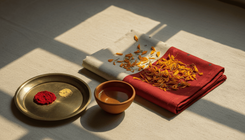
Kanya pujan is a ritual in which young girls are worshipped as living manifestations of the Devi, the divine feminine, during Navratri. The word kanya means girl, and pujan means worship. On the ninth day of Navratri, known as Dussehra or Vijayadashami, or sometimes on Ashtami (the eighth day), a family invites girls from their household or community, treats them as embodiments of the goddess, and offers them prasad—food that has been blessed. This ritual appears across India, particularly in the north, with regional variations in how it is observed.
The practice emerges from a belief central to Hindu philosophy: that the divine is present in all living beings, and especially that girls and women carry the shakti, or energy, of the goddess. During Navratri, when the nine forms of Devi are worshipped over nine days, kanya pujan makes that belief concrete by inviting the presence of the goddess into the home through these young girls.



The Nine Forms and Their Meaning
Each day of Navratri celebrates a different form of Devi, and the ritual of kanya pujan honours all nine together. The nine girls invited to the home are sometimes called Kanya, Rohini, Chandrika, Shailputri, Brahmacharini, Chandghanta, Maghavi, Kanyakumari and Shamavi, each associated with a form of the goddess. However, this naming is not universal—the girls are primarily recognized as vehicles for the goddess's presence, rather than as distinct personalities. The number nine carries its own significance; nine represents completion and the full power of the goddess spread across the cosmos.
In some traditions, the girls are seen as embodiments of the nine shakti peeths, the sacred sites said to be scattered across the Indian subcontinent where the goddess's energy is concentrated. By welcoming them into the home, a family is drawing that cosmic energy into their own space.
Preparing for Kanya Pujan
The preparation for this ritual usually begins a few days before Ashtami or Navami. The home is cleaned thoroughly, and an altar or worship space is arranged with flowers, images of the goddess, and offerings. The girls to be invited are typically aged between two and ten years old, though the age range varies by family and region. Some traditions invite nine girls to represent the nine forms; others may invite just four or five.
In some homes, one girl is chosen to represent Kanyakumari, the virgin form of the goddess, and is treated with particular reverence. Clothes and ornaments are prepared for the girls, and the meal is planned in advance. The food offered in kanya pujan is always vegetarian and often includes kichdi (a simple rice and lentil dish), aloo (potatoes), halwa (a sweet semolina pudding), puri (fried bread), and sometimes chole (chickpeas). The specific menu varies by family tradition and region.
The Ritual Itself
When the girls arrive, they are seated in a row, usually on a mat or on the floor. Their feet are washed with warm water as an act of reverence—this is a key moment that marks the girls as sacred guests rather than ordinary visitors. Tilak (a mark) is applied to their foreheads, often made with vermillion or sandalwood paste, and a garland of flowers may be placed around their necks.
Next, the family members, usually the women and elders, perform aarti before the girls, moving a lamp in a circular motion in front of them as a form of worship and blessing. During this time, a mantra or devotional song may be sung. After the aarti, the girls are offered the specially prepared meal. It is important that the girls eat at least some of the food offered; this is believed to complete the transmission of the blessing from the goddess.
Some families ask each girl to place her hand on younger children's heads or on the heads of family members, bestowing blessings. The girls are then given gifts—these might be clothes, bangles, books, or money—as tokens of gratitude and respect. Before the girls leave, they often receive more prasad wrapped to take home.
Regional Variations
Kanya pujan is observed with different emphases across India. In North India, particularly in Uttar Pradesh, Delhi, and Punjab, the ritual is often called Kanjak or Kanjeevak, and it marks the eighth or ninth day of Navratri. Here, the nine girls are invited together, and the ritual follows a fairly consistent pattern across families.
In West Bengal and Assam, a similar ritual called Kumari Pujan forms part of the Durga Puja celebrations, though the exact timing and customs differ. In some regions, the ritual is performed on the day immediately before Diwali, making it the last major observance of the Navratri period. In Gujarat and Maharashtra, the timing and some elements of the ritual may also vary, though the core practice remains similar.
In parts of South India, the practice takes different forms. Some communities perform similar worship of young girls during Navratri, while others mark the same period with different rituals focused on the goddess. The underlying principle—that the divine dwells in the young—is shared across regions, but the expression of that belief takes many forms.
The Meaning Behind the Practice
At its root, kanya pujan teaches that divinity is not distant or confined to temples and idols. It lives in the people around us, and particularly in the young, who embody potential and new life. By worshipping girls, the ritual affirms the value and sacredness of women and girls in a society where they have historically held limited power.
The gesture of washing the feet and offering food and gifts is also an act of humility on the part of the worshippers. Those who perform kanya pujan are acknowledging that the divine principle they revere exists beyond their own control, and that meeting it with reverence and service is the proper response.
For the girls involved, kanya pujan can be a memorable moment in which they feel honoured and seen. In many cases, it offers a concrete experience of being valued and blessed, which carries meaning that extends far beyond the ceremony itself.
Common questions
How many girls should I invite for kanya pujan?
Many families invite nine girls to represent the nine forms of the goddess, but the number can be fewer—four or five girls is also common. There is no rigid rule; the choice depends on your family tradition and how many girls you have access to invite.
What is the difference between kanya pujan and kumari puja?
Kanya pujan and kumari puja are largely the same ritual, with regional names. Kanya pujan is the term used in North India, while kumari puja is common in Bengal and eastern regions. Both honour young girls as manifestations of the goddess during Navratri.
What if I do not have young girls in my family to invite?
You can invite girls from your extended family, neighbourhood, or community. The ritual can also be performed with the image or idol of the goddess if no girls are available, though inviting living girls is considered more potent and is preferred when possible.

Related Articles


