
Kansa Vadh 2026: Why Mathura Celebrates Krishna's Victory
When the tyrant fell to the one he feared most

Abhilash Ramakrishna
25 Oct 2026 • 7min
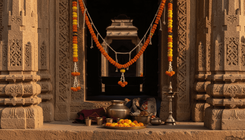
Kansa Vadh marks the day when Lord Krishna defeated the tyrant king Kansa in the city of Mathura. This annual observance celebrates Krishna's victory over a ruler who had tormented his family and his people for years. In 2026, this event will be observed according to the lunar calendar as it is every year. The day recalls one of the most pivotal moments in Krishna's early life and remains deeply significant in the devotional traditions of northern India, particularly in Mathura and the surrounding Braj region.



The Tyrant and the Prophecy
King Kansa was the maternal uncle of Krishna's mother Devaki. A prophecy had foretold that Devaki's eighth child would bring about Kansa's downfall, and the king became consumed with fear and paranoia. He imprisoned his sister and her husband Vasudeva to prevent the prophecy from coming true, killing each of their children as they were born. Despite his vigilance, Krishna was born and secretly spirited away to safety in the cowherd village of Gokul, where he grew up far from Kansa's reach. For years Kansa's dread deepened, knowing that the child destined to end him was growing in strength somewhere beyond his control.
The story of Kansa captures a fundamental tension in dharma: the righteous and the unrighteous cannot coexist indefinitely. Kansa was not merely a flawed ruler; his tyranny had become the defining feature of his reign. He harassed the people, abused his power, and lived in constant fear of the unknown. His story is a reminder that unchecked cruelty and injustice eventually draw a response from the cosmic order itself.
The Battle in Mathura
When Krishna reached manhood, he and his brother Balaram travelled to Mathura, ostensibly to attend a wrestling festival that Kansa had arranged. This was Kansa's trap: he believed he could finally confront and kill the boy he had come to dread. Instead, the festival became the stage for his reckoning. Krishna faced and defeated the strongest wrestlers Kansa sent against him, then confronted the king himself in single combat.
The battle between Krishna and Kansa is depicted in the devotional texts not as a mere fight between two warriors, but as a cosmic struggle between dharma and adharma, righteousness and unrighteousness. Krishna's victory was swift and complete. The tyrant who had plotted so carefully for years was defeated by the very nephew he had sought to destroy, the child he believed he had prevented from being born.
After Kansa's death, Krishna restored legitimate rule to Mathura by placing Kansa's father Ugrasena back on the throne. This act underscores a crucial aspect of Krishna's character: his role was not simply to destroy evil, but to restore proper order and governance. The victory over Kansa was not an end in itself, but the beginning of Krishna's work to establish dharma.
Observance in Mathura and Braj
Kansa Vadh is observed with particular devotion in Mathura, the city where the events unfolded, and throughout the Braj region where Krishna spent his childhood and adolescence. The day is marked with prayers, temple gatherings, and recitations of Krishna's stories in the local temples and sabhas, or community halls. Devotees visit temples dedicated to Krishna, particularly the Krishna Janmasthan temple in Mathura, which marks the site of Krishna's birth, and other sacred spaces associated with his early life.
The observance blends joy and reverence. There is jubilation at the victory of dharma, but also a recognition of the gravity of what was at stake. In many communities, the day is observed with fasting or dietary restraint as a spiritual practice, deepening one's connection to the divine play and intention behind Krishna's actions. Some temples hold special aarti, or ritual worship, and offer devotional music and singing through the day.
The date of Kansa Vadh is determined by the lunar calendar and typically falls in the month of Bhadrapada (August-September), though the exact date shifts from year to year. Many families mark it as a day of reflection on the themes of Krishna's life: the eternal struggle between justice and injustice, the presence of the divine in unexpected forms, and the ultimate victory of truth.
Regional Variations and Practices
The way Kansa Vadh is observed varies across different regions and sampradaya, or spiritual lineages. In some communities it is a day of solemn prayer and fasting. In others, it is celebrated with more festive overtones, as a reminder that the forces of dharma will ultimately prevail. Temple observances may include the retelling of the Kansa Vadh story through kirtans, devotional songs that bring the narrative alive for the listeners.
Some practitioners observe Kansa Vadh as part of their broader devotional practice to Krishna, while others mark it more casually as a cultural and religious event. The flexibility of how the day is observed is itself part of the tradition: there is no single prescribed way, but rather a space for individual devotion and family custom to find expression.
In Mathura itself, the day holds special significance as it commemorates events that literally shaped the city's spiritual character. Pilgrims often time their visits to Mathura to be there during Kansa Vadh, understanding it as an opportunity to connect with Krishna at a moment when his presence in the city feels particularly vivid.
Why This Victory Still Matters
The story of Kansa Vadh remains central to Krishna's narrative not because it is historically remote, but because it speaks to perennial human concerns. Every person encounters moments where injustice seems entrenched and change appears impossible. The story reminds us that the arc of dharma, though sometimes long, does bend toward justice. It is also a story about duty: Krishna acted not out of personal anger toward his uncle, but out of his obligation to restore right order in the world.
Kansa Vadh invites reflection on the nature of power and protection. Kansa believed that imprisoning his sister and killing her children would secure his throne. Instead, his very attempts to prevent the prophecy accelerated its fulfilment. The story teaches that fear-driven rule is unstable and that resistance to natural order leads only to suffering.
For devotees today, Kansa Vadh is an opportunity to reconnect with these timeless themes through ritual and reflection. Whether through temple worship, fasting, or simply remembering the story with intention, the day keeps alive the understanding that dharma is not abstract but embodied, that righteousness eventually triumphs, and that divine grace can arrive in the form we least expect.
Common questions
When is Kansa Vadh celebrated in 2026?
Kansa Vadh is observed according to the lunar calendar and typically falls in the month of Bhadrapada (August-September), with the exact date shifting from year to year. Check a lunar calendar or temple announcements for the precise date in 2026.
What do people do on Kansa Vadh?
Observance varies by region and family practice. Many devotees visit temples, particularly in Mathura, attend prayer gatherings and kirtans, and may observe fasting or dietary restraint. Some communities celebrate with special aartis and recitations of Krishna's stories.
Is Kansa Vadh celebrated outside Mathura and Braj?
While most prominent in Mathura and the Braj region, Kansa Vadh is observed by Krishna devotees in communities across India and beyond. The extent and style of observance depends on local sampradaya and individual practice rather than a uniform national celebration.

Related Articles


