Jaanu Vakshasana
The Knee-to-Chest Balance Pose
Shanti Arunkumar
24 Jul 2025 • 6min
Embracing the Still Point
In the fast-paced rhythm of daily life, balance—both physical and emotional—often becomes elusive. Jaanu Vakshasana, or the Knee-to-Chest Pose, serves as a quiet reminder that stability can be cultivated through stillness. A deceptively simple standing posture, it calls upon our core strength, focus, and breath to find equilibrium—literally and metaphorically.
This asana might seem like a basic lift-and-hold, but within its stillness lies a potent opportunity to develop proprioception (body awareness), postural alignment, and above all, balance. It challenges the practitioner to rise above the natural wobble, gently training the body to stand tall and rooted like a tree, even while drawing inward in a protective embrace.
There is something profoundly introspective about standing on one leg, holding the other knee close to the chest. It invites us to become aware of our centerline, to align breath with posture, and to shed the outer noise for a moment of inner quietude. The lifted knee not only strengthens the hips and engages the abdominal muscles—it also encourages us to emotionally “hug” ourselves, reclaiming a sense of grounding from within.
Balancing postures like Jaanu Vakshasana awaken our inner compass. They teach patience, reveal imbalances, and over time, rewire the body's natural instincts to stabilize, adapt, and hold firm. With practice, this pose becomes more than a physical feat; it becomes a metaphor for life—where balance is not a given, but a daily act of gentle recalibration.
Whether you’re a beginner learning to steady your breath or a seasoned practitioner refining your poise, this posture serves as an invitation: to pause, to connect, and to stand your ground—with grace and quiet strength.
How to Perform Jaanu Vakshasana
Begin in Tadasana (Mountain Pose)
Stand tall with feet together, spine long, and arms resting gently by your sides. Distribute your weight evenly across both feet.
Shift the Weight
Gently shift your body weight to your left foot, grounding it firmly into the mat.
Lift the Right Knee
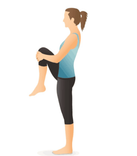
On an inhalation, bend your right knee and slowly lift it up toward your chest. Keep the knee facing straight ahead.
Hug the Knee
Interlace your fingers around your right shin and gently hug the knee toward your chest. Avoid slouching—keep your spine erect, chest lifted, and shoulders relaxed.
Focus Your Gaze
Fix your gaze on a still point in front of you—this drishti helps to stabilize your balance.
Engage Your Core
Activate your abdominal muscles to support your lower back and maintain your center.
Breathe and Hold
Hold the position for 5–7 deep breaths, or up to 30 seconds. Feel the steadiness in your standing leg and the softness in your upper body.
Release and Repeat
Exhale as you gently lower your right foot back to the mat and return to Tadasana. Repeat the pose on the opposite side.
Balance-Building Benefits
Strengthens the Standing Leg: The grounded leg builds strength in the calf, thigh, and hip muscles, enhancing lower body stability.
Enhances Core Engagement: The need to stabilize while lifting the other leg activates deep core muscles, improving posture and spinal integrity.
Trains Focus and Stillness: The mental clarity required to hold the pose hones concentration, making it excellent for cultivating mindfulness.
Improves Coordination and Body Awareness: With regular practice, proprioception improves—helping the practitioner become more aware of their body in space.
Deepens Breath Control: Controlled breathing during the hold trains the lungs to function efficiently even during muscular effort.
Do's and Don’ts
Do’s
- Keep your gaze fixed on an unmoving object to improve balance.
- Engage your abdominal muscles to prevent swaying or tipping over.
- Use a wall for support if you're new to balance-based asanas.
- Practice barefoot on a firm, non-slippery surface.
Don’ts
- Do not hold your breath while balancing—keep your breath slow and even.
- Avoid locking the knee of the standing leg; keep a micro-bend to protect the joint.
- If you feel strain in the lower back, avoid pulling the knee too close.
Contraindications
Vertigo or balance disorders: Those with conditions affecting equilibrium should perform the pose with guidance or near support.
Recent hip, knee, or lower back injury: Seek medical advice before attempting this posture.
Pregnancy (third trimester): Avoid standing balancing poses unless practiced regularly with guidance.
Rooted in Breath, Lifted by Focus
Jaanu Vakshasana is not merely an act of lifting the knee—it is a conscious choice to center oneself amidst inner tremors. With each practice, we train our body to stabilize under pressure and our mind to remain anchored amidst distraction. This pose teaches us a deeper life lesson: true balance comes not from rigidity, but from aligned intention, core strength, and breathful awareness.
By holding one knee close to the heart, we symbolically draw our attention inward, creating a moment of deep connection with the self. We are reminded that balance isn’t about perfection—it’s about presence. Wobbling is part of the journey; the ability to correct, to realign, and to stay with the process is what transforms effort into grace.
Over time, Jaanu Vakshasana helps build a quiet resilience—a mental stillness that extends beyond the mat. It empowers us to face daily chaos with calm determination and to trust the foundation we’ve built within ourselves.
Let Jaanu Vakshasana be a gentle yet powerful step in your journey toward unwavering steadiness—on the mat and in life. In its embrace lies a whisper of stillness, a breath of clarity, and the enduring strength to stand tall through every sway.

Related Articles