
How to Read a Panchang: A Beginner's Guide to the Columns
Decode Time With India's Sacred Almanac

Kushal K
16 Nov 2026 • 8min
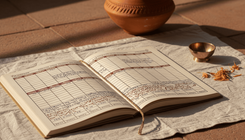
A panchang is India's traditional almanac, and learning how to read it opens up the rhythms that guide Hindu practice and daily life. The word panchang means "five limbs", and these five columns—tithi, nakshatra, yoga, karana and vara—form the foundation of the system. Each column tracks a different cycle in the lunar and solar calendar, and together they tell you what day it is, what energies are at work, and which times are suitable for different activities. If you have a panchang in front of you but have never read it, this guide will walk you through each column so you can use it with confidence.



The Five Columns of a Panchang
A panchang has five core columns, each showing one of the five limbs. The columns normally appear in this order: vara (the day of the week), tithi (the lunar day), nakshatra (the constellation), yoga (an auspicious quality), and karana (half a lunar day). Some panchangs add extra information like sunrise and sunset times or notes about important festivals, but these five are what every panchang contains. The columns repeat and cycle through their patterns at different rates, so a given date will have a particular combination of all five that you will not see again for many years. This combination is what makes each day unique and suitable for different purposes.
Vara: The Day of the Week
Vara is simply the day of the week: Monday, Tuesday, Wednesday, Thursday, Friday, Saturday or Sunday. In Sanskrit, these are Somvar, Mangalvar, Budhvar, Guruvar, Shukravar, Shanivar and Ravivaar. Each vara is associated with a planet and carries its own qualities. Monday is ruled by the Moon, Wednesday by Mercury, Friday by Venus, and so on. You will see these associations used in Hindu practice: Monday is often a day for Moon-related rituals and fasting, Friday for Venus-related activities like marriage planning. Vara is the easiest column to read because it follows the same seven-day pattern you are already familiar with, but knowing the Sanskrit names and their associations deepens how you use the panchang.
Tithi: The Lunar Day
Tithi is the lunar day, and it is the most important column for ritual timing. The lunar month is divided into 30 tithis, not 30 calendar days. A tithi ends when the Moon moves 12 degrees ahead of the Sun, which takes about 24 hours but sometimes less and sometimes more. The tithis are numbered 1 to 15 in the bright half of the month (the waxing moon) and 1 to 15 in the dark half (the waning moon). The bright half runs from the new moon to the full moon, and the dark half from the full moon to the next new moon. You will often see tithi written as a number with a suffix like "Shukla Tritiya" (the third tithi of the bright half) or "Krishna Dasami" (the tenth tithi of the dark half). Many rituals and fasts are tied to specific tithis rather than calendar dates. Ekadashi (the eleventh lunar day) is sacred for fasting, and many festivals occur on particular tithis that shift across calendar dates each year.
Nakshatra: The Lunar Mansion
Nakshatra is the constellation or lunar mansion the Moon is passing through on that day. There are 27 nakshatras in the Hindu system, each spanning an arc of 13 degrees and 20 minutes across the sky. You will see them written as names like Ashwini, Bharani, Krittika, Rohini and many others. Each nakshatra has its own character and qualities, and learning them takes time, but a beginner only needs to know that your birth nakshatra (the one the Moon was in when you were born) is considered especially significant in astrology. Some panchangs show nakshatra alongside a half-moon symbol or a number from 1 to 27. Nakshatra matters less than tithi for most everyday rituals, but it is important for auspicious timing of major life events and for understanding your own lunar nature.
Yoga: The Auspicious Quality
Yoga in this context does not mean physical postures; it means a quality or state of auspiciousness. Yoga is calculated by adding the degrees of the Sun and Moon together. There are 27 yogas, and each one carries a particular character—some are very auspicious, some are neutral, and some are considered inauspicious. A yoga lasts about 24 hours. You might see a yoga marked as "Auspicious" or "Neutral" or "Malefic", and knowing this helps you decide whether a particular day is good for beginning something important. Many people consult the yoga before starting a journey, beginning a new project, or buying something significant. A pandit or astrologer can give you more detailed advice about each yoga, but the panchang often flags the most important ones with simple labels.
Karana: The Half-Lunar Day
Karana is half of a tithi, so there are two karanas in each tithi and 60 karanas in a full lunar month. Karana is the least commonly used of the five limbs in daily life, but it is included in the panchang for completeness and for detailed astrological work. Karana matters most when you need to time something very precisely—an astrologer might use karana to find the exact hour within a tithi that is best for a ritual. As a beginner, you can note the karana column but focus your attention first on tithi, vara and nakshatra, which are more widely used in practice and easier to learn.
Using Your Panchang in Practice
Now that you know what each column contains, you can begin using a panchang for planning your spiritual practice and daily life. Many people check the tithi before deciding to fast or perform a puja, or look at the nakshatra to time an important event. The vara tells you which day of the week it is and what its planetary associations might be. The yoga helps you choose auspicious times for new beginnings. You will find that reading a panchang becomes easier with practice, and soon you will be able to glance at it and sense the energies of the day. Start by learning one column well—most people begin with tithi—and add the others as they become familiar. A panchang is not meant to make decisions for you, but to help you align with the natural rhythms that Hindu tradition recognises and works with.
Where to Find a Panchang
Panchangs are widely available in print, online, and as apps. Many temples distribute free printed panchangs at the start of the year. Online sites and apps offer panchangs that you can check any day, and some allow you to set your location so that sunrise and sunset times are accurate for where you live. When you choose a panchang, make sure it is from a reputable source, as the calculations must be done correctly to be useful. Once you have a panchang you trust, keep it handy when you plan rituals, fasts, and important events. Over time, reading it will become second nature, and you will find yourself working naturally with the cycles it maps.
How to read a panchang
- Find the date you want Locate the calendar date you are interested in. Most print panchangs show one date per line or per page. Online panchangs or apps allow you to search or scroll to any date.
- Read the vara column The vara is the day of the week. Identify which of the seven days it is and note any practices or associations you know for that planetary day.
- Check the tithi Find the tithi for that date. If you are planning a fast or ritual, this is the column to check first. Note whether it is in the bright half (Shukla) or dark half (Krishna) of the month.
- Look at the nakshatra Identify the nakshatra the Moon is in. If you know your birth nakshatra, you might note when the Moon passes through it. Otherwise, note if the panchang flags it as significant.
- See the yoga Check whether the yoga is marked as auspicious, neutral or inauspicious. This helps you assess whether the day is favourable for beginning something important.
- Note any special information Some panchangs include sunrise and sunset times, planetary positions, or notes about festivals and observances. Read any notes or flags for that date.
Common questions
What does panchang mean?
Panchang means five limbs or five parts. It refers to the five core columns—tithi, nakshatra, yoga, karana and vara—that make up a traditional Hindu almanac.
Why do festival dates change every year?
Festivals are tied to lunar tithis and nakshatras, not to calendar dates. Since the lunar month and the solar calendar do not align perfectly, a festival that falls on a particular tithi will shift across calendar dates from year to year.
Which column in a panchang is most important for beginners?
Tithi is the most widely used column for timing rituals and fasts. Starting with tithi gives you immediate practical use of the panchang before learning the other columns.

Related Articles


