
How to perform Lakshmi puja at home on Diwali
Wealth and blessing flow where light is welcomed

Sunil Chaurasia
09 Nov 2026 • 6min
What Lakshmi puja at home means
Lakshmi puja during Diwali is an invitation. On the new moon night of the month of Kartik, families gather to welcome Lakshmi—the goddess of prosperity, abundance and auspiciousness—into their homes. The practice is rooted in the belief that Lakshmi moves through the world on this night, and a home that is clean, lit and prepared with reverence receives her blessings. This is not transactional: the puja expresses gratitude for what you have and creates the mental and physical space for growth. Lakshmi puja at home transforms a room into a place of intention and devotion. Many families also perform Ganesha puja alongside Lakshmi puja, since Ganesha removes obstacles before any new endeavour begins.
Performing the ritual at home, rather than in a temple, makes it intimate and personal. Your own altar, your own offerings, your own words—this closeness deepens the practice. The puja need not be elaborate to be meaningful. What matters is sincerity, cleanliness and the will to prepare.



Preparing your altar and space
Begin by choosing a clean, quiet corner of your home where you will not be disturbed. Many families set up their altar in the prayer room, the living room, or even a shelf in the kitchen. Wash the area thoroughly, as cleanliness is fundamental to puja. Some people sprinkle water mixed with turmeric or rose water to sanctify the space.
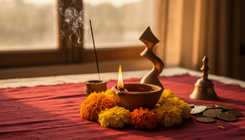
Arrange a low wooden platform or table as your altar. Cover it with a clean cloth, traditionally a red or yellow one. In the centre, place an image or statue of Lakshmi, and if performing Ganesha puja too, place Ganesha to the left or in front. You can use a printed image if you do not have a statue. Arrange around them the items you will need: a small oil lamp (diya), flowers, incense, and the offerings. A small bowl of water and another of rice sit ready for ritual use.
Some families light the main lamps around their home before the puja begins—in windows, doorways and on the porch. This transforms the whole house into a welcoming space. Others keep the room softly lit during the ritual, with just the diya burning brightly at the altar. Both approaches honour the festival.
The steps of the puja itself
The puja begins with an invocation. Many people chant "Om Namah Shivaya" or "Om Namah Lakshmi Mata" to centre themselves and call in the presence of the divine. Some families recite the Lakshmi Chalisa, a hymn of forty verses, while others offer their own prayers in their own language.
After the invocation, you purify yourself and the space. Sprinkle water lightly around the altar with your right hand. This act of sprinkling symbolises cleansing. Some families light incense now; the rising smoke is believed to carry prayers upward.
Place flowers at the feet of the image—marigolds and roses are traditional. Offer rice grains, coconut, or sweets such as laddu. These offerings represent the bounty of the earth and the sweetness you invite into your home. Many people also place a coin or note at the altar as a symbol of prosperity and as gratitude for abundance already received.
Light the diya in front of the image. As you do, you might whisper a personal prayer or intention. Some people sit quietly here for a few minutes, holding their gratitude and their hopes. Others sing a devotional song or listen to devotional music.
When you feel the puja is complete—there is no fixed time, and this is between you and your intention—perform aarti. Hold the diya close to the image in a circular motion, moving it clockwise. Then move the lit diya to each member of the household present, so that the lamp's blessing touches each person. The aarti concludes the ritual in most home practices.
Items you will need
Gather these items before you begin, so you are not interrupted during the puja:
- An image or statue of Lakshmi
- A small oil lamp or diya
- Oil and a wick (or ready-made diyas)
- Flowers, preferably marigolds or roses
- Incense sticks or dhoop
- Rice grains or sesame seeds
- Coconut (whole or shredded)
- Sweets such as laddu, barfi or kheer
- Coins or a note
- A small bowl of water
- A clean cloth for the altar
- A bell (optional, but many families ring it during the ritual)
Many families shop for these items together in the days before Diwali, making the preparation itself part of the devotion.
After the puja: distribution and reflection
After the aarti, the ritual is not finished—it extends into your household. Distribute the sweets and coconut among family members as prasad, blessed food that carries the offering forward. Eat together if you can. Some families give some of the prasad to neighbours or friends, spreading the blessing beyond the home.
This is also a moment to reflect. What are you grateful for? What do you hope to nurture in the year ahead? Lakshmi puja invites you to think not just about money, but about the resources that matter: time, health, relationships, creativity. Prosperity in the fullest sense includes all of these.
Keep the flowers and ashes from the diya at the altar until the next morning. Some people scatter them in running water or in a plant pot. The lamp might remain lit through the evening, or you might relight it each evening for a few days. There is no single rule here; families develop their own rhythm.
Performing Lakshmi puja at home connects you to millions of others doing the same ritual on the same night, each in their own way, each holding their own intention. That shared attention, repeated year after year, is part of what gives the practice its power.
Common questions
What time should I perform Lakshmi puja on Diwali?
There is no fixed time, but most families perform puja in the evening after dusk. Your local temple or the panchang for your region may suggest a more auspicious time window, but the intention and preparation matter more than the exact minute. Perform it whenever your household is ready and undisturbed.
Can I do Lakshmi puja alone, or must the whole family be present?
You can perform puja alone, and it is equally valid. However, many families choose to do it together for the shared intention and closeness. If some family members are away or unable to be present, proceed without them—there is no loss of power in that.
What should I do if I don't have a statue of Lakshmi?
A printed image or photograph of Lakshmi works just as well. You can find images online or use a calendar picture. Some families also perform puja to an empty space at the altar, focusing purely on intention. The form of the image matters less than the reverence with which you approach the ritual.

Related Articles


