
How to perform ghatasthapana at Navratri: establishing the kalash
Seeds of the sacred year, planted in clay

Aditya Pandey
18 Nov 2026 • 7min
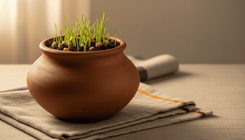
Ghatasthapana is the ritual establishment of a clay pot—the kalash—at the start of Navratri. This is how the festival begins: you plant seeds and invite the energy of Devi, the goddess, into your home for the nine days ahead. The practice is ancient and widespread across India, rooted in both agriculture and devotion.
On the first day of Navratri, which falls during the month of Chaitra (March-April) in spring or Ashwin (September-October) in autumn, families perform ghatasthapana to mark the festival's opening. The kalash, a metal or clay vessel, becomes the focal point of worship for the next nine days.



Why the kalash matters
The kalash is not merely a decorative object. In Hindu tradition, it represents the cosmos itself: the pot is the body of the universe, and water fills it as the cosmic waters from which all life emerges. When you establish a kalash during Navratri, you are symbolically inviting the presence of the divine mother into that vessel and into your home.
The seeds you plant inside grow green shoots over the nine days—what is called jwarey or jawar. These tender shoots become an offering to Devi on Dussehra, the tenth day when Navratri concludes. That they grow in the presence of the deity during those nine days makes them sacred. Many families later plant these shoots in their gardens or fields, carrying the blessing forward into their crops and homes.
Ghatasthapana also marks the start of the seasonal turn. In spring, as the earth awakens and planting season arrives, the ritual honours that renewal. In autumn, as the harvest nears, it invokes abundance. The two Navratri celebrations thus anchor the agricultural year itself.
Setting up the kalash: what you need
Gather these items before you begin:
- A clay pot or brass kalash (either works; clay is traditional)
- Soil or sand to fill it
- Seeds: usually barley, wheat or mung bean seeds
- Water
- A small platform, low table or stool to place the kalash on
- Oil lamp, incense and flowers (for worship)
- A cloth or small mat to place beneath the pot
Some families use the same kalash each year. If you do, clean it thoroughly with water before the festival. You can also use a new terracotta pot; this adds freshness to the ritual.
Choose a spot in your home that feels like the heart of it: often the puja room or altar, but a clean corner of the main room works as well. The kalash should be elevated slightly, on a table or platform, so it sits above the ground level of the household. This placement shows respect and keeps the pot from being accidentally disturbed during the nine days.
Planting the seeds
Fill the kalash three-quarters full with soil or sand. If you are using sand, moisten it lightly with water first so it holds together. Press the seeds into the soil—barley, wheat or mung—distributing them across the surface. Then cover them loosely with another layer of soil, about half an inch thick.
Water the soil gently until it is moist but not waterlogged. The seeds should sprout within two or three days and grow into tender green shoots by Dussehra. Water the pot every day or every other day, depending on your climate. In warmer regions, you may need to water more often. In cooler regions, less. The soil should feel damp to the touch but not soggy.
Some families perform a small worship ceremony as they plant the seeds, chanting the names of the goddess or simply offering an intention of growth, health and blessing over the coming year. This step is personal; what matters most is the care with which you tend the kalash.
Worshipping the kalash during Navratri
Once the kalash is established, it becomes a focus for daily worship throughout the nine days of Navratri. Each morning or evening, you may light a lamp near it, offer flowers, and recite prayers or chants honouring Devi. Some families perform a simple puja, while others simply bow before the kalash and offer flowers.
The act of tending the kalash—watering it, watching the shoots grow—becomes a form of worship in itself. You are nurturing life in the presence of the divine. This quiet attention is as much a part of Navratri as any formal ritual.
Different regions have different customs. In some parts of North India, the kalash remains the centre of worship throughout the nine days, with all other rituals oriented around it. In the South, the kalash is often placed alongside idols of the goddess or other ritual objects. In Gujarat, the first day of Navratri marks the start of Garba and Dandiya dances, and the kalash is honoured at the start of the dancing circle. The core practice remains the same: the kalash is the threshold between the human and the divine during these nine days.
On Dussehra: completing the cycle
When Navratri ends, on Dussehra or Vijayadashami, the green shoots are harvested. Many families place them on the ears of family members as a blessing, or they distribute them among friends and relatives. Others plant the shoots in gardens or fields, or immerse them in water as a final offering.
The kalash itself may be emptied and stored for use next year, or the soil and any remaining plant material may be scattered in a garden. Some families prefer to discard the old pot and begin with a fresh one the following year, symbolising renewal.
This closing ritual completes the cycle that ghatasthapana begins. What was planted in faith is harvested with gratitude, and the blessing is carried forward into the world.
Perform ghatasthapana
- Gather and prepare the kalash Collect a clay pot or brass kalash, soil or sand, seeds (barley, wheat or mung bean), water, a platform to elevate it, and ritual items like oil lamp and flowers. Clean the pot if reusing one from a previous year, and choose an elevated, clean spot in your home.
- Fill and moisten the soil Fill the kalash three-quarters full with soil. If using sand, moisten it lightly first. Gently water the soil until it is damp but not waterlogged.
- Plant the seeds Distribute seeds across the soil surface and cover them loosely with another half inch of soil. Water gently again. You may recite a prayer or intention as you plant.
- Establish the kalash with worship Place the kalash on the elevated platform on the first day of Navratri. Light a lamp nearby, offer flowers, and perform a simple puja or bow in honour of the goddess.
- Water daily during Navratri Tend the kalash each day, watering it to keep the soil moist. The seeds should sprout within two or three days and grow green shoots over the nine days.
- Harvest on Dussehra On the tenth day (Dussehra), harvest the green shoots. Place them on family members' ears as a blessing, distribute them to others, plant them in gardens, or immerse them in water as a final offering.
Common questions
Can I use a plastic pot instead of clay or brass for ghatasthapana?
Traditionally, clay pots are preferred because they are natural and allow the soil to breathe as the seeds grow. Brass is also widely used and works well. Plastic is not recommended, as it conflicts with the principle of bringing natural, living energy into the home.
What do I do if the seeds don't sprout within a few days?
Check that the soil is moist (not dry or waterlogged), and that the kalash is in a reasonably warm, light place. Most seeds sprout within two to three days, but in cool weather it may take slightly longer. If nothing sprouts after a week, the seeds may have been too old or the moisture balance wrong—you can start again with fresh seeds.
Is ghatasthapana observed the same way in all parts of India?
The core practice—establishing the kalash on the first day of Navratri—is universal, but regional customs vary. In some areas, the kalash is the sole focus of worship; in others, it is placed alongside deity idols. In Gujarat, it is honoured as part of the Garba dancing tradition. All versions are equally valid expressions of the same underlying intention.

Related Articles


