
How Diwali traditions differ across Odisha, Bengal and Assam
Light takes different forms from east to east

Sunil Chaurasia
03 Nov 2026 • 6min
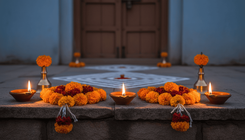
Diwali is celebrated across India, but the way people observe it in Odisha, Bengal and Assam reflects their own histories, landscapes and devotional practices. While the festival of lights marks a shared moment of victory over darkness, each region expresses this through distinct rituals, local deities and seasonal customs. Understanding these regional variations shows how a single festival can belong equally to all of India while belonging most intimately to the place you live.



Diwali in Odisha: Govardhan and the monsoon
In Odisha, Diwali celebrations centre around Govardhan Puja—the worship of the sacred mountain Krishna lifted to protect the people and cattle of Vrij. This observance falls on the day after Lakshmi Puja, making it the principal ritual of the festival in the state. Homes are prepared with careful ritual: courtyards are painted with rangoli designs in rice flour, and small oil lamps are lit in the corners of houses and fields to invite protection and abundance.
The landscape shapes the observance. Odisha's monsoon only recently departed when Diwali arrives, so the festival carries the spirit of the harvest's beginning rather than its fullness. Farmers worship their ploughs and agricultural tools during Govardhan Puja, recognising these as the instruments of survival. Many communities observe the four-day festival by making special sweets such as khir mohan—rice pudding sweetened with jaggery and flavoured with cardamom—and exchanging them with neighbours.
The Jagannath Temple in Puri holds a significant place in Odia Diwali. Thousands of visitors come to the temple during the festival to witness the celebrations there, and the temple's observance of Diwali influences practice across the state. While Lakshmi Puja is common, the ritual emphasis remains on Govardhan Puja and the blessing of the earth's gifts for the year ahead.
Diwali in Bengal: Kali Puja and the goddess of destruction
Bengal's celebration of Diwali is distinctive in part because Kali Puja—worship of the goddess of power and transformation—coincides closely with the festival dates. In many parts of Bengal, particularly in rural areas and in Kolkata's traditional neighbourhoods, Kali Puja holds equal or greater significance than Lakshmi Puja.
This reflects a deeper spiritual tradition in Bengal. The region has a long history of Shakti worship, the veneration of divine feminine power in all its forms. Kali is understood not as a figure of destruction alone, but as the dissolving force that makes renewal possible. Temples and shrines dedicated to Kali see heightened worship during Diwali, with devotees making offerings of flowers and preparing traditional dishes to offer to the goddess.
Lakshmi Puja in Bengal centres on a ritual called the Lakshmi Puja ceremony, where an earthen image or a single lotus leaf represents the goddess. The ritual is precise and layered: prayers are made for prosperity and protection, and sweets such as luchi (fried bread) and sandesh (creamed cottage cheese sweets) are prepared as offerings. After the puja, these are shared as prasad—blessed food—with family and guests.
Beyond these formal observances, Bengal celebrates Diwali with the festival of lights as a primarily cultural event. Fireworks light the night sky across Kolkata, and the streets fill with celebrations. The festival marks not just a religious moment but a social one, where the boundaries between different communities often blur in shared joy.
Diwali in Assam: Laxmi Puja and the Magh Bihu connection
In Assam, Diwali is observed mainly through Laxmi Puja, which follows patterns similar to those in much of north India but carries its own regional character. The festival arrives during the early autumn when Assam begins its transition toward the harvest season. The spiritual significance remains tied to the earth and its gifts.
Assamese homes prepare for Laxmi Puja by cleaning and decorating with lamps and flowers. Earthen lamps fuelled by mustard oil are lit along doorways and window sills, and marigolds are strung as garlands. The puja itself follows the invocation of Lakshmi with specific prayers and offerings of rice, coins and sweets. Traditional Assamese dishes such as pitha (rice cakes) and laru (sweet balls made from rice flour and jaggery) are prepared in homes across the state.
An important context for Assamese Diwali is its relationship to the agricultural calendar. The region's major harvest festival, Magh Bihu, falls in mid-January, and Diwali is understood as a preliminary celebration of the earth's continuing fertility. The festival acknowledges both abundance and gratitude for what sustains life. In many Assamese families, the celebration includes prayers for family wellbeing and economic security in the year ahead.
The Kamakhya Temple in Guwahati, one of the most sacred Shakti shrines in India, draws many worshippers during Diwali. While the temple is dedicated to the feminine divine year-round, the festival season sees particularly large gatherings of devotees seeking blessings and performing puja.
What connects these celebrations
Despite the differences, threads run through all three regions. Each observance includes the lighting of lamps, the worship of prosperity and protection, and the preparation of sweets specific to local tradition. Family and community remain central everywhere. Each region's version of Diwali emerges from the land itself—the rhythm of seasons, the particular deities venerated there, the crops that sustain the people.
Understanding these variations enriches how we see Diwali across India. The festival is neither narrower nor broader than the sum of these regional practices. It remains most alive and real when lived in the particular way of a particular place, with the particular gods you have grown up knowing, and the particular sweets your family makes each year.
Common questions
Is Kali Puja celebrated the same way as Lakshmi Puja in Bengal?
No. Kali Puja and Lakshmi Puja are separate observances. In Bengal, Kali Puja often holds equal or greater significance than Lakshmi Puja during Diwali, reflecting the region's tradition of Shakti worship. Both are celebrated, but they involve different rituals, deities, and offerings.
What role does Govardhan Puja play in Odia Diwali?
Govardhan Puja is the principal ritual of Diwali in Odisha. It falls on the day after Lakshmi Puja and centres on worship of the sacred mountain. Farmers particularly emphasise this puja by blessing their tools and equipment for the year ahead.
How does Assamese Diwali connect to the harvest?
Assamese Diwali is understood as a preliminary celebration of the earth's fertility, with Magh Bihu (the major harvest festival) following in mid-January. Diwali observances include prayers for family wellbeing and economic security, acknowledging both the earth's continuing gifts and gratitude for them.

Related Articles


