Hinduism’s Concept of Time
Yugas and the Endless Cycle of Creation and Destruction.

Meghana C
08 Nov 2024 • 4min
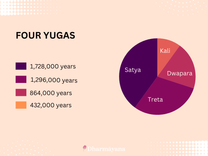
Have you ever wondered how time is measured in Hinduism? Unlike our usual clocks and calendars, Hinduism takes a much grander view of time, one that stretches over vast cycles spanning thousands, even millions of years. Time flows in four great ages, known as Yugas. Think of Yugas as epochs or eras that the world moves through in a set order, each with distinct characteristics. Each Yuga represents a gradual decline in goodness, moral strength, and spiritual purity.
The four Yugas are:
Satya Yuga
Satya Yuga, the first age, is the purest and most virtuous era. It’s a time when everyone lives in harmony, wisdom flows freely, and dharma (moral duty) is at its peak. Think of it as a time of perfect peace, where everyone is dedicated to truth, and there is almost no need for laws or punishments. The lifespan in this age is the longest, and people have natural wisdom and spiritual strength.
Treta Yuga
After Satya Yuga, we enter Treta Yuga, where things are still good but not quite as perfect. Lord Rama, considered an ideal figure of righteousness, appeared during Treta Yuga, embodying dharma in every aspect of life. His story, told in the Ramayana, is seen as a blueprint for virtuous living. In Treta Yuga, virtue and goodness are still strong, but challenges emerge, and the balance between good and evil becomes less certain.
Dvapara Yuga
In Dvapara Yuga, things take a more noticeable turn. People are still capable of good, but selfishness, greed, and dishonesty begin to spread. It’s no longer enough to simply be good; now, society requires rules, laws, and systems to maintain order. One of the most significant events in Dvapara Yuga was the arrival of Lord Krishna, an incarnation of Lord Vishnu. Krishna played a central role in re-establishing dharma and guiding humanity back to righteousness.
Kali Yuga
Finally, we arrive at Kali Yuga—the age we are in today. It’s known as the age of darkness, where dharma is at its lowest point, and materialism and ignorance dominate. But it’s a phase where spirituality is difficult to maintain, yet it also holds the possibility for great spiritual awakening. In this age, simple acts of kindness, charity, and truthfulness are highly valued, as they become rare and precious. According to Hindu prophecy, Kalki, the final avatar of Lord Vishnu, is destined to appear at the end of Kali Yuga. Kalki will come as a powerful warrior to cleanse the world of darkness and restore dharma, initiating the rebirth of the universe.
One unique idea in Hinduism is that time isn’t a straight line that just keeps going. Instead, it’s a cycle—an endless loop of creation, preservation, and destruction. Each time the four Yugas are completed, the universe resets. This means that once Kali Yuga ends, the universe will be renewed, and Satya Yuga will begin again, starting a fresh cycle.
In fact, this cycle of Yugas doesn’t just happen once. Hindu cosmology believes in countless cycles that have come before and will come after. This teaches us that time is bigger than just our lifetime and that every phase has a purpose. The Yugas remind us that while we may be tiny specks in the universe, we’re all part of an incredible, infinite story.

Related Articles
Try a fuller and better experience on the
Dharmayana App