Hindu Temple Etiquette for First-Time Visitors
Respect, devotion, and the quiet art of entering sacred space

Abhilash Ramakrishna
08 Nov 2026 • 8min
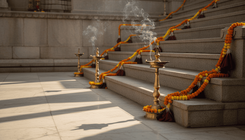
When you visit a Hindu temple for the first time, you are entering a space where daily life and the sacred meet. Hindu temple etiquette is not a list of rules to anxiously memorise, but a set of customs that arise from respect for the space, the deities worshipped there, and the people who gather to pray. A temple welcomes visitors of all backgrounds—the etiquette exists to help you move through that space with care and presence. This guide covers what to wear, how to behave, the meaning of key rituals you will see, and how to participate if you wish to.



What to Wear to a Temple
Dress matters at a temple because it signals respect for the sacred. This does not mean formal or expensive clothing; it means modesty and cleanliness. Wear clothes that cover your shoulders and knees—a loose salwar kameez, a dhoti, a long skirt and shirt, or trousers and a tunic are all appropriate. Men often wear traditional clothes such as a dhoti or kurta, but Western trousers and a shirt are equally acceptable. The principle is the same: nothing too tight, sheer or revealing. Women should avoid clothing that exposes the midriff or back.
Footwear will be removed. Most temples have a shoe rack or shelves near the entrance; remove your shoes there and leave them in the open or in a locker if one is provided. Some temples have attendants who look after shoes. In a few temples, particularly if the sanctum is elevated or sacred ground is involved, you might remove shoes at a second location. Watch what others do and follow their lead.
Jewellery is fine, and many people wear mangalsutras, tilaks, or other items of spiritual significance. There is no rule against wearing it. Some temples ask women to remove mangalsutras or nose rings during certain rituals, but this is uncommon and the temple staff will tell you if it applies.
Understanding Darshan and Movement Through the Temple
Darshan—the viewing of the deity or the sacred image—is the heart of a temple visit. The word means "sight" or "vision", and it describes both the act of seeing the deity and the blessing believed to flow from that sight. You will queue in a line, often winding through the temple halls, and move toward the sanctum (the innermost chamber where the main deity is housed). This is not a race or a rush. People stand in line for minutes or sometimes longer, and when you reach the sanctum, you will have a few moments to stand or kneel before the image, look upward, and perhaps place your palms together in a gesture of prayer or greeting (called namaste or anjali mudra). Then you move on, making space for the person behind you.
Some temples have a pradakshina path—a passage that circles the sanctum or entire temple. Pradakshina means circumambulation: walking around the sacred object or space as an act of worship. You walk clockwise, keeping the deity to your right. This is not mandatory; many people offer darshan and leave. But if you see others moving in a circle, you can join them. It is a meditative practice, a way of honouring the sacred with your physical movement.
Many temples have multiple shrines. You may see smaller sanctums dedicated to different deities within the same building. You can visit any of them, and again, darshan is the central act. There is no required order; follow what feels natural or what other visitors do.
Temple Conduct and Respect for Others
The atmosphere inside a temple is one of prayer and quiet. This does not mean complete silence—there is often music, the chanting of priests, the sound of bells and conch shells, and the murmur of many people in prayer. But it does mean keeping your own voice low, your phone off or on silent, and your movements unhurried. Do not photograph the deity or the sanctum. Many temples prohibit photography entirely in the inner sanctum; others permit it outside. Look for signs, or ask a temple official.
If you are menstruating, pregnant, or have recently given birth, some temples have restrictions on entering the sanctum. This varies greatly by temple, region and sampradaya (school of worship). Many modern temples and urban temples have moved away from these restrictions, but they remain in some places, particularly in South India. Ask respectfully at the entrance if you are unsure. No one will judge you; the temple staff are used to these questions.
You may see people making offerings or participating in rituals—lighting lamps, ringing bells, touching the feet of the deity or a statue, or accepting ash or flowers from the priest. You are not obligated to do any of these things. Observing quietly is completely appropriate for a first visit. If you feel drawn to an action, you can participate; most temples welcome this. If you are uncertain, it is safer to watch first.
Receiving Prasad and Leaving the Temple
Prasad is blessed food or flowers offered to the deity and then distributed to worshippers. It might be a sweet, fruit, flowers, or sacred ash. If prasad is offered to you, accept it—it is an honor. You can eat it, wear it (in the case of ash on the forehead, called tilak), or keep it. There is no wrong answer. If you do not want to eat something, you can still accept it and leave it as an offering back in the temple, or discard it respectfully outside.
As you leave, you may wish to pause, turn and bow toward the sanctum, or place your palms together. This is a natural gesture of gratitude, but it is not required. Simply leaving with a calm mind is enough.
Visiting During Special Occasions
Temples are busier during festivals and on auspicious days in the lunar calendar. These are wonderful times to visit—you will see ritual, music and gathering at their fullest. But the crowds are larger and movement is slower. Lines for darshan can last an hour or more. Go with time and patience. Some temples manage crowds by opening multiple entrances or staggering movement. Trust the flow and follow others.
Some temples hold specific rituals in the early morning or evening. These are called aarti or puja. If you are invited to witness or participate, the experience is profound. Arrive a few minutes early, remove your shoes, and stand to one side; the ritual typically lasts 10 to 20 minutes. You will see lamps lit, flowers offered, bells rung, and sometimes water or ash blessed and offered to worshippers. If you are new, watch first; participation will feel natural if it is right for you.
How to Offer Darshan at a Temple
- Remove your shoes Leave your shoes at the designated rack or shoe-keeper near the entrance. If the temple has multiple levels, you may need to remove shoes again at a higher entrance.
- Enter the temple and locate the queue Follow other visitors or ask a staff member where the darshan line begins. Most temples have a clear queuing path that winds through halls or corridors.
- Move through the line with presence Walk slowly, keeping pace with others. Use this time to settle your mind. Do not photograph the sanctum or deity.
- Approach the sanctum As you draw near the inner chamber, you will see the deity or sacred image. Step forward when space allows, and spend a few moments looking upward at the image.
- Greet the deity Place your palms together in front of your chest (namaste or anjali mudra) as a gesture of respect and prayer. You may also bow slightly, or simply stand in quiet acknowledgment.
- Accept prasad if offered As you leave the sanctum, a priest or volunteer may offer you blessed food, flowers or ash. Accept with your right hand or both hands, and receive it as a blessing.
- Circumambulate if you wish If there is a pradakshina path, you may walk clockwise around the sanctum, keeping it to your right. This is optional; many people offer darshan and leave directly.
- Bow as you depart As you exit the main prayer area, pause and turn toward the sanctum, placing your palms together or bowing gently as a final gesture of gratitude.
Common questions
Can I enter the temple if I am menstruating or recently postpartum?
This varies by temple and region. Many modern and urban temples have no restrictions, but some temples in South India and traditional spaces do restrict entry to the inner sanctum during menstruation or for a period after childbirth. Ask respectfully at the entrance; staff are accustomed to this question and will give you a clear answer without judgment.
What if I do not want to remove my shoes?
Removing shoes at temple entrances is a core custom, not optional. It signifies purity and respect for sacred ground. If you have a medical reason that makes removal impossible, speak to a temple official at the entrance—they may make an exception or offer an alternative.
How long do I need to spend in the temple?
There is no minimum or maximum. Darshan may take two minutes if the line is short, or thirty minutes if it is long. Some people circumambulate multiple times; others visit once and leave. A typical first visit, including waiting and darshan, is usually 20 to 40 minutes, depending on how busy the temple is.

Related Articles