
Harvest Festivals of India: How Regions Thank the Land
Gift and gratitude, ripening across the seasons

Aditya Pandey
18 Nov 2026 • 6min
Across India, the moment when the harvest comes in is marked not by a single date but by a wave of festivals that travel through the calendar, each one tied to the crops and seasons of its region. From the rice fields of the south to the wheat plains of the north, communities gather to thank the earth for what it has given. These harvest festivals of India are woven into the rhythm of the monsoon and the agricultural year, and they tell us as much about how Indians relate to land, gratitude and family as they do about the crops themselves.



Pongal and the Tamil Harvest
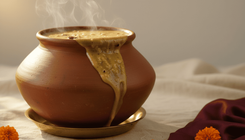
In Tamil Nadu and parts of Andhra Pradesh, the month of Thai brings Pongal, a four-day festival whose name comes from the Tamil verb "to overflow." Families cook a new harvest of rice in large clay pots with jaggery and milk until the mixture overflows—the pot's overflow is itself the blessing. The word pongal means both the dish and the festival: cooking it is the ritual. Cattle that worked the fields are garlanded and walked through the streets in a celebration called Mattu Pongal. In homes across the region, kolams—floor designs made with rice flour—welcome Lakshmi, the goddess of abundance, with intricate patterns renewed each morning. This is a festival that feeds the body and the senses at once: the sweetness of jaggery, the smell of sesame, the sound of cattle bells.
Makar Sankranti Across the North
In northern and western India, Makar Sankranti marks the sun's shift into the zodiac sign of Capricorn and the beginning of longer days. The festival is known by different names in different places—Lohri in Punjab, Uttarayan in Gujarat, Poush Sankranti in Bengal—but everywhere it carries the same meaning: the year has turned, winter is ending, and the new harvest is here. In Punjab, families light bonfires and throw popcorn and sesame seeds into the flames as an offering of thanks. In Gujarat, the skies fill with kites as children compete to cut each other's strings, a sport that marks the moment when the winter crops are safely stored. The sharing of til and gur—sesame seeds and jaggery—is universal: sticky on the tongue, these sweets carry a blessing: "Til gur khao, aur mit-mit baat karo" (eat sesame and jaggery, and speak sweetly to one another).
Bihu in Assam and the Northeast
In Assam and the northeast, the start of the Bengali new year is marked by Bihu, celebrated in spring when the Boro rice is harvested. Bihu is a dance as much as a festival: young men and women move in circles, their movements mimicking the planting and reaping of rice. The rhythm of the dance is the rhythm of the fields. Families prepare pitha—sweet rice cakes made with jaggery and coconut—and offer them to neighbours and guests. The festival connects the household to the land so directly that when Bihu is celebrated, families often bathe in the river at dawn and light lamps by the water's edge, returning to the source that watered the crop. This is thanksgiving as movement, as taste, as community ritual.
Onam and the Abundance of Kerala
In Kerala, Onam arrives when the monsoon rice begins to ripen, and it carries its own mythology. The festival celebrates the legendary return of the benevolent king Mahabali to his people once a year. Homes are decorated with elaborate flower carpets called pookalam, laid out in spirals that draw the eye inward toward an empty centre—a space held for the divine. The boat races on backwater rivers, the feast of sadhya (a meal of many vegetarian dishes served on a banana leaf), the music and the dance all speak of a harvest so abundant it overflows from house to field to water. Unlike some harvest festivals centred on a single dish or day, Onam is a festival of duration, unfolding over days with a ritual for each, and each ritual rooted in gratitude for the year's abundance.
The Common Thread: Gift and Gratitude
What ties these festivals together is not a date or a name but an understanding: that the harvest is a gift that must be received with open hands and an open heart. Each festival makes this gratitude physical. Pongal overflows. Makar Sankranti is shared from hand to hand. Bihu is danced. Onam is painted and feasted. In every case, the first taste of the new harvest is offered to the divine before the family eats. The crop belongs first to the powers that made it grow—the sun, the monsoon, the earth itself—and only then to human hunger.
These festivals also reveal how deeply Indians understand the connection between season, labour and gratitude. They remind us that before food arrives in a shop, it has ripened in a field tended by human hands over months of work. The harvest festival is a pause to acknowledge both: the grace that made growth possible, and the labour that brought it to ripeness. In a world where food often arrives with no story attached to it, these festivals insist on memory, on knowing where abundance comes from, and on saying thank you.
If you have access to ingredients and recipes for any of these festivals, trying to cook a traditional dish—pongal, til gur, pitha, or elements of a sadhya—is one way to enter into the spirit of harvest gratitude yourself, even if you do not live in the region where it is celebrated. The festivals are rooted in place but their meaning—that we are held by the land and by seasons beyond our control—travels.
Common questions
Which harvest festival is celebrated in which month?
Pongal arrives in Thai (December-January), Makar Sankranti in the same period, Bihu in spring during the Boro rice harvest, and Onam when monsoon rice begins to ripen. Exact dates shift yearly with the lunar and agricultural calendars.
Are these harvest festivals only celebrated in temples?
No. While temples participate, these festivals are primarily household and community celebrations. Families cook traditional dishes, decorate homes, visit relatives, and gather in public spaces. The festival happens at home first, then extends outward.
What is the main food offered in each harvest festival?
Pongal offers the rice-jaggery-milk dish of the same name; Makar Sankranti features til and gur (sesame and jaggery); Bihu brings pitha (rice cakes); Onam features sadhya (multi-dish vegetarian meal). Each reflects the region's available crops and cooking traditions.

Related Articles


