Guru Raghavendra’s Magnificence and Glory
Guru Raghavendra still answers the calls of His devotees.
Shanti Arunkumar
28 Jan 2025 • 8min
The Raghavendra Swami mantra
Poojyaaya Raaghavendraaya
Satya Dharma Rathaayacha
Bhajathaam Kalpa Vrikshaaya
Namathaam Kaamadhenuvey
पूजयाया राघवेंद्राया
सत्य धर्म रतायच
भजतां कल्प वृक्षाय
नमतां कामधेनुवे
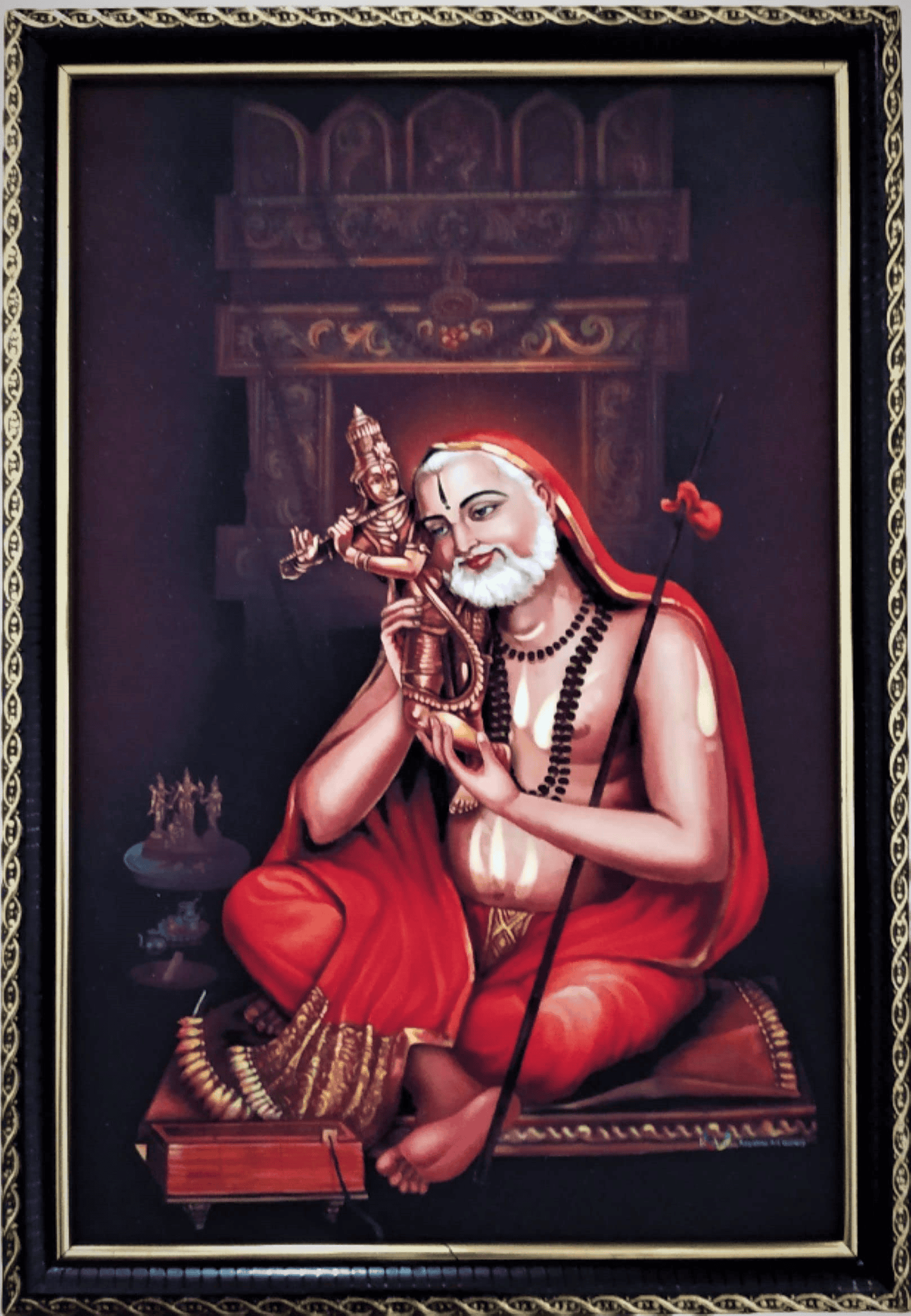
One of the most revered places of worship as a place extolling the Guru, is Mantralayam, which has the temple of Sri Guru Raghavendra, whose mortal remains are consecrated in the brindavanam (the samadhi where His mortal coils are entombed). Sri Raghavendra Tirtha was born as Venkatanatha in the town of Bhuvanagiri, Tamil Nadu, into a Kannada Madhwa Brahmin family of Gautama Gotra of musicians and scholars.
His great-grandfather Krishna Bhatta was a teacher to the renowned Vijayanagara Emperor, Sri Krishnadevaraya. His grandfather was Kanakachala Bhatta, and his father Thimmanna Bhatta (also known as Thimmannacharya), was an accomplished scholar and musician.
After the fall of the Vijayanagara Empire, Thimmanacharya migrated to Kanchipuram with his wife Gopikamba. Venkatanatha had two siblings—Gururaja and Venkatamba.
Venkatanatha's education was taken care of by his brother-in-law Lakshmi Narasimhacharya at Madurai after the early demise of his father, and he subsequently got married.
It was in 1624, that Sri Raghavendra Tirtha became the pontiff of the Kumbhakonam Matha, which was earlier known as Vijayeendra Matha or Dakshinadi Matha, now known by the name of Mantralaya Sri Raghavendra Swamy Matha.
After a short stay at Kumbakonam, he went on a pilgrimage to Rameswaram, Ramnad, Srirangam, and Mathura. Later, he moved westwards to Udupi and Subramanya, and then to Pandharpur, Kolhapur, and Bijapur. At Kolhapur, he is said to have stayed for a long time.
After that, he returned to Kumbakonam. By 1663 he left for Mysore where he got a grant from Dodda Devaraya Odeyar. Finally, he chose to settle down in Mantralayam.
Guru Raghavendra shed His physical body in 1671 in Mantralayam. To give the exact location, it is a village on the bank of the Tungabhadra river in Adoni Taluk in Andhra Pradesh.
There are millions of followers of Guru Raghvendra, all over the world. There are countless miracles attributed to Raghavendra Swami. It is widely believed by ardent devotees that Guru Raghavendra is said to solve all the problems that his followers and disciples encounter- many go to Mantralayam and follow a series of austerities, that can invoke His guidance and grace, and finally, the problems dissipate on their own, and faster than the speed with which they had descended on the person.
One of the miracles that has been recorded in print, is a conversation that Sir Thomas Munro, a gazetted officer of the British Empire in India, had with him, after Guru Raghavendra’s death: “While Rayaru had his Brindavana Pravesha around 1:30 pm in the 17th century, it is recorded in the Gazette of then Madras Presidency that he gave darshan and spoke to Sir Thomas Munroe, a civil servant of British Government and discussed with him the restitution of the Inam Lands to the government which was being proposed then, meaning that Mantralaya would have become part of the restituted lands. After such a conversation, which Sir Thomas Munroe dutifully transcribed, the restitution was withdrawn”.
More miracles substantiate the power of Guru Sri Raghavendra. Sri Raghavendra symbolized magnanimity, and compassion. Innumerable people recount the miracles that He performed, to help people from their countless and daunting problems. The sacred sand of the Moola Brindavana (Moola Mrithika) has very special significance, to cure diseases and combat the influence of negative and evil forces. A few the miracles are listed below:
CHOLA KING
During the life of Raghavendra Theertha, the Chola kingdom experienced political unrest. The Kingdom experienced plunder and accession and a terrible famine followed too. The king spent his money from his personal coffers. But the famine did not abate. He approached Raghavendra Swami, and prayed for his kind indulgence in the welfare of his subjects. The Swamiji readily consented and stayed at Tanjore for 12 years and came to the rescue of the people and the king. The Swamiji with his miraculous powers was able to save the people.
The king who was all grateful offered a jeweled necklace to Swamiji and the same was put by Swamiji in the Fire of Sacrifice as the Swamiji was a great saint with complete renunciation of the material objects. The king felt insulted when he saw his presentation thrown into fire. The Swamiji knew his (King's) disturbances in mind and prayed to Lord Parasurama (another incarnation of Lord Vishnu), and the in-dweller of Fire God, and showed his amazing powers by getting it back. The king realized that Raghavendra Swamy was not an ordinary ascetic but one who possessed divine powers.
DRY WOOD SPROUTS LEAVES
Once when Guru Raghavendra was travelling, he passed through a village where an atheist headman was harassing all Brahmins. This atheist did not believe in god, mantras, or Vedas. Raghavendra Swami decided to bring him on the right track, and so stayed in the local temple and announced a grand puja. The headman immediately challenged him to a confrontation and asked him to prove the efficacy of the Vedic mantras.
He produced a dry and hard piece of dead wood, used to pound grain in a pestle, and challenged Guru Raghavendra to make it sprout leaves. The Brahmins present there, protested saying that this was impossible and against the laws of Nature. Guru Raghavendra, calmed them down saying that God knows how to protect the laws of Nature, and how to overcome them when the occasion demands.
He chanted many Vedic mantras and sprinkled water from his kamandala on the dry stout wood. Within a short time, it sprouted fresh green leaves, vindicating Guru Raghavendra’s words. The headman saw the error of his ways and surrendered at the feet of Guru Raghavendra.
Ultimately, it is the depth and the single-focused belief in the power of the Almighty, and the Guru, that helps one overcome difficulties in life. Guru Raghavendra, like all the gurus of this great land, came to substantiate that aspect, to the common man.
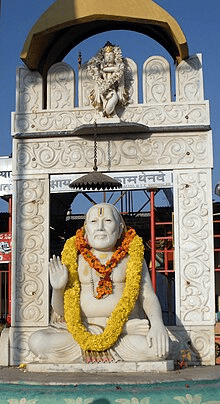
Guru Raghavendra is known as a scholar par excellence. Some of his works are mentioned below, which comprise on 25 % of his total oeuvres.
- Tantra Deepika: An interpretation of the Brahma Sutra from the perspective of Dvaita
- Bhavadipa: A commentary on Jayatirtha's Tattva Prakasika
- Nyaya Sudha Parimala: A commentary on Nyaya Sudha
- Bhatta Sangraha: A commentary on Jaimini Sutras
- Mantramanjari: A commentary on the first three chapters of the Rigveda
- Geetartha Sangraha: A commentary on the Gita, also known as Geeta-Vivrutti
- Prameya Deepika Vyakhya: A commentary on Madhwacharya's Geeta Bhashya
- Tatparya Chandrika: A commentary on the Brahma Sutras
- Nyaya Muktavali: A commentary on the Adhikaraaashareeras of the Brahma-Sutra
- Tattva Manjaree: A commentary on Madhwacharya's Anubhashya.

Related Articles