Govardhan Puja 56 Bhog: What Is Chhappan Bhog?
Fifty-six sweets for a mountain of love

Sunil Chaurasia
17 Oct 2026 • 6min
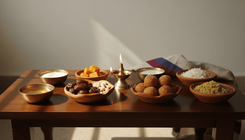
Chhappan Bhog, or 56 Bhog, is an offering of 56 different dishes and sweets made to Krishna during Govardhan Puja, which usually falls on the day after Diwali. The word "chhappan" means fifty-six in Hindi, and "bhog" means food offered to a deity, which becomes prasad, or blessed food, once it has been offered. This elaborate feast celebrates the day Krishna lifted the Govardhan hill to protect the cows and cowherd community of Braj from the storm sent by Indra, the king of the gods, humbling Indra's pride. Though not every celebration includes all 56 items, the practice symbolises abundance, gratitude and the richness of Krishna's grace.
The number 56 holds significance in Krishna's life and worship. The most widely told explanation comes from the Govardhan story itself: Krishna was used to eating eight meals a day, but for the seven days he held up the Govardhan hill, he ate nothing at all. When the storm ended, his grateful family and the people of Braj prepared eight dishes for each of the seven days he had gone without food—seven times eight, making 56. Other traditions offer different explanations. One tells of the gopis, the cowherd women of Braj, who kept a month-long vow to win Krishna's love and offered him 56 dishes at its completion. Another links the number to the divine lotus in Goloka, Krishna's eternal abode, on which he is said to sit, with 56 petals arranged in three layers. The exact reason varies between traditions and regions, but the consistency of the number across different sampradaya shows its deep roots in Krishna devotion.



The Story Behind Chhappan Bhog
Chhappan Bhog is most closely linked to Krishna's childhood in Braj, where he grew up among the cowherds of Gokul and Vrindavan. Each year, the people of Braj performed a great worship of Indra, the king of the gods and the lord of rain. The young Krishna persuaded them instead to honour the Govardhan hill, which sheltered their cows and provided the pastures and water that sustained them. Angered by this, Indra unleashed a devastating storm, sending torrential rain over Braj for seven days. To protect his people, Krishna lifted the Govardhan hill on his little finger and held it up like an umbrella, sheltering the entire community and their cattle beneath it for seven days and nights. Humbled, Indra finally withdrew the storm and acknowledged Krishna's divinity. After this protection, the grateful community brought Krishna 56 types of food and sweets as an offering of thanks. This became the foundation of the Chhappan Bhog tradition, celebrated each year during Govardhan Puja to remember Krishna's care and the devotion of those he loves.
The story emphasises Krishna's role not just as a god, but as a protector of the vulnerable and the meek. The offering acknowledges this protection and expresses the community's gratitude. When devotees prepare and offer Chhappan Bhog today, they are reliving this moment and inviting Krishna's blessings into their own lives.
What Goes Into 56 Bhog
The 56 items in Chhappan Bhog vary across regions and family traditions, but they generally include a mix of savoury and sweet dishes. Common items are khichdi (a rice and lentil preparation), dahi (yoghurt), ghee (clarified butter), milk, makhan (white butter, a favourite of Krishna), pedas (milk-based sweets), ladoos (round sweets), various dried fruits, nuts, jaggery preparations, puris (fried bread), and different seasonal vegetables and fruits. Some include pickled items, chutneys, and grains like rice, wheat and barley.
In practice, many families make fewer than 56 items but maintain the spirit of the offering. A simpler version might include rice, dal, vegetables, milk products, sweets and fruits. What matters is the intention and effort: each item represents a form of nourishment and care, mirroring the way Krishna nourished and protected the people of Braj. Families often pass down their own list of 56 items, adapted to what grows locally and what their kitchen can produce.
Regional and Family Variations
Chhappan Bhog is observed across regions where Krishna worship is strong, particularly in Uttar Pradesh, Rajasthan, Gujarat, Madhya Pradesh and Maharashtra, but the specific dishes vary. In Mathura, Vrindavan and the wider Braj region, the tradition is inseparable from Krishna's life story, so local recipes and seasonal ingredients shape the offering. Govardhan Puja is also known as Annakut, meaning "mountain of food," and in many temples the Chhappan Bhog forms part of a grand Annakut offering. The Pushtimarg tradition of the Vallabh sampradaya, centred at the Shrinathji temple in Nathdwara, Rajasthan, is especially known for its elaborate Annakut celebrations. In Gujarat, Annakut offerings often feature a vast array of dishes and sweets such as mohanthal. Rajasthani families might include more millet-based preparations. In Odisha, Lord Jagannath at Puri is offered 56 dishes as part of his temple's food offerings, and in Bengal, where Krishna worship also thrives, local sweets like sandesh replace some items, while maintaining the number and spirit.
Chhappan Bhog is not limited to Govardhan Puja. It is also offered on Janmashtami, Krishna's birthday, and on other festivals and special occasions in Krishna temples and households.
Some families prepare all 56 items as a single large meal to be shared as prasad, the blessed food given to devotees. Others arrange them on small plates or bowls, set them before Krishna's image for a ritual period, and then distribute them to family and neighbours. The exact ritual also varies: some communities perform a formal puja (worship ritual), others mark Govardhan Puja with a simpler household observance. What unites them is the commitment to feed Krishna, symbolically and literally, and to experience the shared meal as a form of grace.
Preparing and Offering Chhappan Bhog
Most families begin preparing Chhappan Bhog the day before Govardhan Puja, or the night before if Govardhan Puja falls early. The preparations are seen as a form of devotion in themselves. Rice and wheat are cleaned and sorted. Milk is boiled and yoghurt is set. Sweets are made—often multiple types—to cover the variety the offering requires. Some items can be made weeks ahead and stored, while fresh dishes like vegetables and milk products are prepared closer to the ritual day.
On the day of Govardhan Puja, the prepared items are arranged on a table or altar in front of a statue or image of Krishna, or before a representation of the Govardhan hill, often shaped from cow dung or food. Some families set all 56 items individually; others group them by category. A simple prayer or mantra honouring Krishna and the Govardhan hill is often recited, though the prayer itself is not standardised. After the offering has been set before Krishna for a set period—often several hours—the food is distributed to family members and sometimes to neighbours and those in need, as prasad.
The Meaning of Sharing Chhappan Bhog
Chhappan Bhog is not just an offering; it is a meal that ties the community together. In Krishna's life, the celebration of Govardhan Puja included the whole cowherd community of Braj sharing the feast. When families distribute the 56 Bhog today, they echo that collective joy and care. Eating prasad after it has been offered to Krishna is believed to carry Krishna's blessing. The act of preparing, offering and sharing connects the devotee to Krishna's story while nourishing those around them.
The abundance expressed in 56 dishes also reflects the idea that Krishna's grace and protection are limitless. Each dish represents a different flavour or form of nourishment, just as Krishna's love manifests in many ways in the world. By preparing and sharing this variety, devotees acknowledge their own need for Krishna's care and their desire to extend care to others.
Common questions
Can I prepare Chhappan Bhog with fewer than 56 items?
Yes. Many families prepare simpler versions with 7, 11 or 21 items, maintaining the spirit of the offering even if they cannot manage all 56. What matters is the intention and effort, not a rigid count. Some households also prepare 56 items together as a community rather than as one family alone.
What are some common items in the 56 Bhog?
Typical items include milk, yoghurt, ghee, makhan (white butter), rice, lentils, khichdi, puris, pedas, ladoos, jaggery sweets, dried fruits, nuts, chutney, and seasonal vegetables and fruits. Exact items vary greatly by region and family tradition, with local specialities often replacing standard dishes.
When exactly is Chhappan Bhog offered during Govardhan Puja?
Chhappan Bhog is offered during Govardhan Puja, also known as Annakut, which usually falls on the day after Diwali, though depending on tithi timings it can occasionally fall a day later. Preparations usually begin the day before, and the offering is made in the morning or through the day on Govardhan Puja itself.

Related Articles