
Gopashtami 2026: Why Cows Are Worshipped on This Day
Krishna, Cattle, and Sacred Care

Abhilash Ramakrishna
23 Oct 2026 • 6min
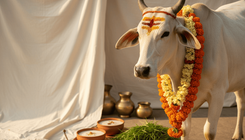
Gopashtami is a Hindu festival dedicated to honouring cows and the pastoral heritage of Lord Krishna. It is observed on the eighth lunar day of the light fortnight in the month of Kartik, which typically falls in October or November. On this day, cows are bathed, garlanded, fed special treats, and venerated as sacred beings. The festival celebrates both Krishna's childhood as a cowherd and the spiritual significance of cattle in Indian life.



Why Cows Are Sacred in Hinduism
Cows hold a special place in Hindu philosophy and daily practice. In Sanatan Dharma, the cow is seen as a symbol of the earth itself and a representation of abundance, motherhood and dharma—right action. The cow nourishes without taking anything of value; it gives milk, strength, and even its waste becomes fertiliser and fuel. This generosity is seen as a reflection of the divine.
More than symbolism, the cow's sacredness is rooted in its relationship to the soil, the community and sustenance. In agricultural India, cattle have always been central to survival and prosperity. A healthy herd meant food security; a cow's well-being was the family's well-being. This practical wisdom over centuries became woven into spiritual practice, making the protection of cows a mark of spiritual discipline.
Vedic texts refer to cows as aghnya—literally "not to be killed"—and Mahabharata teaches that caring for cattle is one way to serve all living beings. The cow appears in many stories of Krishna, the most beloved deity in Hinduism, which anchors this reverence in the devotional heart of the tradition.
Krishna the Cowherd
Krishna spent his childhood as a cowherd in Vrindavan, tending cattle and playing in the forests. These stories are not about an ordinary shepherd; they are among the most celebrated narratives in Hindu tradition. In the Bhagavata Purana, Krishna is described as Govind—the one who nourishes and protects the cows—and these pastoral episodes are understood as divine play revealing deeper truths about love, care and the bond between the divine and creation.
The young Krishna lifting the Govardhan mountain to protect the cattle and people from torrential rain is one such story. Another shows him playing his flute while herding cows, a scene that devotees see as Krishna playing with all of creation. Through these stories, the act of tending cows becomes a form of devotion and divine service.
Because Krishna's earthly life was so deeply connected to cattle, worshipping cows on Gopashtami is, for many devotees, a way of honouring Krishna himself. The festival brings these ancient stories into the present, making them alive in practice. It is a reminder that caring for animals and the natural world is not separate from the spiritual path, but central to it.
How Gopashtami Is Observed
On Gopashtami, many people begin the day by bathing cows with water mixed with turmeric and flowers. Garlands of marigolds or banana flowers are placed around the cows' necks. Sweets, fresh grass, and special preparations like rice pudding are offered as food. Some people apply tilak—a sacred mark—on the foreheads of cattle, as would be done in a temple during worship.
In homes and communities across India, Gopashtami brings together the practical and the spiritual. The festival is not only about ritual reverence; it is an occasion to check on the health and well-being of the cows. People ensure that the animals are well-fed, sheltered and cared for throughout the coming months. In this way, the worship translates into concrete action.
The observance can vary by region and family tradition. In some places, people visit cows at temples or local gaushalas (cow shelters) to offer worship. In others, families who own or know cattle do the honours themselves. The essence remains consistent: a day set apart to acknowledge the cow's place in Hindu life and to extend care and gratitude.
Many also use Gopashtami as a time to reflect on their relationship with animals and the natural world. Some choose to avoid meat on this day or adopt practices that reduce harm to animals more broadly. For many devotees, the festival is an annual reminder of Krishna's teachings about compassion and duty toward all living beings.
The Lunar Calendar and When Gopashtami Falls
Gopashtami is fixed by the lunar calendar, not the Gregorian calendar, so the date changes each year. It falls on the eighth day of the light fortnight of Kartik, the month in the Hindu calendar that typically spans mid-October to mid-November. To find the exact date in any given year, it is best to check a Hindu calendar or panchanga—a traditional astronomical calendar.
The reason for lunar timing is rooted in Vedic timekeeping, where months are marked by the phases of the moon rather than the path of the earth around the sun. This makes Gopashtami a movable festival, tied to natural cycles rather than a fixed point on any secular calendar.
Planning to observe Gopashtami well means checking the date in advance. Many temples announce the festival date well ahead of time, and family members often share the information with one another. Some people keep a panchanga at home or check online Hindu calendar resources as the month of Kartik approaches.
Gopashtami Beyond the Festival Day
While Gopashtami marks a single day of special worship, the practice of honouring cows extends through the year in many Hindu households and communities. Some people offer food and water to cows they encounter, while others support gaushalas—shelters that provide care for abandoned or aging cattle. This year-round practice reflects the understanding that the sacred is not confined to festival days.
For many, Gopashtami serves as an anchor point. It reminds them to renew their commitment to non-harm and to think consciously about their relationship with animals and the environment. Some use the festival as a time to reassess their choices—what they eat, how they spend money, what they support—in light of their values.
In this way, a single day of ritual practice connects to a larger way of living. Gopashtami invites us to consider what it means to live alongside other creatures, and how tending to their welfare is, in the Hindu understanding, tending to our own spiritual lives.
Common questions
When is Gopashtami in 2026?
Gopashtami falls on the eighth day of the light fortnight of the month of Kartik, which typically occurs in October or November. Check a Hindu panchanga or calendar app for the exact date in 2026, as lunar festivals move each year on the Gregorian calendar.
Can I observe Gopashtami if I don't own cows?
Yes. You can visit a local gaushala (cow shelter) or temple with cattle to offer worship and care. Many communities organise Gopashtami celebrations in shared spaces, and your presence and intention to honour the animals is what matters.
What should I offer to cows on Gopashtami?
Traditional offerings include fresh grass, grains, sweets like rice pudding, milk, and fruits. You can also bathe the cow with water mixed with turmeric and flowers, and apply tilak on its forehead. Offer whatever is available and clean—the gesture of care is the essence of the practice.

Related Articles


