
Gita Jayanti 2026: Why Krishna's Teaching Still Resonates
The timeless voice of wisdom on the battlefield

Abhilash Ramakrishna
21 Oct 2026 • 6min
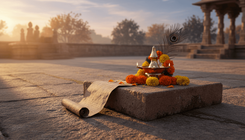
Gita Jayanti 2026 marks the day when Krishna's teaching to Arjun on the Kurukshetra battlefield is remembered and celebrated across India. The Bhagavad Gita Jayanti falls each year on the full moon (Purnima) in the month of Margshirsh, usually in November or December. On this day, devotees, scholars and seekers gather to reflect on the 700 verses of the Gita, a conversation that has shaped philosophy, ethics and spiritual practice for over two thousand years. The text remains central to Hindu thought not because it is old, but because readers keep finding themselves in it.



What the Gita Teaches
The Bhagavad Gita is set at a moment of crisis. Arjun, a warrior prince, stands on the battlefield facing his own relatives and teachers. He is paralysed by doubt: should he fight? Does he have the right? Krishna, his charioteer and guide, speaks to him across eighteen chapters, moving from the nature of the soul to the paths of action, knowledge and devotion.
The Gita does not give simple answers. Instead, it teaches Arjun—and through him, every reader—how to live with complexity. It speaks of dharma, the duty and righteousness that fits each person's place and time. It describes karma yoga, the path of acting without attachment to results. It explains that the soul, or atman, is eternal and cannot be harmed, while the body dies. Krishna teaches that devotion to God, bhakti, is open to everyone regardless of background, and that knowledge, meditation and service are all valid paths to the divine.
What makes the Gita remarkable is that it addresses both the warrior on a battlefield and the person sitting in confusion at home. When you read that you must do your duty without clinging to the outcome, or that the divine dwells in all beings, you are not reading ancient history. You are reading something that feels like it was written to you.
Why Gita Jayanti Is Observed
Gita Jayanti is celebrated because the Gita's teaching is understood as eternal and ever-fresh. In the Hindu calendar, certain moments and teachings are honoured each year so that they remain alive in memory and practice. The day gives space to step back from routine and ask the questions Krishna asks Arjun: Who are you? What is your duty? What truly matters?
Many spiritual teachers and philosophers have pointed out that the Gita is not a historical curiosity but a manual for living. Mahatma Gandhi read the Gita throughout his life and drew from it the principle of non-violence, even as others found in it the ethics of warfare. Swami Vivekananda taught that the Gita's message of action and courage applied to anyone seeking to serve humanity. The text has been interpreted by teachers across many schools of thought, each finding fresh meaning in its verses.
Gita Jayanti reminds us that the questions Arjun asked—about duty, meaning, courage and surrender—do not belong to the past. They surface in anyone's life when facing a difficult choice, a loss, or a moment that tests their values. That is why the day is marked: not to preserve something dead, but to keep alive something living.
How Gita Jayanti Is Celebrated
On Gita Jayanti, devotees and practitioners mark the day in various ways. Many visit temples to hear readings or recitations of the Gita, or to listen to scholars discuss its verses. In homes and ashrams, people may read a chapter of the Gita as a daily practice, or set aside time to study and reflect. Satsang groups—gatherings of seekers—often meet to read together and share thoughts.
In some temples, devotees recite the entire Gita, a recitation that can take many hours. In others, particular verses are chanted or studied. Across India, especially in cities with a strong spiritual culture, Gita Jayanti is marked by lectures, study circles and discussion forums where teachers and students explore what the text means today.
The celebration is not confined to any one sampradaya or school of thought. The Gita Jayanti is observed by devotees of different paths—those who follow Advaita Vedanta, those who walk the path of bhakti, those who practise Karma Yoga—because the text speaks to all of them. What unites the celebration is the recognition that on this day, we pause to listen again to Krishna's voice.
The Gita's Relevance Now
Readers today find the Gita speaks to contemporary dilemmas. When you face a choice between what you ought to do and what you want to do, the Gita's teaching on dharma and duty becomes personal. When work feels empty or exhausting, its message that you can act without attachment to the result offers a different way to engage. When you are confused about who you are or what lasts, its teaching about the eternal self and the temporary world frames the question differently.
The Gita also speaks to the modern confusion about action itself. In a world of endless options, the text teaches that right action flows from understanding your own nature, your circumstances, and the needs of the moment. It does not tell you to renounce the world or to chase success obsessively. Instead, it points toward a middle path: to act with full commitment and integrity, while holding your results lightly, knowing that outcomes are not entirely in your hands.
This message of balance—between effort and surrender, between duty and freedom—makes the Gita as alive in 2026 as it was on the Kurukshetra battlefield. Gita Jayanti exists to remind us that we can turn to it whenever we need guidance not on what to do, but on how to be while we do it.
Common questions
When is Gita Jayanti 2026 observed?
Gita Jayanti in 2026 falls on the full moon day of Margshirsh month, which typically falls in November or December each year. The exact date changes annually because the Hindu calendar is lunar. You can find the precise date through your annual panchanga or Hindu calendar.
What is the difference between reading the Gita and reciting it whole?
Some people read and study chapters over time to understand the teaching deeply. Others undertake a full recitation of all 700 verses, which is a practice of devotion and can take many hours in one sitting or spread across several days. Both approaches are valued; the choice depends on your intention and capacity.
Can people from outside the Hindu tradition study the Gita?
Yes. The Gita speaks to universal questions about duty, ethics, action and meaning. Scholars, philosophers and spiritual seekers from many traditions study it, and it has been translated into most major languages. Gita Jayanti is primarily observed within Hindu practice, but the text itself is open to anyone who seeks its teaching.

Related Articles


