
Ghati, Pahar and Muhurta: How Ancient India Divided the Day
Time itself is sacred—measured in moments and seasons

Abhilash Ramakrishna
16 Nov 2026 • 6min
The way we measure time shapes how we live. Ancient Indian timekeepers divided the day and night into smaller units with names and durations still used today in ritual, astrology and daily observation. The three main units—ghati, muhurta and prahar—form a system as practical and layered as the Hindu calendar itself. If you need to know when to perform a puja or plan your day by astrological timing, you will need to understand these divisions.



The Ghati: Measuring Time by the Water Clock
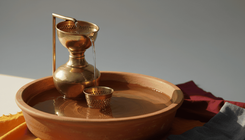
A ghati (also spelled ghatika) is the smallest standard unit in this system. One ghati equals 24 minutes in modern time. Think of it as a quarter of an hour, though finer: six ghatis make two hours and 24 minutes. In the past, these were measured by a water clock called a ghati, a metal vessel that held a fixed amount of water and emptied in exactly the time it took a standard ghati to pass.
The ghati was further divided into two smaller units. Each ghati holds 60 vipal (or vipala), which means one vipal is 24 seconds. Ten vipal make one prativipal, a unit equal to 2.4 seconds. These divisions were precise enough for astronomical observation and ritual timing, yet simple enough to track without modern instruments. If a ritual text says something should happen at a certain number of ghatis after sunrise, it is specifying an exact moment that a trained observer could identify.
The Prahar: Dividing Day and Night
A prahar (also written as prahara) is a larger unit that divides each day and night into six equal parts. In a 12-hour day, each prahar lasts 2 hours. In a 12-hour night, the same applies. A prahar therefore runs about 120 minutes, or five ghatis. The first prahar of the day begins at sunrise; the first prahar of the night begins at sunset.
These six prahars of day and six of night are counted in order and have traditional names and associations. In some sampradaya (lineages), they are linked to particular deities and times for specific practices. Morning prahars are often considered more auspicious for certain rituals, while evening prahars may be reserved for others. A few temples in South India still ring bells at each prahar change to mark the passage of time through worship and work.
The Muhurta: The Auspicious Moment
A muhurta is 48 minutes long—exactly two ghatis. This unit carries special weight in Hindu practice and astrology because it is understood not just as a measure of time but as an auspicious window. When an astrologer says a marriage or ritual should take place during a particular muhurta, they mean that 48-minute span has been calculated to favour success based on the position of planets, lunar phases and other factors.
The day is divided into 30 muhurtas: 15 during daylight and 15 during night. This means each muhurta occupies one of the 30 equal slots the Hindu calendar recognises in each 24-hour cycle. In practice, only some of these muhurtas are considered suitable for major life events; others are inauspicious and best avoided. The concept of muhurta-finding remains central to Hindu astrology, and timing important events within an auspicious muhurta is still widely observed.
How These Units Relate
All three systems exist at once and overlap intentionally. The ghati measures small stretches of time useful for ritual and observation; the prahar marks the body's natural rhythm through day and night; the muhurta adds the astrological layer that tells you when a time is favourable. To understand one is to see them as part of a single, coherent way of reckoning time that binds together mechanics, rhythm and meaning.
A practical example: if a pandit calculates that your wedding should occur during the muhurta known as Brahma (the first muhurta of the day), that muhurta lasts 48 minutes. Within that window, the exact moment might be specified down to the ghati—say, the second or third ghati after sunrise—and marked by the prahar division as well. A knowledgeable family member could recognize that moment without a clock.
Regional Variation and Modern Use
The names, properties and associations of these time units vary slightly between regions and between schools of astrology. South Indian traditions often use somewhat different nomenclature for the prahars and may calculate muhurtas with different emphasis on planetary positions. North Indian astrology places different weight on certain muhurtas depending on the ritual involved. A muhurta considered excellent for a house-warming might be unsuitable for a wedding.
Today, many people still consult a pandit or a panchang (Hindu calendar) to find the right muhurta for a wedding, naming ceremony, new business or house entry. The three units remain embedded in the way Hindu ritual is timed, even though most of us now tell time by clock and calendar. Understanding them gives deeper sense to why certain moments are held as sacred, and what astrologers mean when they speak of timing.
Why These Divisions Still Matter
The system reflects an astronomy and philosophy developed centuries ago, yet it endures because it answers a real human need: the wish to act at times that feel right. Modern astrology continues to work with these ancient measures. Whether you believe in planetary influence or not, the fact that so many people still consult muhurta to time important events shows how the old system of ghati, prahar and muhurta has remained woven into daily Hindu life. To read a panchang, understand ritual timing or simply follow the conversation around an important family event, some familiarity with these units is invaluable.
Common questions
What is the difference between a ghati and a vipal?
A ghati is 24 minutes long, while a vipal is much smaller—24 seconds. Each ghati contains 60 vipal. Vipal is the unit used for more precise timing when needed, such as marking the exact moment within a longer time window.
Can I use muhurta timing if I do not believe in astrology?
Yes. While muhurta is rooted in astrological calculation, many people consult it simply as a way to mark important moments deliberately and connect with tradition. Using muhurta is a choice about intention and mindfulness, not a requirement to believe its astrological basis.
Is the same muhurta considered auspicious for all kinds of events?
No. Different muhurtas are considered suitable for different activities. A muhurta good for a wedding may not be appropriate for starting a business or entering a new home. A pandit or astrologer calculates the right muhurta based on the specific event and the positions of planets at that time.

Related Articles


