
Gange Cha Yamune Chaiva: The River Invocation in Puja
Calling the sacred waters to bless your altar

Kushal K
19 Nov 2026 • 7min
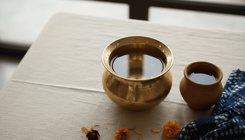
When you begin a puja at home, you may pour water into a kalash or ritual vessel and speak words that call upon the Ganga and Yamuna rivers. This invocation is known as "Gange cha Yamune chaiva," and it stands at the threshold between the everyday and the sacred. It is one of the oldest practices in Hindu ritual, a way of bringing the presence and blessing of India's most sacred rivers into your home, no matter where you are.
The mantra you recite does far more than name two rivers. It carries the spiritual weight of thousands of years of devotion, geography and philosophy woven together. Understanding what you are saying and why makes the words come alive in your hands.



What the Mantra Says and Means
The full invocation is: "Gange cha Yamune chaiva Godavari Saraswati / Narmade Sindhu Kaveri jale asmin sannidhim kuru."
Translated simply, it says: "O Ganga, O Yamuna, and also Godavari, Saraswati, Narmada, Sindhu and Kaveri—be present in this water." The mantra names seven of India's most sacred rivers and asks them to bless and sanctify the water before you. This is not poetry or decoration. In Hindu philosophy, each river holds a distinct spiritual quality and power. By naming them together, you are not asking for physical river water—you are invoking the sacred essence and protection each river embodies.
The phrase "jale asmin sannidhim kuru" means "make your presence felt in this water" or "be present in this water." It is a direct invitation, not a distant prayer. You are speaking to the rivers as though they are alive and able to hear you. In the Sanatan tradition, they are understood to be divine beings themselves, expressions of shakti—cosmic energy and power.
The seven rivers carry their own significance in Indian geography and spirituality. The Ganga and Yamuna are pre-eminent, honoured as goddesses. The Godavari flows through the Deccan and holds equal weight in southern practice. The Saraswati is mythologically said to flow underground in parts of India, while the Narmada marks the boundary between north and south. The Sindhu (Indus) flows through the northwest and beyond India's borders, and the Kaveri is sacred to the Tamil south. Together, they represent the spiritual geography of the entire subcontinent.
When and Why You Use This Invocation
This mantra is recited at the beginning of most pujas done at home—whether you are honouring a deity, performing daily ablutions, or consecrating an object. It is typically spoken when you touch water to your forehead or sprinkle it on the altar space. Some people recite it when filling the kalash itself.
The purpose is to sanctify ordinary tap water. In Hindu ritual thinking, water is already sacred, but the recitation transforms it consciously into a purified vehicle for the divine. It is your acknowledgement that even in a home far from any river, you are drawing on the spiritual resources of the entire tradition. The invocation bridges distance and time.
This same practice is used in many regional variants of puja across India. In some temples, a priest will recite the mantra as he pours water into a vessel during aarti. In home practice, you may whisper it quietly or speak it aloud, depending on the context and your own custom. Families often pass the words down through generations, each person learning them from someone older.
The Rivers as Spiritual Principles
Beyond their geographical reality, each river in the invocation represents something philosophical. The Ganga is known as the river of liberation—to bathe in her waters is said to wash away karma accumulated over lifetimes. The Yamuna holds the memory of Krishna's childhood and love. The Godavari is called the "Dakshan Ganga" (the Ganga of the south) and carries equal sanctity. The Saraswati is associated with knowledge and learning. The Narmada is said to be a pure river that grants moksha—liberation—to anyone whose dust it touches. The Sindhu represents the ancient roots of Hindu civilization. The Kaveri is honoured as a nurturing mother.
When you invoke these rivers together, you are not only asking for water to be made pure. You are also asking to embody the qualities each river represents. You are calling on liberation, divine love, knowledge, purity and nourishment to enter your puja and your home.
How This Fits Into the Ritual Sequence
The river invocation usually comes early in a puja, after you have set up your altar and gathered your materials. You may have already rung a bell to announce the beginning. The invocation of the rivers typically follows the initial greeting to the deity or the space itself. After this, you might perform achamana—the ritual sipping of water—or begin to wash your hands and face before approaching the altar more fully.
In some traditions, especially in South India, this mantra is part of a longer sequence of water invocations. After calling the seven rivers, you might continue with other prayers or simply proceed to worship. The specific order varies by sampradaya and family custom. What remains constant is the belief that the water, once blessed by the mantra, carries the protection and presence of the sacred rivers.
Using the Mantra Authentically
You do not need to be in a temple or performed by a priest to speak these words. A home puja is every bit as valid, and the mantra works in your own voice. Pronunciation matters less than intention. If you mispronounce a syllable, the mantra does not fail—the rivers understand your heart.
Some people write the mantra out and keep it near their puja space until it becomes familiar. Others listen to a recording and learn by ear. Regional variations exist in how the mantra is chanted; different sampradayas may emphasize different syllables or add or subtract lines. None of these versions is more "correct" than another. What matters is that you are calling on the rivers with respect and faith.
If you do not know the full mantra, you can begin with simply "Gange cha Yamune chaiva"—just naming the Ganga and Yamuna—and that is complete in itself. Many households do exactly this. The practice deepens as you learn, not as a requirement but as a natural unfolding.
The ritual power of the mantra lies not in the words themselves as sound, but in the consciousness you bring to them. When you speak them slowly, aware of what you are invoking, ordinary water becomes a vessel for something far larger than itself.
Common questions
Is the full mantra required, or can I just say Gange cha Yamune?
Many households use just the opening line, naming only the Ganga and Yamuna. This is complete and carries full weight. The full seven-river version is richer, but either form is authentic and effective. What matters is your intention, not the length.
Can I use this mantra with tap water in a city apartment, far from any river?
Yes, absolutely. The entire point of the invocation is to sanctify water wherever you are. Distance from a physical river does not weaken the mantra—it is meant precisely for people who cannot reach a river themselves. The spiritual essence of the rivers is invoked into the water you hold.
What if I mispronounce the Sanskrit words?
Mispronunciation does not break the mantra. The power lies in your awareness and intention, not in perfect phonetics. If you are unsure, listen to a recording or ask someone in your family to teach you. Even then, a sincere attempt with a pure heart is fully valid.

Related Articles


