
Gangaur Festival: Rajasthan's Celebration of Shiva and Gauri
Devotion, colour and the union of the divine couple

Abhilash Ramakrishna
11 Nov 2026 • 6min
Gangaur is Rajasthan's most vibrant spring festival, celebrated primarily by women to honour the divine couple Shiva and Gauri—the god and goddess of fertility, family and conjugal harmony. Observed during the month of Chaitra, usually in March or April, Gangaur draws crowds into the streets with clay idol processions, traditional songs, dancing and brilliant colours. Though rooted in Rajasthan, Gangaur is also celebrated across Madhya Pradesh, Gujarat, Jharkhand and parts of the Deccan, each region bringing its own customs and intensity to the festival.



The Story of Shiva and Gauri
The festival's foundation lies in the devotion between Shiva and Gauri, one of the central love stories of Hindu tradition. Gauri, an incarnation of Parvati, performed rigorous penance to win Shiva's heart and become his consort. According to tradition, her devotion was so powerful that Shiva himself acknowledged her in marriage. In Rajasthan, the festival celebrates this union—Gauri represents the ideal devoted wife and shakti (divine feminine power), while Shiva represents the yogin and universal consciousness. The name "Gangaur" itself is a contraction of "Gana" (Shiva) and "Gauri", joining them as a couple.
For women in Rajasthan, Gangaur is a festival of her own making. It honours not just Gauri, but every woman—her strength, her role in family life, and her connection to the natural cycles of fertility and the seasons. The spring timing is no accident: it marks the end of winter and the arrival of the flowering season, when new life appears in crops, gardens and herds.
The Sixteen-Day Observance
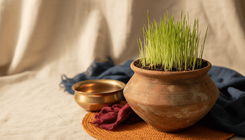
Gangaur is observed for sixteen days, though the main festival culminates in elaborate celebrations on the final day. The festival begins on the day after Holi—the spring festival of colour—and ends on Gangaur Tritiya (the third day of the lunar month of Chaitra). On the opening day, women prepare clay idols of Gauri and Shiva or buy them from potters. These idols are placed in an earthen pot filled with barley seeds and water, then kept in a warm place so the seeds germinate.
Over the sixteen days, women gather daily for puja (worship), singing traditional songs called gangaur geet and applying henna to their hands and feet. The singing tells stories of Gauri's penance, Shiva's wandering, marriage and family life, weaving together mythology with the everyday experiences of marriage, motherhood and devotion. Each song carries layers—it is at once a religious invocation, a social gathering and a creative space where women's voices are central.
The germinated barley shoots, called jwar, grow pale and tender during these sixteen days. They become sacred offerings, symbolising fertility and the renewal promised by the season.
The Main Festival Day
On the final day of Gangaur, the celebration reaches its height. In towns and villages across Rajasthan, women dress in their finest clothing—bright ghaghra-choli (skirts and blouses) in reds, yellows, greens and golds, adorned with silver jewellery and traditional mirror work. Young girls are dressed by their mothers with the same care given to an idol.
The centrepiece is the procession of idols. Women carry the clay figures of Gauri and Shiva in decorated palanquins or on their heads, walking through the streets singing, dancing and playing traditional musical instruments like the dholak (drum). The procession moves through fields and watercourses—the goddess is traditionally taken to water, acknowledging the connection between Gauri, water and fertility.
In many villages, the procession ends at a shrine or temple where the idols are immersed in a river or pond, similar to the immersion of Durga's idols during Navratri. Some regions keep the idols for longer worship before immersion. The pale jwar shoots are distributed as blessed offerings (prasad) to family members and neighbours, representing the blessing of fertility and abundance.
Regional Variations Across India
While Gangaur is most closely linked to Rajasthan, the festival takes on different forms elsewhere. In Madhya Pradesh and Gujarat, Gangaur celebrations focus similarly on women and marital devotion, though musical styles and ritual details vary. In some communities, Gangaur is called Ghaur or Gaur. In Jharkhand and parts of the Deccan, spring festivals honouring the feminine divine—such as Chaitra Parva—share Gangaur's themes of fertility and renewal, though they may invoke different deities alongside or instead of Gauri.
The unifying thread is that Gangaur belongs to women as both devotees and celebrants. It is not primarily a family occasion or a temple-based ritual; it is a women's festival, and the authority and joy of the celebration flow from the women themselves.
Gangaur and Women's Agency
What makes Gangaur distinctive is that it celebrates marriage and family life—traditionally male-dominated territories—entirely through the voices, hands and decisions of women. Women design the decorations, sing the songs, perform the worship, and lead the procession. The songs they sing are often passed down through generations of mothers, aunts and grandmothers, creating an oral tradition that belongs to women as keepers of cultural memory.
The festival also contains space for unmarried girls. Young girls join the processions and participate in the puja, sometimes making vows or prayers related to marriage and family. This integration means Gangaur simultaneously honours the married couple and welcomes those not yet married into the tradition.
In modern times, Gangaur has become a public celebration in Rajasthan, with state-sponsored processions, cultural programmes and competitions. Yet at its heart remains the intimate gathering of women—in homes, courtyards and villages—singing songs that are as old as the tradition itself.
Common questions
When is Gangaur celebrated each year?
Gangaur is celebrated over sixteen days beginning the day after Holi and concluding on Gangaur Tritiya, the third day of the lunar month of Chaitra (typically in March or April). The exact dates vary each year because they follow the lunar calendar rather than a fixed solar date.
Why do women grow barley in pots during Gangaur?
The germinating barley shoots, or jwar, symbolise fertility and the renewal of spring. Over sixteen days, the seeds sprout pale green shoots that are then offered as blessed prasad to family and neighbours, carrying blessings of abundance and new life.
Is Gangaur celebrated only in Rajasthan?
While Gangaur is most prominent in Rajasthan, it is also observed in Madhya Pradesh, Gujarat, Jharkhand and parts of the Deccan. Regional variations exist in ritual details and musical styles, though the core theme of honouring the divine couple and celebrating women remains constant.

Related Articles


