
Gangasagar Mela: Where the Ganga Meets the Sea
Sacred waters merge at earth's threshold

Aditya Pandey
18 Nov 2026 • 6min
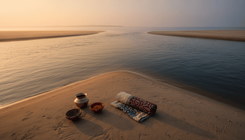
The Gangasagar Mela is a pilgrimage festival where the Ganga River meets the Bay of Bengal on Sagar Island in West Bengal. Held once a year, it draws hundreds of thousands of devotees who believe that bathing in these waters washes away sin and brings spiritual merit. The mela is also associated with Kapil Muni, a legendary sage whose ashram is said to have stood at this spot, and whose meditation blessed the pilgrimage site itself.



The Ganga and the Pilgrimage
The Ganga is sacred in Dharma not just as a river, but as a goddess, Ganga Maata, flowing from the Himalayas to the sea. In Hindu belief, the waters of the Ganga purify all who touch them. The spot where she reaches the ocean is held to be especially sacred—the moment where the finite meets the infinite, where the river's journey ends but its spiritual power does not. This is what draws pilgrims to Sagar Island during the mela.
The pilgrimage is not new. People have travelled to this confluence for centuries, walking great distances on foot in earlier times. Many still arrive by train and bus, and each year the numbers grow. The festival has become one of India's largest religious gatherings, though it draws far less international attention than Kumbh Mela or Kashi.
The Legend of Kapil Muni
According to the Bhagavata Purana, Kapil Muni was a great sage and an avatar of Vishnu. A king named Sagar was cursed to lose his sons, who were burnt to ash by Kapil's gaze when they disturbed his meditation. The ashes of these sixty thousand princes were said to lie at the place now known as Sagar Island. When the river Ganga was brought to earth to flow across the land, her waters flowed over these ashes and liberated the souls of Sagar's sons, which is why the meeting of Ganga and sea remains a place of liberation.
The presence of Kapil Muni does not require proof in the way that a modern reader might expect. What matters is that the story is part of the Bhagavata Purana, one of the most widely revered texts in the Sanatan Dharm, and that the connection between the sage and the place has been established in tradition for many generations. The ashram where Kapil meditated is the spiritual anchor of the pilgrimage.
When the Mela Happens
The Gangasagar Mela is observed during the month of Magh, which falls in the Indian winter. The most auspicious day is Makar Sankranti, the solar festival that marks the sun's northward movement, when the sun enters the zodiacal sign of Makara or Capricorn. On this day, the gathering is largest and the spiritual benefit is held to be greatest. However, pilgrims arrive in the days before and continue to come afterward, and many complete their pilgrimage even if they cannot be present on the exact day.
The timing is tied to the agricultural and astronomical calendar. Makar Sankranti is a festival celebrated across India, but at Sagar Island it becomes a gateway to the Ganga's meeting with the sea. Some years the mela lasts for several weeks; in other years, the main bathing days are concentrated into a shorter period.
What Pilgrims Do
Those who come to Gangasagar typically bathe in the confluence at dawn, when the water is believed to be most sacred. Many travel with family, making it both a spiritual journey and a family occasion. Devotees often observe fasts, perform rituals, and recite prayers. Some walk the whole island in circumambulation. The experience is both internal—a meditation on faith and mortality—and collective, since pilgrims come together in vast numbers.
Many pilgrims also visit the ashram site and temples dedicated to Kapil Muni that stand on the island. These give form to the sacred story and provide a focus for worship. The mela is not a rigid ceremony with prescribed steps, but rather a pilgrimage shaped by each person's devotion and intention.
The Practical Journey
The logistics of the Gangasagar Mela are substantial. Sagar Island is remote and accessible mainly by ferry. The infrastructure to handle hundreds of thousands of visitors has grown over time, with temporary camps, bathing ghats, and medical facilities set up during the mela season. The West Bengal government and local communities work together to manage the gathering.
Travel conditions can be challenging. The island is cold and often wet during Magh, the river is tidal and strong, and basic facilities are limited. Yet these hardships are not accidental to the pilgrimage—they are part of what makes it a test of faith and devotion. For many pilgrims, the journey itself is the practice, not merely the arrival.
A Pilgrimage Among Millions
The Gangasagar Mela belongs to a wider family of Ganga-centred pilgrimages. Nearby Hooghly also has ancient temples on the Ganga's banks. Kashi and Haridwar are older and more celebrated. But Gangasagar holds a unique place as the journey to the river's end, to the point where the sacred meets the oceanic. It is a pilgrimage rooted in the landscape itself—not in a temple town built by humans, but in the spot where two waters meet.
For those planning a visit, the journey requires time, physical preparation, and awareness of tidal and weather conditions. But for pilgrims across India and the diaspora, the Gangasagar Mela remains one of the most direct ways to touch the sacred current that has flowed through Dharma for thousands of years.
Common questions
When exactly does the Gangasagar Mela happen each year?
The mela is held during Magh, and the most auspicious day is Makar Sankranti, the solar festival that marks the sun's entry into Makara. This date shifts with the solar calendar rather than the lunar one, typically falling in mid-January.
How many people attend the Gangasagar Mela?
The mela is one of India's largest religious gatherings, drawing hundreds of thousands of devotees. Exact numbers vary year to year, but the event ranks among the most heavily attended pilgrimages in India.
Can I visit Sagar Island at other times of year?
Yes, Sagar Island is accessible year-round, but the pilgrimage is focused during Magh. Outside the mela season, the island receives far fewer visitors and some facilities may be limited, but devotees can still visit the temples and ashram site.

Related Articles


