
Ganesh Chaturthi: Customs, Meaning and Visarjan
Ten days of welcome, worship and letting go

Sunil Chaurasia
10 Nov 2026 • 6min
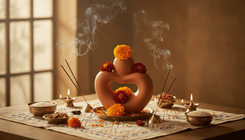
Ganesh Chaturthi is a ten-day festival honouring Ganesha, the deity of beginnings, wisdom and the remover of obstacles. It is observed in homes and public spaces across India and by Hindu communities worldwide. The festival falls on the fourth day of the dark fortnight in the month of Bhadrapada, which usually falls between August and September. At its heart is a simple cycle: bringing an idol into the home, worshipping it, and then immersing it in water—a custom called visarjan. What makes this cycle meaningful is what happens between arrival and departure.



The meaning of visarjan
Visarjan literally means "to release" or "to send off". When devotees immerse the idol in water on the tenth day, they are not discarding Ganesha. The immersion is understood as a return: the clay returns to the earth, the idol dissolves back into nature, and Ganesha himself—understood as eternal and formless—continues beyond the physical form. This practice teaches an important principle found throughout Hindu philosophy: that nothing material is permanent, and that attachment to form creates suffering. By letting the idol go, devotees are reminded not to hold too tightly to any outcome or possession.
The act of visarjan is also communal. Neighbours, friends and sometimes thousands of people carry idols to rivers, ponds or the sea to immerse them together. They sing, dance and celebrate as the idols enter the water. What could be sad—saying goodbye—becomes joyful, because the philosophy behind it is one of trust and transformation rather than loss.
How Ganesh Chaturthi is observed
Most homes and temples begin by installing a clay idol of Ganesha on the first day of the festival. The idol is usually placed on an altar decorated with flowers, leaves and garlands. Daily worship involves offering flowers, incense, and food to the idol. A traditional offering is modak—a sweet dumpling made with rice flour, jaggery and coconut—which is believed to be Ganesha's favourite. Some families make modak at home as part of their devotion; others buy them from sweet shops.
The festival is marked by gatherings where families and communities come together to sing devotional songs called bhajans and share prasad, sanctified food. In many parts of India, neighbourhood pandals—temporary structures—are set up where large, elaborately decorated idols are installed for public worship. People visit these pandals to pray and leave offerings.
On the tenth day, the visarjan takes place. The idol is carried in a procession, often with music and dancing, to a body of water where it is immersed. The choice of immersion site varies: in coastal cities it is the sea, in inland areas it may be a river or even a large tank. Some families perform a smaller, private immersion at home using a tub of water.
Why clay idols matter
Many idols made for Ganesh Chaturthi are now crafted from clay, especially in regions like Maharashtra where the festival is most widely celebrated. Clay is a natural material that dissolves harmlessly in water, returning to the earth. This practice has deep roots in the principle of working with nature rather than against it.
However, not all idols are made this way. Idols made from plaster of Paris, plastic or painted with non-biodegradable paints do not dissolve. They remain in water bodies and can harm aquatic ecosystems. Over the past two decades, many artisans and devotees have returned to or committed to clay idols as a way to honour both the festival's spiritual meaning and the environment.
The choice to use a clay idol aligns visarjan with the festival's philosophy. The immersion becomes a genuine return: matter to matter, form dissolving back into formlessness. A plastic idol that remains in the water contradicts this teaching, turning the ritual into something else—disposal rather than release.
Regional and family variations
Ganesh Chaturthi is celebrated most prominently in Maharashtra, but it is observed across India in different ways. In Karnataka, the festival is called Vinayaka Chaturthi and is marked by similar customs. In Tamil Nadu, it is Vinayakavarthi. In all these regions, the core practice—installing an idol, worshipping for several days, and immersing it—remains the same, though the scale and style vary.
Within families, too, there are many variations. Some families keep the idol for all ten days; others keep it for shorter periods. Some perform elaborate daily pujas with specific mantras; others offer simple prayers. Some communities immerse their idols on the tenth day; others immerse on the eleventh. These differences reflect the flexibility within Hindu practice—there is room for interpretation based on local custom, family tradition and individual capacity.
What remains consistent is the principle: a period of worship, and then a letting go. The exact form that takes depends on where you are, who you worship with, and what feels true to your understanding.
Living the festival's lesson
The deeper teaching of Ganesh Chaturthi is available to anyone who reflects on it. The festival asks: what do we invoke at the beginning of something new? Ganesha is called the remover of obstacles, the lord of beginnings. We invite that energy into our homes and hearts. For ten days we sit with it. And then we release it, trusting that the wisdom has stayed within us even as the form goes.
This is why the festival is observed not just by those with elaborate home altars or access to public pandals. Many devotees perform a simple puja with a small idol or even a drawing. Some light a lamp and offer flowers and incense. What matters is not the scale of the celebration but the intention: to acknowledge Ganesha, to seek his blessing at the threshold of something new, and to practice the art of letting go.
Visarjan, then, is not an ending. It is a completion—a closing of one cycle so that the next one can begin.
Common questions
How long does Ganesh Chaturthi last?
The festival lasts ten days. The idol is installed on the first day and immersed in water on the tenth day, though some families perform the immersion on the eleventh day. The exact dates change each year because the festival follows the lunar calendar.
What is modak and why is it offered?
Modak is a sweet dumpling traditionally made with rice flour, jaggery, coconut and cardamom. It is offered to Ganesha because it is considered his favourite food. Many families prepare modak at home as an act of devotion, though it can also be purchased from sweet shops.
Why do idols need to be made of clay?
Clay idols dissolve harmlessly in water during visarjan, returning naturally to the earth. Idols made from plaster of Paris, plastic or synthetic paints do not dissolve and can pollute water bodies. Using clay idols aligns the ritual with both the festival's spiritual meaning of release and transformation, and with care for the environment.

Related Articles


