
Ganapati Atharvashirsha: The Upanishad Devoted to Ganesha
The sacred text that names Ganesha's true form.

Kushal K
11 Nov 2026 • 7min
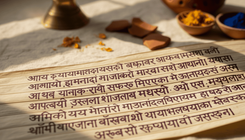
The Ganapati Atharvashirsha is an Upanishad devoted entirely to Ganesha, drawn from the Atharva Veda. It stands apart from other sacred texts because it focuses not on philosophy or ritual technique, but on direct encounter with Ganesha as Brahman, the ultimate reality. If you are looking to deepen your relationship with Ganesha through study or recitation, this text offers a concentrated path.
The text belongs to the Upanishadic tradition, which emerged from the Vedas as investigations into the nature of reality and the self. While most Upanishads explore Brahman in abstract terms, the Ganapati Atharvashirsha takes Ganesha himself as the gateway to that understanding. It is short—only around twenty verses in the most common recension—but each verse is dense with meaning, moving from the visible form of Ganesha to the formless reality he embodies.



The Place in Vedic Literature
The Upanishads form the philosophical core of Vedic learning, and the Ganapati Atharvashirsha holds a particular role within them. Its name tells you its source: Atharvashirsha means "the head of the Atharva Veda," and it is classified as an Upanishad of that Veda, though some traditions also associate it with Rigvedic or Yajurvedic lineages. The text emerged in the period when Ganapati worship became central to Hindu devotion, likely in the early medieval centuries, though we do not know the exact date of composition.
Unlike the older Upanishads, which are couched in dialogue between teacher and student or in elaborate metaphors, the Ganapati Atharvashirsha speaks directly and simply. It names Ganesha repeatedly, invoking him through his many forms and names, before revealing the non-dual truth at its heart. This directness makes it powerful for personal recitation and meditation.
What the Text Reveals about Ganesha
The Ganapati Atharvashirsha describes Ganesha through multiple dimensions at once. It opens by naming him as the lord of all beings, the lord of all speech, and the remover of obstacles—the familiar roles that devotees invoke him for. But the text does not stop there. It moves into deeper territory, identifying Ganesha as the embodiment of sacred syllables and divine knowledge. It speaks of his form as encompassing all elements, and his nature as consciousness itself.
One of the text's most striking declarations is that Ganesha is Om—the primordial sound from which creation emerges. In this vision, when you chant Om, you are invoking Ganesha directly. The text also identifies him with Brahman, the ultimate reality beyond form. These are not poetic flourishes; they are assertions of identity. To the Ganapati Atharvashirsha, Ganesha and the ground of being are one.
The text names Ganesha through his various forms: Ganesh as the remover of obstacles, as the lord of wisdom, as the wielder of the axe. It invokes him as being beyond all qualities, yet appearing in all forms. For the reader approaching the text for the first time, this multiplicity can seem contradictory—how can Ganesha be both the elephant-headed deity of the shrine and formless consciousness? The text answers that question by collapsing the distinction. Form and formlessness are not separate; they are expressions of a single reality.
How to Work with the Text in Practice
Many devotees recite the Ganapati Atharvashirsha as part of their daily worship, either as the opening to a longer puja or as a meditation in itself. The text is usually recited in Sanskrit, though translations and transliterations in English and Indian languages are widely available. Some practitioners learn it by heart; others read from a text or listen to recorded versions.
If you are practising at home, you need not have elaborate preparation. A clean space, facing east or north if possible, is sufficient. Many devotees recite the text early in the morning, when the mind is clear. Some do it before beginning other work, asking for Ganesha's blessing on the day ahead. There is no single correct way; the tradition welcomes different approaches.
The text serves different purposes for different practitioners. Some use it as a mantra for japa, repeating sections over weeks or months to deepen their connection with Ganesha. Others study it philosophically, exploring the Upanishadic teaching that Ganesha represents. Still others recite it as an offering, treating the recitation itself as puja. There is also a role for the Ganapati Atharvashirsha in formal temple worship and in guided group recitations during festivals or Ganesha Jayanti.
When you recite the text, you are participating in a practice that extends back centuries. Devotees across India and beyond have sat with these verses, asked their questions, and found answers. The text is alive in that way; it invites engagement rather than passive reception.
The Philosophical Depth Beneath the Words
The Ganapati Atharvashirsha draws on Vedantic philosophy, the non-dual tradition that teaches all apparent separateness is ultimately illusion. In this framework, Ganesha is not a god among gods, but a name for the infinite consciousness that underlies all existence. The text uses Ganesha as a pointer toward that realization.
This does not diminish personal devotion to Ganesha. Rather, it suggests that when you call on Ganesha to remove obstacles or grant wisdom, you are invoking something far larger than a personal deity. You are calling on the power of consciousness itself to dissolve the barriers within you. The elephant-headed form in the shrine becomes an image through which the infinite becomes visible to the finite mind.
Different philosophical traditions interpret the text in different ways. In the Shaiva tradition, Ganesha is understood as a form of Shiva. In the Shakta approach, he is inseparable from Devi, the divine mother. Vaishnava devotees have their own readings. The Ganapati Atharvashirsha contains layers that can accommodate these varied approaches because it speaks at multiple levels simultaneously—to the devotee seeking blessing, to the philosopher seeking truth, and to anyone in between.
Recitation as Sadhana
For many practitioners, reciting the Ganapati Atharvashirsha regularly becomes a sadhana, a spiritual discipline. Consistency matters more than length; a few verses recited with attention every day shapes the mind more than many verses recited once in distraction. Some devotees commit to reciting the full text daily for a set period—forty days, or one hundred eight days. Others weave it into their morning worship as a permanent part of their practice.
If you are drawn to this path, you might begin with a single recitation, perhaps on a day you associate with Ganesha—a Tuesday, or the day of the new moon. Listen to how the verses sound. Notice which words resonate with you. Over time, the text will become familiar, and that familiarity itself becomes a kind of meditation. The meanings shift as you change; the same words touch you differently at different times.
The recitation of the Ganapati Atharvashirsha is ultimately a conversation between you and Ganesha. The text is the words, but your practice—your attention, your intention, your willingness to show up—is what brings it alive.
Common questions
Can I recite the Ganapati Atharvashirsha if I don't know Sanskrit?
Yes. English transliterations and translations are widely available online and in books. Many devotees recite from transliteration or listen to recorded versions; the practice is valid regardless of language, though some feel Sanskrit carries particular power for mantra work.
How long is the Ganapati Atharvashirsha?
The most common version contains around twenty verses and takes five to ten minutes to recite, depending on your pace. Some recensions are slightly shorter or longer, but all are brief enough to fit daily practice.
Is there a specific day I should recite it?
Ganesha is traditionally honoured on Wednesdays and Tuesdays, and recitation on these days is auspicious. Many also recite it on Ganesha Jayanti, his birthday, or simply daily as part of personal practice, with no restriction on day.

Related Articles


