
Fire-Walking at Draupadi Amman Temples: The Theemithi Festival
Walking Through Fire, Walking in Faith

Sunil Chaurasia
18 Nov 2026 • 7min
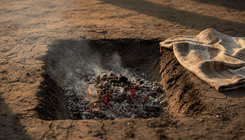
Fire walking is a spectacular act of faith performed during Theemithi, a festival celebrated primarily at Draupadi Amman temples across South India. Each year, thousands of devotees walk barefoot across smouldering coals as an offering to the goddess Draupadi. Unlike fire walking as a secular performance or test of will, Theemithi is a vow carried out in devotion—a ritual that has endured for generations and draws pilgrims from across India and the diaspora.



The Story of Draupadi and the Festival's Roots
The fire walk draws its power from the Mahabharata, the epic that recounts the ordeal of Draupadi. According to the story, Draupadi faced trial by fire to prove her purity and honour after being publicly shamed. She entered the flames unharmed, emerging vindicated. In her temples, especially the famous one at Meenakshi Amman Temple precinct in Madurai and at other Draupadi shrines across Tamil Nadu and Puducherry, the festival commemorates her strength and sovereignty. The fire walk re-enacts the devotee's own passage through trial and transformation, mirroring the goddess's triumph.
This narrative is not merely mythological backdrop; it shapes the ritual's meaning. Walkers carry vows—promises to the goddess made during hardship—and the walk itself is the fulfilment. For many, it represents a turning point: illness healed, a danger passed, a life restored. The coals become a threshold between prayer and answered grace.
How Theemithi Is Observed
Theemithi falls during the month of Aavani, typically in August or September, aligned with the Tamil calendar. The festival begins with preparations days in advance. Temple committees oversee the construction of the fire pit—a carefully laid bed of coconut husks, neem wood and other materials that burn to create the walking surface. The exact composition varies by temple, but the aim is consistent: coals that are hot enough to be spiritually significant yet managed with safety in mind.
Before the walk, devotees gather for worship. Priests offer prayers to Draupadi and invoke her blessings. Some devotees have fasted; others wear simple white or red clothing. The atmosphere builds as the walk approaches. Drummers play traditional rhythms. People chant the goddess's names. This preparation is not incidental; it is the devotional container that holds the ritual's meaning.
When the moment comes, walkers approach the fire pit in groups or singly. Some move quickly. Others walk slowly, deliberately. Many report feeling no pain, describing instead a sense of protection or presence—experiences they attribute to the goddess's grace rather than physiology. After the walk, participants often visit a water tank or stream nearby to cool their feet, though burns are rare and typically minor when they do occur.
Why Devotees Walk
The reasons people undertake the fire walk are as varied as the walkers themselves. Some fulfil a vow made during crisis—a sick child recovered, a court case won, a danger narrowly escaped. Others walk as an act of thanksgiving for answered prayers. Some come seeking blessing for a specific intention: healing, protection for a family member, or resolution of a long-standing difficulty. The walk is understood as a direct conversation with the goddess, embodied in action.
For many, the walk is also an affirmation of belonging—to a community of devotees, to a living tradition, to a lineage of faith stretching back through the Mahabharata. The courage required to walk across fire is taken as a measure of devotion itself. To walk is to place oneself entirely in the goddess's hands, surrendering doubt and fear.
There is also a quieter significance: the walk confirms that the body is not the only reality that matters. In a ritual framework, the body's vulnerability becomes secondary to the spirit's intention. This does not diminish the body but rather positions it as an instrument of devotion rather than an obstacle to it.
Regional Variations and Spread
While Theemithi is most deeply rooted in South India, particularly Tamil Nadu and Puducherry, the practice has spread wherever Tamil communities maintain temples to Draupadi. Significant celebrations occur at temples in Bangalore, Hyderabad and other Indian cities, as well as in diaspora communities in Singapore, Malaysia and beyond. The Meenakshi Amman Temple in Madurai remains one of the most prominent venues, drawing thousands during the festival.
Regional practice varies in detail. Some temples walk on coals; others include additional rituals or different timings aligned with local lunar calendars. The core elements remain consistent—devotion, fire, the goddess's protection—but the particular expression shifts with place and community. These variations are not contradictions but rather evidence of a living tradition that adapts while maintaining its essence.
Safety and Misconceptions
Fire walking at Theemithi is neither sleight of hand nor a test of endurance divorced from faith. Temple authorities work to ensure the ritual is conducted safely. Fire pits are constructed with care. Organisers are experienced in managing the practice. Medical personnel are typically present. The festival is not reckless; it is intentional.
Common misconceptions persist. Some observers assume the walkers are in trance or hypnotised. Others suggest the coals are not hot enough to cause real burns. Still others attribute any lack of injury purely to psychology. What these explanations often miss is the devotee's own framework: within a lived faith, the separation between psychological and spiritual, between belief and power, is far less clear. The devotee does not arrive at the fire pit uncertain whether grace will hold. They arrive already trusting, and the walk confirms that trust.
Preparing Your Own Visit
If you are considering witnessing or participating in Theemithi, approach the festival with respect for its religious nature. Theemithi is not entertainment or a tourist spectacle; it is worship. Dress modestly. Follow the guidance of temple officials. If you are not participating in the walk yourself, maintain a reverent distance from the fire pit and from walkers. Photography is sometimes restricted; always ask before photographing.
If you intend to walk, prepare spiritually as well as practically. Understand the vow you are making. Connect with the tradition and the goddess through prayer in the days before. Arrive at the temple early to absorb the atmosphere and the teachings of experienced devotees. Speak with temple priests or elders about what the walk means. This preparation is as important as the walk itself.
The fire walk ultimately invites you into a centuries-old conversation between devotees and the divine—a conversation written not in words but in courage, faith and the willing transformation of the body into prayer.
Common questions
When does Theemithi take place each year?
Theemithi is observed during the month of Aavani in the Tamil calendar, typically falling in August or September. The exact date shifts annually because it follows the lunar calendar rather than a fixed date.
Can anyone participate in the fire walk?
While the ritual is open to devotees of all backgrounds, participants are expected to approach it with sincere faith and respect for its religious nature. Many temples encourage preparation through prayer and fasting beforehand. It is advisable to speak with temple officials about your readiness before attempting the walk.
Are people actually injured when they walk across the coals?
Serious injuries are rare, though minor burns do occasionally occur. Temple authorities take safety precautions seriously, and the coals are genuine and hot. Most walkers report no pain during the walk, which they attribute to the goddess's protection rather than to tricks or psychology alone.

Related Articles


