
Durga's Weapons: What Each Hand Holds and Why
Ten arms, ten powers, one divine victory

Aditya Pandey
18 Nov 2026 • 6min
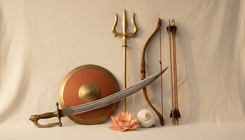
Durga is shown with ten arms, and each one holds a weapon or symbol. These are not random objects: each weapon carries its own meaning, and together they tell the story of how the goddess overcomes the forces that obstruct spiritual progress and dharma. To understand Durga's weapons is to understand what her form represents and why she is invoked at moments when strength and clarity are needed most.



The Weapons and Their Symbolism
Durga holds the trident (trishul) given by Shiva, which represents his divine power and her role as destroyer of ignorance and ego. The discus (chakra) from Vishnu is the wheel of time and law, the power to cut through confusion with wisdom. The conch shell (shankha) is sound and creation itself. The bow and arrow signify focus and the ability to strike at the root of a problem without hesitation. The curved sword (talwar) cuts through illusion. The thunderbolt (vajra) is the most direct and undefeatable strike against evil. The serpent (nag) shows mastery over the forces of nature and the base instincts that must be tamed. The shield (dhal) is protection, both for herself and for those who take refuge in her. The lotus flower that often appears in her hands symbolises grace, purity and the unfolding of spiritual potential.
Each weapon is drawn from the gods. This is significant: the Devi Mahatmya, the ancient text that tells of Durga, shows how the gods gave her their power because no single god could defeat the demons that threatened the cosmos. Only the goddess in her supreme form could do what they could not. Her arsenal is thus a sign of universal divine power concentrated in her hands.
Why Ten Arms
Ten arms are more than symbolic richness. They show Durga acting in all directions at once, responding instantly to any threat, never caught off guard or unable to act. The number ten itself has meaning in Hindu philosophy: it is the number of completion, of the cycle finished. Ten is also significant in the mantra of the goddess. Durga's form with ten arms represents totality, wholeness, the fullness of divine action.
Different texts and traditions describe the position and order of the weapons in different ways. The most common depiction shows her seated or standing in a posture of assured calm, often riding a lion or tiger, with her weapons arranged in a way that shows her readiness. Some depictions emphasise certain weapons more heavily: in some regions, the sword or trident appears larger or more prominent. But the core principle remains the same. She holds the tools needed to restore order when chaos threatens.
The Weapons in Her Battles
The most famous encounter described in the Devi Mahatmya is Durga's battle against the buffalo demon Mahishasura. This demon was so powerful that he could not be killed by any god, yet Durga defeated him in combat. The different weapons came into play at different moments: the bow and arrow to weaken him from a distance, the sword and trident in close combat, the thunderbolt as the final strike. This narrative shows that defeating obstacles often requires many kinds of action, not just one approach.
The Devi Mahatmya also tells of other demons she defeated: Shumbha, Nishumbha, and Raktabija. Against each one, she used her weapons with precision and strategy. The text describes her as moving with the grace of a dancer even as she fights with the force of a warrior. This is an important point: Durga's weapons are not wielded in blind anger or aggression, but with perfect understanding of what each moment requires.
Durga Puja and the Weapons
When Durga is worshipped, especially during the nine nights of Navratri or during Durga Puja itself, the weapons are often depicted in her form or painted on the altar. In some temples, the weapons are made of wood, clay, or metal and placed around her image. In others, they are part of the painted or sculpted form itself. Each region has its own tradition of how these weapons are shown and honoured.
The weapons also appear in many regional forms of the goddess. Kali, Tara, and other forms associated with Durga also carry weapons, sometimes the same ones, sometimes different ones suited to their particular role. But Durga's ten arms and her specific combination of weapons remain the most widely recognised and depicted.
Understanding the Deeper Meaning
To worship Durga's weapons is to ask for the clarity, courage and skill to handle one's own obstacles. The weapons are not meant to inspire violence. Rather, they represent the tools of spiritual work: the ability to distinguish truth from falsehood (the sword), to act with perfect timing and aim (the bow), to receive and hold divine grace (the lotus), to protect what matters (the shield). When you see Durga with her weapons, you are seeing a form that says: these are the powers you need, and they are available to you through dedication to dharma.
The ten arms remind us that we do not act in only one direction or with only one approach. Life requires adaptability, readiness and the wisdom to know which tool to use when. This is what Durga teaches through her image, and why she has been called upon for thousands of years as the power that restores balance when the world tilts toward chaos.
Common questions
What does each of Durga's weapons represent?
The trident (from Shiva) destroys ignorance, the discus (from Vishnu) cuts through confusion, the conch creates and sanctifies, the bow and arrow strike at problems with focus, the sword cuts through illusion, the thunderbolt is the ultimate strike against evil, the serpent shows mastery over base instincts, the shield protects, and the lotus represents spiritual unfolding. Each comes from a different god, showing that Durga holds universal divine power.
Why does Durga have ten arms instead of two?
Ten arms show that the goddess can act in all directions at once and respond instantly to any challenge. The number ten also represents completion and wholeness in Hindu philosophy, reflecting the totality of divine power and action needed to maintain cosmic order.
Where does the story of Durga's weapons come from?
The Devi Mahatmya, part of the Markandeya Purana, describes how Durga received these weapons from the gods because no single deity could defeat the demons threatening the cosmos. The text recounts her battles with Mahishasura and other demons, showing how she used each weapon with strategy and perfect timing.

Related Articles


