
Dol Jatra: Bengal's Spring Swing Festival of Colour and Joy
Spring arrives on the swing, in laughter and colour.

Abhilash Ramakrishna
20 Nov 2026 • 6min
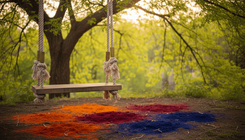
Dol Jatra is Bengal's spring festival, celebrated with swings, music, colour and togetherness. The name comes from "dol", meaning swing, and the festival centres on swinging—a joy so simple that it carries something sacred. Across West Bengal and parts of Assam and Odisha, families and communities mark the arrival of spring by gathering around swings strung from sturdy branches, singing folk songs, and throwing coloured powder and water. It is a festival of laughter and renewal, where age and status matter less than the pleasure of being together as the season turns.



The timing and the story
Dol Jatra falls during the month of Phalgun, usually in March, when winter loosens its grip and the spring flowers—especially marigolds and other blooms—turn the world bright. In Bengal, this festival is often linked to the love story of Radha and Krishna. The Radha Krishna lila is central to the festival's spirit: the divine couple are said to play on a cosmic swing, and their playfulness invites all of creation to join in the joy of spring. By swinging and celebrating, devotees share in that divine play.
The festival is also celebrated by some as a secular marking of the new season, independent of any mythological association. Many families observe Dol Jatra simply as a day to step outside, sing together, and feel the warmth returning to the world. This openness—celebrating both the devotional and the seasonal—is part of what gives the festival its reach across communities in Bengal.
The swing as centre
The swing is not decoration or backdrop. It is the heart of Dol Jatra. Families erect sturdy swings, often from the branch of an old mango or jackfruit tree, using ropes that have been prepared or maintained through the year. The act of swinging itself is considered playful worship—a way of expressing joy and freedom. During the festival, children and adults take turns on the swing while others gather around, clapping and singing traditional Dol Jatra songs, known as dol gan.
The most well-known dol songs describe the divine couple at play, or call out invitations to join the swing. The music has a particular lilt and rhythm, designed to match the motion of the swing itself. Many of these songs have been sung for generations, passed down through families and communities. The singing and swinging create a kind of rhythm together—musical, physical, and communal all at once.
Holika and colour
Dol Jatra is closely woven with Holi, the broader spring festival celebrated across India. In fact, Dol Jatra and Holi overlap, with Dol Jatra often considered the Bengali expression of Holi's spirit. Like Holi, Dol Jatra involves colour—the throwing of coloured powder (called gulal or phag) and coloured water. These colours are now often synthetic, but traditionally came from natural sources: indigo, turmeric, poppy flowers, and other plants gave the festival its palette.
The playful spraying of colour is not random. It carries a meaning: the colours wash away boundaries, blur the lines between rich and poor, young and old, and invite everyone to play as equals. A person covered in colour cannot preserve the usual distances of social hierarchy. This levelling effect is part of what makes the festival joyful and, in its way, sacred.
Regional and local expressions
While Dol Jatra is strongest in West Bengal, the festival appears across other parts of eastern India with different names and customs. In some areas of Odisha, a similar swing festival is called Dola Purnima. Assam celebrates Rongali Bihu, another spring festival with overlapping themes of renewal and community. In each place, the core remains: a swing, a community, the arrival of spring.
Even within West Bengal, local variations are common. Some villages have swing competitions, others focus more on the communal meal and gathering. Some families maintain the same swing through the year, carefully stored and brought out each spring; others build new ones each time. Urban celebrations may be smaller or more informal than village-wide events, but the element of swinging and singing persists.
Preparation and the larger calendar
Dol Jatra does not stand alone. It arrives as part of the broader spring awakening that includes Basant Panchami (a celebration of spring itself, observed a month or so earlier), and it flows into Holi. Together, these festivals mark the shift from the dry cold of winter to the moisture and warmth of spring. Farmers mark the season as a turning point in the agricultural year. The blooming of spring flowers—especially mustard flowers and marigolds—becomes part of the visual and emotional landscape of the festival.
Many families prepare in the weeks before: gathering or making coloured powder, setting up or repairing swings, and learning or reviewing the traditional songs. The preparation itself is part of the practice, especially for children who grow up learning the dol gan and the meaning of the festival through participation.
Carrying the festival forward
Dol Jatra is a festival that invites participation, not observation. If you encounter it—whether in Bengal or among Bengali communities elsewhere—the gesture is an invitation to swing, to sing, and to share in the colour and laughter. The festival does not require specific ritual knowledge or spiritual background. It asks only that you step into the circle, take a turn on the swing, and let yourself feel what spring brings.
In a world of increasing distance and isolation, Dol Jatra remains rooted in one of the simplest, oldest forms of togetherness: the swing, the song, the circle of people gathered together. That simplicity is what carries its power.
Common questions
When is Dol Jatra celebrated?
Dol Jatra is observed during the month of Phalgun, usually in March, when winter ends and spring arrives. The exact date shifts each year because it follows the lunar calendar, not a fixed calendar date.
Is Dol Jatra the same as Holi?
Dol Jatra and Holi overlap, and Dol Jatra is often understood as the Bengali expression of Holi's spirit of colour and renewal. While Holi is celebrated across India, Dol Jatra is specifically the spring swing festival of Bengal and neighbouring regions.
Can anyone participate in Dol Jatra celebrations?
Yes, Dol Jatra is an inclusive festival that welcomes everyone. The throwing of colour and the swinging deliberately blur social boundaries, and the invitation to join extends to all who wish to celebrate the arrival of spring.

Related Articles


