
Dev Deepawali 2026: Why Kashi Celebrates Tripurari Shiva
The Festival of Divine Lamps in the City of Light

Abhilash Ramakrishna
26 Oct 2026 • 7min
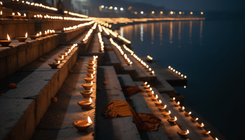
Dev Deepawali, also called Dev Diwali, is the festival when Kashi illuminates itself with lamps along the Ganges to celebrate Shiva's victory as Tripurari, the one who destroyed the three cities. Unlike the Deepawali celebrated across India in autumn, Dev Deepawali falls in the month of Kartik, on the full moon night (Kartik Purnima), when devotees gather to witness Kashi's ghats transformed into a constellation of sacred light.
The festival is rooted in one of Shiva's most celebrated victories. According to Hindu tradition, three asuras named Vidyunmali, Tarakaksha and Kamalaksha were granted a boon: they could only be destroyed if a single arrow could pierce all three of their cities at once. Protected by this near-impossible condition, they grew arrogant and tyrannical, troubling the gods and the world. Shiva, moved by the suffering they caused, responded to the call for help. He took his celestial chariot, drew his bow, and released one arrow that pierced all three cities simultaneously, destroying the asuras and restoring balance. This act earned Shiva the title Tripurari, the destroyer of the three cities.
Kashi holds a unique place in this narrative. The city is considered Shiva's eternal abode, the place where he dances in bliss and destruction intertwine. When the Dev Deepawali festival is observed here, it takes on a particular resonance. The lighting of lamps is not merely commemoration but an act of devotion and gratitude, acknowledging Shiva's protection and his cosmic role in maintaining dharma, or righteous order.



The Story of the Three Cities
The tale of the three cities reaches back into Hindu scripture and philosophy. The three asuras each ruled a city: one was made of gold, one of silver and one of iron. They represented not just political power but also spiritual ignorance and ego. Their destruction by Shiva symbolises the annihilation of forces that oppose cosmic harmony.
In some retellings, the three cities are understood symbolically as representing the three qualities of materiality: the past, present and future; or the three gunas—sattva, rajas and tamas. Shiva's single arrow piercing all three simultaneously points to a deeper truth: that ultimate liberation transcends the divisions created by material time and nature. When Shiva acted, he did so for the welfare of all beings, not out of anger but out of compassion and duty.
The festival celebrates this victory and, by extension, celebrates the order and protection that Shiva's presence brings to the universe. It is a reminder that Shiva is not merely the ascetic in meditation but also the supreme protector who acts decisively when dharma is threatened.
Why Kashi Lights the Lamps
Kashi, or Varanasi, is the holiest city in Hinduism. It sits on the Ganges, the river believed to carry the grace of Shiva himself. The city's association with Shiva is unbreakable: he is said to hold Kashi as his eternal home, the axis around which spiritual life revolves. When Dev Deepawali arrives, Kashi transforms this devotional geography into a visible spectacle.
On the night of Kartik Purnima, devotees, pilgrims and residents light countless lamps along the ghats—the stepped stone embankments that line the river. These are not haphazard offerings but carefully arranged, covering the riverbanks in a continuous glow. The practice has been observed for generations, woven into the fabric of Kashi's spiritual life.
The lighting of lamps serves multiple purposes. It honours Shiva's victory, certainly, but it also symbolises the illumination of knowledge dispelling ignorance. In Kashi, a city where many come seeking liberation and spiritual truth, the lamps represent the light of wisdom. The Ganges itself becomes a mirror, reflecting thousands of flames back into the night, creating the effect of a river of light flowing through the city.
For pilgrims and residents alike, Dev Deepawali in Kashi is also an occasion for ritual bathing in the Ganges and circumambulation of the temples. Many perform pujas, or worship rituals, at the ghats and nearby shrines dedicated to Shiva. The spiritual energy of the city during this night is considered especially potent.
The Timing: Kartik Purnima
Dev Deepawali occurs on Kartik Purnima, the full moon night in the month of Kartik, which falls between October and November in the lunar calendar. The full moon is always significant in Hindu practice, marking a time of heightened spiritual energy and the culmination of the bright half of the lunar month. Kartik Purnima is particularly auspicious for rituals and devotion.
The choice of this night connects to Shiva's worship across the tradition. Many important Shiva observances fall during Kartik: Kartik Maas, the entire month, is considered especially favourable for Shiva worship and meditation. Dev Deepawali, arriving at its climax, draws many who are already engaged in deeper spiritual practice during this period.
It is worth noting that while Dev Deepawali is most renowned as a Kashi observance, the broader celebration of Kartik Purnima is observed across India. In many regions, the night carries other significances: Guru Nanak Jayanti, the birth of Sikhism's founder, falls on this date; in some traditions it marks the end of the monsoon and the beginning of the new season. Yet in Kashi, it is the festival of Tripurari Shiva that dominates the spiritual calendar.
The Festival's Spiritual Meaning
Beyond its mythological narrative, Dev Deepawali carries deep spiritual meaning. The destruction of the three asuras can be understood as the destruction of ego, attachment and delusion within each person. Shiva, in piercing the three cities, demolishes the false security that comes from identification with the material world.
The lighting of lamps on the banks of the Ganges mirrors this inner transformation. Each flame represents the awakening of consciousness, the light of the atman or self, which is never truly separate from Shiva. For devotees present at the ghats, the sight of thousands of lamps has been described as a visible manifestation of this truth: countless individual lights that together form a unified luminescence.
Kashi's Dev Deepawali also reflects the city's role as a place of pilgrimage and seekers. Many come to Kashi seeking moksha, or liberation from the cycle of birth and death. The festival reminds them that Shiva is the one who grants this liberation, who destroys not out of cruelty but out of supreme wisdom and compassion. In honoring Tripurari, devotees are also invoking this aspect of Shiva's grace.
The festival is not only for the initiated or the spiritually advanced. Families gather, children witness the spectacle of light, and the atmosphere becomes one of shared devotion. In this way, Dev Deepawali bridges individual spiritual aspiration and communal celebration, making the sacred accessible to all who come to Kashi with reverence.
Common questions
When is Dev Deepawali in 2026?
Dev Deepawali 2026 falls on Kartik Purnima, the full moon night in the month of Kartik. The exact date changes each year according to the lunar calendar; you can check a Hindu panchanga or calendar for the precise date in 2026.
Is Dev Deepawali the same as Diwali?
No. Deepawali, celebrated across India in autumn, falls on Amavasya (the new moon) in the month of Kartik. Dev Deepawali is a separate festival observed on Kartik Purnima (the full moon) and is especially significant in Kashi. While both festivals celebrate triumph of light over darkness, they mark different events and dates.
Can I visit Kashi for Dev Deepawali?
Yes, many pilgrims travel to Kashi for Dev Deepawali to witness the lamps along the Ganges ghats and participate in rituals. The festival night draws large crowds, so plan accommodation and travel in advance if you intend to visit during this time.

Related Articles


