
Deep Daan: Floating Lamps on Rivers as an Offering
Light Released, Wishes Carried Far

Kushal K
21 Nov 2026 • 6min
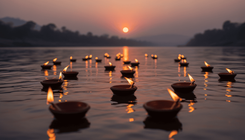
Deep daan is the practice of floating small oil lamps on rivers or other bodies of water as an offering and a prayer. The word deep means lamp, and daan means an offering given with no expectation of return. When you set a lamp adrift on water, you are releasing a piece of light into the world, along with your wishes and gratitude. It is one of India's most peaceful rituals, and it takes only a few moments to perform.
The custom appears across many festivals and observances in the Hindu calendar. The most widely known is Diwali, the festival of lights, when people float lamps on rivers, ponds and lakes. Diwali celebrates the victory of light over darkness and the triumph of good over evil, so floating lamps becomes a way of sending that message of light beyond your home into the larger world. But deep daan is not limited to Diwali. You might float lamps during other festivals too—during Kartik Purnima, when a full moon rises in the month of Kartik, or during times of personal prayer or mourning. Some people do it on significant dates in their lives, or when they want to mark a gratitude or an intention.



What the Lamp Represents
The lamp itself carries meaning. In Hindu philosophy, light has always symbolised knowledge, consciousness and the divine. Darkness represents ignorance and fear. When you float a lamp, you are not just performing an action; you are using the lamp as a carrier for that ancient symbolism. The flame becomes a vehicle for your intention, your gratitude or your prayer. As it drifts away on the water, the light seems to carry those things with it, further into the world and beyond your sight.
Different regions and traditions approach the lamp itself in different ways. In many places, people use small clay vessels filled with oil and a cotton wick—the same deep or diya used in homes during Diwali. These are often made by hand, from clay dug near the river itself, which connects the offering to the earth and the water where it will travel. In some regions, people make elaborate floating lamps with leaves, flowers and petals arranged around a central light. The specific form matters less than the intention behind it.
Timing and Season
Deep daan happens most often during the month of Kartik, which falls between October and November. This is the season when rivers are at a good level—full enough to carry the lamps safely, but often calmer than during monsoon. Kartik is considered an especially auspicious month in the lunar calendar, a time when spiritual practice is thought to yield deeper results. Kartik Purnima, the full moon day in this month, is one of the most important dates for floating lamps, and many temples and cities organise communal deep daans on that evening.
Yet deep daan is not confined to Kartik. During Diwali, which comes several weeks earlier in the autumn, it is practised by families across the country. In some places, it happens year-round—a person may float a lamp on any day when they feel called to do so, to mark a personal occasion or to send a prayer into the world. You do not need permission or a special date. The ritual is accessible to anyone, anywhere there is water.
The Ritual Itself
The act of deep daan is simple. You take a small lamp filled with oil and a lit wick, hold it for a moment—sometimes speaking a prayer or setting an intention silently—and then gently place it on the surface of the water. The lamp floats, carrying its light downstream. Some people do this once, alone; others gather in groups at riverbanks or ghats, and the water fills with dozens or hundreds of tiny lights moving together in the darkness.
There is no fixed mantra or prescribed words you must speak. Some people repeat a simple prayer to a deity they feel close to. Others simply hold a moment of gratitude or say their intention silently. The ritual works because of what it means to you and the sincerity you bring to it. The beauty of deep daan is partly that it leaves room for your own practice and belief.
Many people combine deep daan with other practices on the same day. You might perform a puja—a formal prayer ritual—at home or at a temple, and then go to the water to float a lamp. Or you might fast, meditate, or make other offerings. Deep daan becomes part of a larger observance rather than something you do in isolation. In cities and towns, temples often organise collective deep daans where many people gather to float lamps together, creating a shared moment of light and prayer.
A Practice of Release
There is something profound about deep daan that goes beyond ritual form. You are making an offering, yes—giving something of value to the water and the world. But you are also practicing a kind of release. You set down the lamp and let it go. You cannot control where it drifts, how far it travels, or when its light will fade. That surrender, that trust in what lies beyond your control, is part of what makes deep daan meaningful.
This aspect of the ritual speaks to many people, especially during times of grief or change. Floating a lamp can be a way of honoring someone who has passed, or of letting go of something that has weighed on you. It is an act that acknowledges both the light you carry and the mystery you cannot see or hold. The lamp drifts away, carrying your light and your prayer, and you are left standing on the shore with the rest of the night ahead.
Common questions
When exactly should I float lamps during Kartik?
The most auspicious time is Kartik Purnima, the full moon in Kartik month. However, many people float lamps throughout the month, especially in the evening. If you miss Kartik, Diwali—which comes several weeks earlier—is also widely observed for deep daan, and you can float lamps on that day instead.
Can I do deep daan even if there's no river near me?
Yes. While rivers are traditional, you can float lamps on any body of water: a pond, lake, tank, or even a large basin of water if that is what you have available. Some people create a small pool in their home or courtyard for this purpose. The water carries the same meaning regardless of its size.
What should I do if the lamp sinks or goes out?
It is not considered a failure if the lamp doesn't stay lit or sinks. What matters is the intention you brought to the offering. Some people see a lamp sinking as the light reaching deeper places, still fulfilling its purpose of carrying their prayer into the world.

Related Articles


